
Sport after Ponseti treatment for clubfoot: participation with long-term follow-up
Most children treated with the Ponseti method can play sport. Pain, stiffness, footwear problems or changing foot position deserve review, not a generic ban.
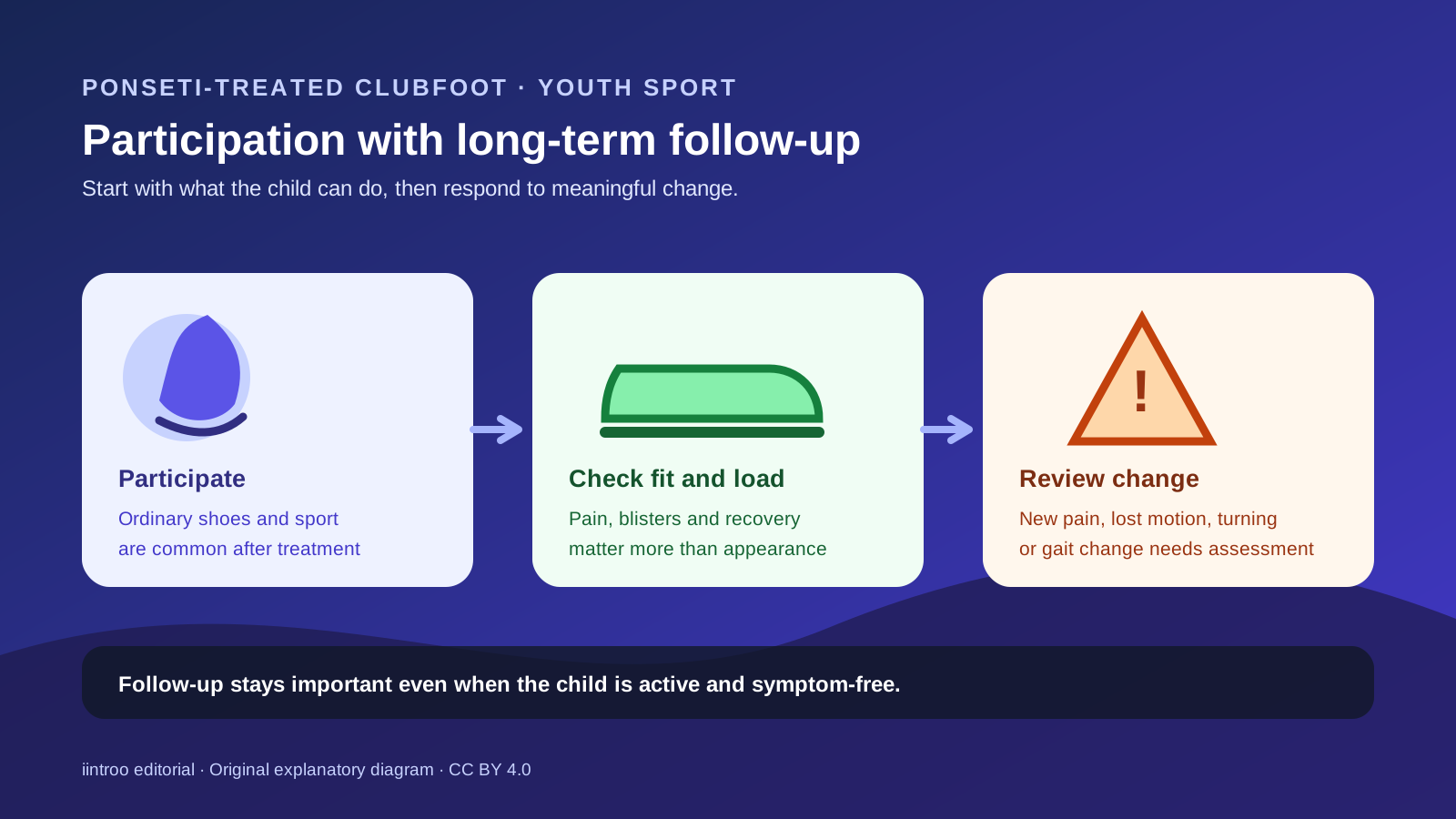
Key points
- Successful Ponseti treatment commonly supports ordinary shoes and sport, but activity and function vary between children and should not be inferred from foot appearance alone.
- Recent sports studies are cross-sectional and do not prove that one sport causes relapse or that participation removes functional differences.
- New pain, loss of motion, altered foot position, shoe difficulty or a change in walking or running should prompt the child's clubfoot team to assess function and possible recurrence.
Expect participation, then assess the individual child
This guide is for children and adolescents with idiopathic clubfoot treated by the Ponseti method, their families and sport staff. Ponseti treatment uses gentle serial casting, usually a small Achilles tenotomy, and a foot-abduction brace to correct and maintain the foot position. The American Academy of Pediatrics states that children with successful treatment and bracing can be expected to participate in sport, wear ordinary shoes and have excellent overall function. That expectation is a starting point for inclusion, not a promise that every foot will have identical motion, strength or comfort.
A 2026 multicentre survey reported sports participation in 120 of 151 Ponseti-treated children aged 5 to 17, compared with 43 of 45 siblings. Football codes, baseball, basketball and swimming were common. Because parents completed a one-time survey and the comparison group was small, the study cannot tell whether a sport caused symptoms or how participation changes over time. A separate small 2026 laboratory study found high multisport participation but measurable differences in some unilateral feet. These studies support opportunity plus individual assessment, not automatic restriction or guaranteed equivalence.
Use pain and function to guide the sport conversation
Ask what the child can do and what happens during and after training. Useful details include pain location, swelling, blisters, fatigue, limping, tripping, balance, push-off, jump or sprint tolerance, next-day recovery and whether footwear fits both feet. A smaller calf or foot, reduced ankle motion or an altered gait can persist without preventing sport, while a foot that looks well aligned can still be painful. Compare current function with the child's own baseline instead of using a teammate or the untreated side as the only standard.
New or increasing pain, loss of dorsiflexion, a foot turning in or down again, recurrent toe walking, difficulty placing the heel, repeated shoe breakdown or a clear change in walking and running deserves review by the clubfoot or paediatric orthopaedic team. Sudden inability to bear weight, major trauma, marked swelling, deformity or severe pain needs urgent assessment like it would in any child. Do not label all foot or leg pain as clubfoot: stress injury, ankle sprain, growth-related conditions and other diagnoses remain possible.
Adjust footwear and load without inventing a restriction
Footwear should protect the sport, fit the child and avoid pressure points. Different shoe sizes, insoles or orthoses may be considered after professional assessment, but no product corrects a recurrence or replaces follow-up. Test new boots, skates, dance shoes or braces in short sessions before competition. Socks, lacing and width can be adjusted when they solve a defined fit problem. Do not cut required protective equipment, force the smaller foot into an unsuitable boot, or buy a corrective device solely from an online claim.
When discomfort or fatigue limits a session, adjust duration, repetitions, surface or recovery and reassess the response. Strength, balance, mobility and sport-skill work can be individualized by a physiotherapist who understands the foot and treatment history. A 2025 community-monitor study found lower average steps and competitive-sport participation than controls, while participating children reported better global function than non-participants. This observational result cannot prove sport improved function, and it should not be used to pressure a child through pain. Enjoyment and self-selected goals remain important outcomes.
Keep long-term follow-up connected to participation
Relapse can occur after initial correction, and longer follow-up studies report higher recurrence than short early reports. Estimates differ by definition, treatment centre, brace adherence and length of observation. A 2021 systematic review included 14 studies with 774 patients and found generally good clinical outcomes but substantial relapse and further treatment over long follow-up; heterogeneity limits a single forecast for one child. The 2025 umbrella review likewise supports Ponseti treatment and long-term surveillance. Families should keep scheduled follow-up even when the child is active and symptom-free.
Sport staff do not need to inspect or diagnose the foot. They can provide a private reporting route, allow clinically advised footwear, note meaningful changes and avoid presenting a childhood diagnosis as fragility. Return after casting, tenotomy, recurrence treatment or surgery is individualized by healing, motion, strength, pain and sport demand; this page cannot provide a timeline or clearance. It also does not apply automatically to syndromic or neurological clubfoot, which may have different needs. The best plan protects access to play while keeping new symptoms and long-term review visible to the clinical team.