
Creatine and kidney tests: separate a creatinine rise from kidney injury
Creatine can raise serum creatinine without proving kidney damage. Healthy athletes still need product-risk checks, clinical context and professional advice when kidney disease or abnormal tests are present.
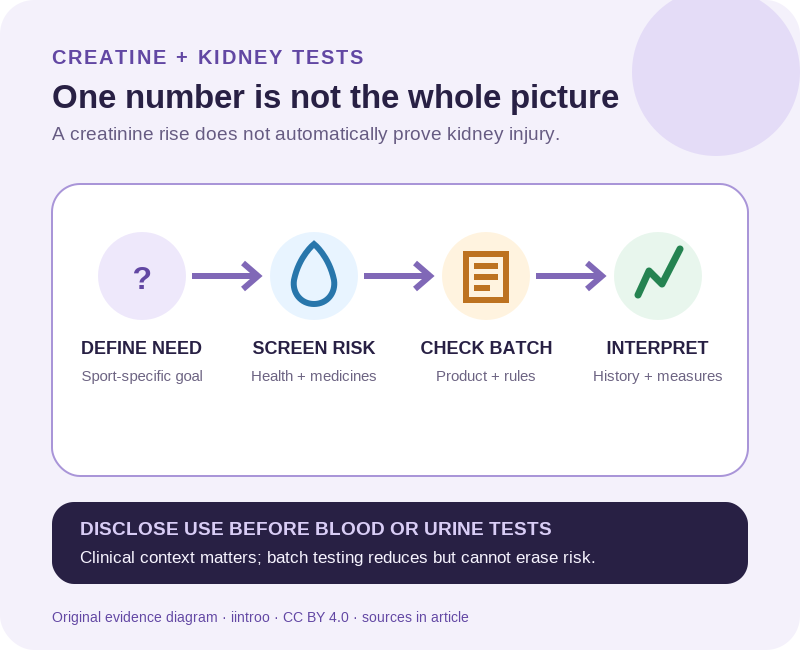
Key points
- Creatine monohydrate has evidence for selected high-intensity sport contexts, but it is optional and should follow a clear performance need.
- Supplementation can modestly raise serum creatinine, which may affect creatinine-based kidney estimates without demonstrating structural kidney injury.
- Kidney disease, abnormal laboratory results, pregnancy, medication use or illness require individual clinical advice before supplementation.
Begin with the sporting reason, not the marketing claim
This guide is for adult athletes and support teams considering creatine. The Australian Institute of Sport places creatine in Group A: ingredients with strong evidence for specific situations when used through evidence-based protocols. That classification is not a recommendation for every athlete, every sport or every commercial blend.
Define the target outcome and review ordinary training, food, sleep and recovery first. Most research and guidance concern creatine monohydrate, while alternative forms often have less evidence. A sports dietitian can help decide whether the likely benefit is relevant to the athlete's event and whether the plan can be tested in training.
Understand why creatinine can change
Creatine is converted in part to creatinine. Two recent meta-analyses found a modest rise in serum creatinine during supplementation. Because many estimated glomerular filtration-rate equations use serum creatinine, the estimate can fall even when other kidney measures do not indicate injury.
That distinction matters, but it should not be used to dismiss every abnormal result. The 2025 review included 21 studies and the 2026 review included 26, with varied populations, doses and follow-up. Longer-term evidence and evidence in people with kidney disease remain less certain than evidence in healthy adults.
Tell the clinician and laboratory about supplement use
If blood or urine tests are planned, disclose the product, amount, duration and timing to the clinician. Interpretation may require repeat testing, medical history and kidney measures that are less dependent on creatinine. Do not stop prescribed medication or alter fluid intake simply to make one laboratory value look better.
Seek prompt medical care for markedly reduced urine output, persistent vomiting, severe weakness, swelling, confusion, chest pain or other acute illness. Athletes with known kidney disease, previous kidney injury, pregnancy, diabetes, uncontrolled hypertension or medicines that affect kidney function need individual medical advice before considering a supplement.
Safety findings apply to studied products and populations
A large 2025 analysis found similar overall participant-reported side-effect frequency in creatine and placebo groups across hundreds of trials. Kidney meta-analyses did not show a consistent signal of injury in healthy study populations when results were interpreted beyond serum creatinine alone. These findings do not prove that every dose, product or user is risk-free.
Trials often have limited duration, exclude people with important medical conditions and use researched creatine monohydrate rather than multi-ingredient powders. Symptoms, contaminants, extreme dosing and interactions may not be captured well. A product label cannot substitute for clinical assessment when an athlete is unwell or has abnormal results.
Control product risk as well as biological risk
Supplements can contain undeclared or prohibited substances. Athletes remain responsible under strict-liability anti-doping rules. Use the sport organisation's current policy and recognised batch-testing programme, while understanding that batch testing reduces rather than eliminates contamination risk.
Record the exact product and batch, reason for use, start date, response and adverse symptoms. Reassess whether the supplement still serves the stated goal. This article deliberately gives no personal loading or maintenance dose: the appropriate decision depends on age, health, event, diet, rules and professional oversight.