
Juvenile knee osteochondritis dissecans: healing—not the calendar—guides return to sport
Juvenile knee osteochondritis dissecans needs lesion-specific assessment. Symptoms, stability, growth and healing evidence—not one date—guide return.
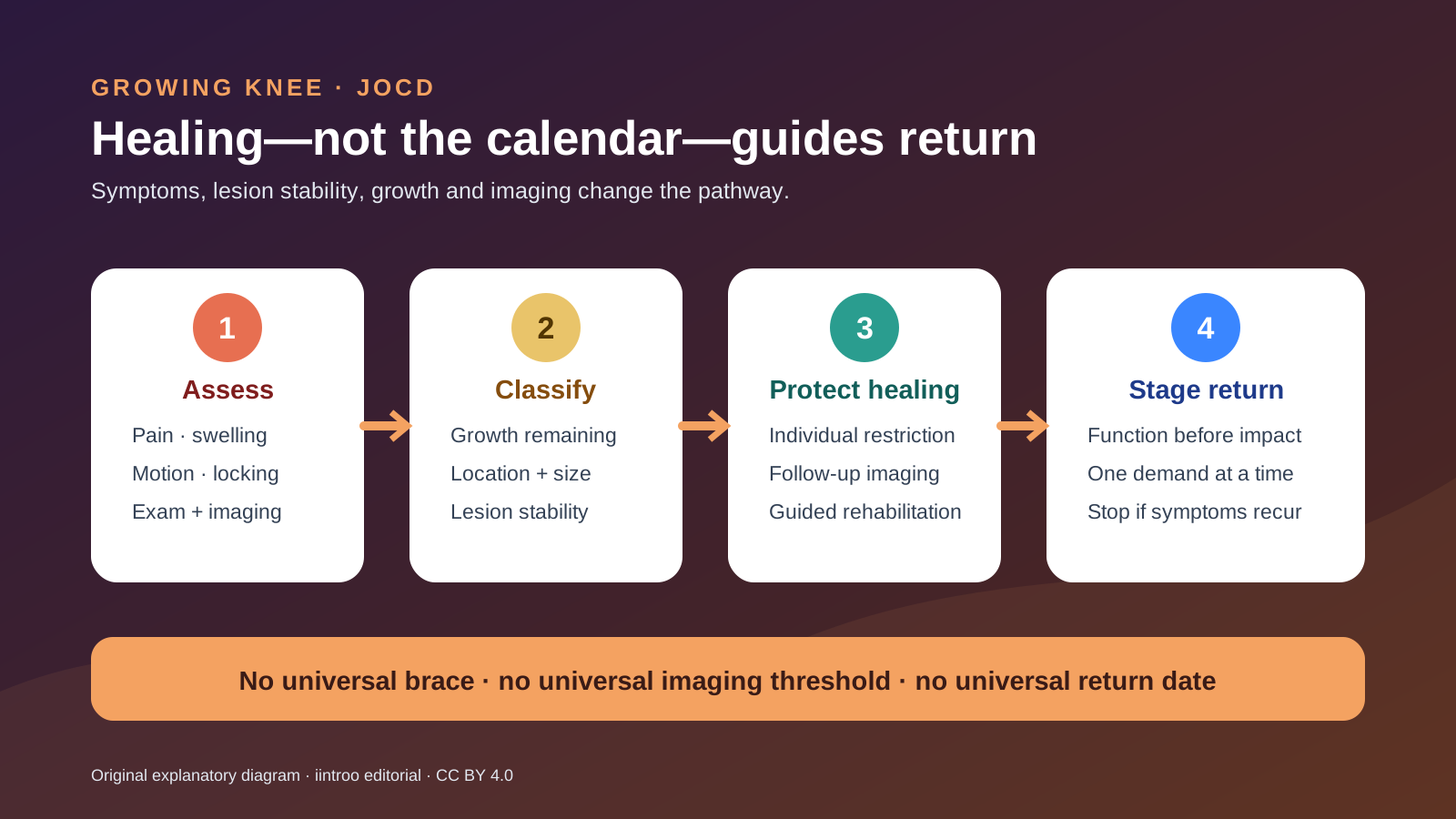
Key points
- Knee osteochondritis dissecans is assessed by symptoms, skeletal maturity, lesion location and stability; these factors change treatment and prognosis.
- Stable juvenile lesions often begin with nonoperative care, but AAOS does not endorse one universal restriction, brace or rehabilitation protocol.
- Pain settling is not the only return criterion: clinical function and imaging evidence of healing are commonly considered, while exact thresholds remain uncertain.
Persistent knee symptoms deserve a diagnosis
This guide is for growing athletes with knee osteochondritis dissecans and the adults supporting them. The condition affects subchondral bone and the overlying joint surface, commonly at the femoral condyle. Pain with running or jumping, swelling after activity, reduced motion, catching or locking may occur, but symptoms can be vague. These complaints also overlap with other knee problems. A sideline test, social-media video or training log cannot determine whether a lesion is present or stable; clinical assessment and appropriate imaging are needed.
Skeletal maturity, lesion location and size, symptoms, stability and healing response influence management. A stable lesion in a younger athlete with open growth plates is different from a displaced fragment or an unstable lesion in a nearly mature athlete. Locking, a suddenly blocked joint, marked swelling, inability to bear weight or an acute traumatic change needs timely assessment. Do not repeatedly test painful jumping, deep flexion or sprinting to decide whether the athlete is ready. Reproduction of symptoms is information for the treating team, not a clearance test.
Nonoperative care is individualized
Stable juvenile lesions commonly begin with activity modification and may include weight-bearing limits, a brace, casting or physiotherapy. The 2023 AAOS guideline summarizes the evidence but does not support one protocol for every patient. POSNA similarly emphasizes limiting excessive running and jumping according to lesion findings. A 2026 retrospective cohort of 148 young patients found similar proportions progressing to surgery across a locked brace, cylinder cast and activity-modification groups. Because treatment was not randomized, it cannot prove those options are equivalent for every lesion.
Families should follow the plan written for the individual child rather than copying another athlete's restrictions. Low-impact conditioning may be allowed in some cases, but swimming or cycling is not automatically appropriate when pain, weight-bearing limits, surgical wounds or another condition is present. Physiotherapy can help restore motion, strength and movement control when the treating team permits it. Supplements, massage, shockwave devices and extra strength work have not been shown to make an unstable fragment safe or replace follow-up imaging.
Separate symptom relief from confirmed healing
Pain and swelling are important, but symptom improvement alone may not establish sufficient healing for impact sport. Clinicians commonly combine examination, function and serial radiographs or MRI where indicated. The 2026 review notes that the degree of radiographic healing needed for safe progression is still debated and that full radiographic change can lag behind clinical recovery. That uncertainty is a reason for lesion-specific review, not permission to set a fixed countdown or demand complete imaging normalization in every case.
A 2025 systematic review included 13 mostly level 3 and 4 studies with 710 adolescent patients and 783 knees. Reported return-to-sport rates were often high after successful nonoperative or operative treatment, but treatment definitions, follow-up and return criteria varied. The review cannot supply one expected date for an individual athlete. A prospective brace study and recent cohort data add useful information, yet selection, lesion characteristics and clinician decisions still shape outcomes. Return percentages should support informed expectations, not become a promise.
Progress impact, skill and competition in stages
When the treating team authorizes progression, restore everyday function and controlled strength before repeated running, jumping, cutting, contact or full practice. Increase one demand at a time and monitor pain, swelling, motion, confidence and the next-day response. A return of symptoms is a reason to stop the progression and contact the team, not a failure of effort. Coaches can offer non-impact technical learning or a modified role without inventing medical exercises or pressuring the child to protect selection status.
Surgery, unstable lesions and failed nonoperative care follow different pathways, and procedure-specific healing matters. This page cannot classify a lesion, interpret imaging, prescribe weight-bearing, select a brace, recommend surgery or provide clearance. The evidence supports staged, monitored return after lesion-specific care; it does not support a universal sport ban or universal timeline. Protecting the joint and preserving the young person's connection to the team can happen together when medical restrictions are respected and participation is adapted.