
Primary ciliary dyskinesia in sport: exercise supports health but does not replace airway clearance
Primary ciliary dyskinesia needs daily airway care and infection planning. Exercise can support fitness, but it is not a substitute for prescribed clearance.
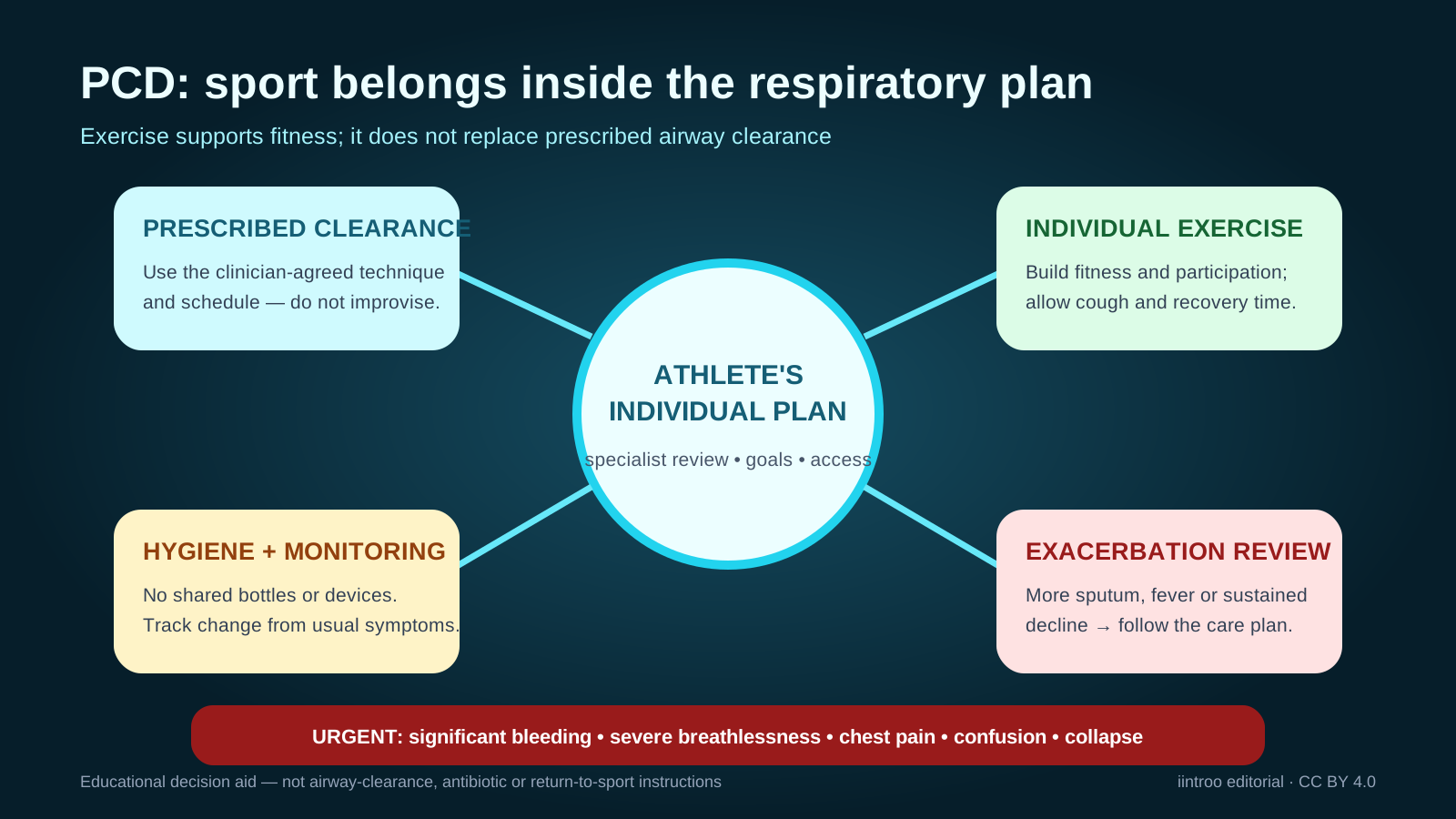
Key points
- PCD impairs mucociliary clearance and can cause chronic upper- and lower-airway disease; symptoms should not be dismissed as poor fitness.
- Daily cardiovascular activity is encouraged in current physiotherapy standards, but exercise does not replace the prescribed airway-clearance plan.
- Coughing blood, severe breathlessness, chest pain, blue or grey colour, confusion or rapidly worsening illness needs urgent assessment.
Build sport around specialist respiratory care
This guide is for athletes with diagnosed primary ciliary dyskinesia, families, coaches and respiratory teams. PCD is an inherited disorder of motile cilia that impairs mucus clearance. Chronic wet cough, sinus and ear disease, recurrent infection and bronchiectasis are common, while organ laterality, hearing and fertility issues vary. An athlete may be highly active and still need daily treatment and microbiology surveillance. Persistent cough is not a character flaw, and a fall in pace should not automatically be labelled deconditioning.
The 2026 UK national expert consensus recommends regular specialist review, lung-function monitoring, respiratory samples when clinically appropriate and an individualized airway-clearance plan. Current paediatric physiotherapy standards also place exercise advice inside specialist care. Ask the athlete what support is useful and what information can be shared. Coaches should not choose an airway-clearance technique, interpret sputum results or start antibiotics, mucolytics or inhaled treatment.
Encourage activity without overselling airway effects
Daily cardiovascular exercise is strongly encouraged in the English physiotherapy standards, with advice tailored to the individual. Activity can support fitness, bone and mental health, participation and quality of life. It may help an athlete mobilize secretions, and planned opportunities to cough or expectorate during or after exercise can be practical. However, the standards explicitly say exercise should not be considered a substitute for airway-clearance techniques.
The direct evidence is limited. A systematic review found only two randomized crossover trials, totalling 54 participants, when comparing device-supported and conventional clearance; certainty was very low. A small aerobic study reported short-term physiological changes but warned that its sample and genetic representation limited generalization. Reduced exercise capacity has been documented in some cohorts, yet lung function, muscle capacity, infection status and habitual activity may all contribute. These findings support assessment, not one mandatory fitness test or training zone.
Plan cough, hygiene, environment and exacerbations
Schedule prescribed airway care in the way agreed with the respiratory physiotherapist, leaving enough time for travel, school or work and recovery. Give the athlete privacy and a safe place to expectorate, with tissues, hand hygiene and disposal available. Shared bottles, mouthguards, respiratory devices and towels increase avoidable infection exposure. Pool, cold-air, pollution or venue irritants may affect symptoms differently; individual experience and clinical advice matter more than a blanket ban on one sport.
A written exacerbation plan should define the person's usual symptoms, who to contact and what changes prompt review. More cough or sputum, colour or volume change, fever, unusual breathlessness, chest discomfort, fatigue or a sustained performance decline may signal infection or another problem. Do not conceal symptoms to protect selection, and do not use a normal wearable oxygen reading to rule out illness. Training reduction is not a treatment plan; prescribed testing and treatment still need the clinical team.
Escalate danger signs and return after stability
Stop exercise and obtain urgent help for coughing more than small streaks of blood, severe or rapidly worsening breathlessness, chest pain, blue or grey colour, confusion, fainting or collapse. Large-volume bleeding, inability to breathe or reduced consciousness is an emergency. A first episode of blood in sputum, repeated bleeding or deterioration despite the person's plan also needs clinical review. Staff should not perform unprescribed airway procedures or give another athlete's inhaler or antibiotics.
After an exacerbation, rebuild from stable daily function and the respiratory team's advice to easy conditioning and then sport-specific volume and intensity. Follow-up may be needed when symptoms or performance do not return to baseline. There is no universal antibiotic-free interval, lung-function threshold or number of cough-free days that clears every athlete. This article cannot diagnose PCD or infection, prescribe airway clearance, medicines or exercise, or clear return. It provides a framework for coordinated, evidence-limited planning.