
Rugby concussion: recognition, removal and a safer return
What community rugby players, parents and coaches should know about suspected concussion, early recovery and medical clearance.
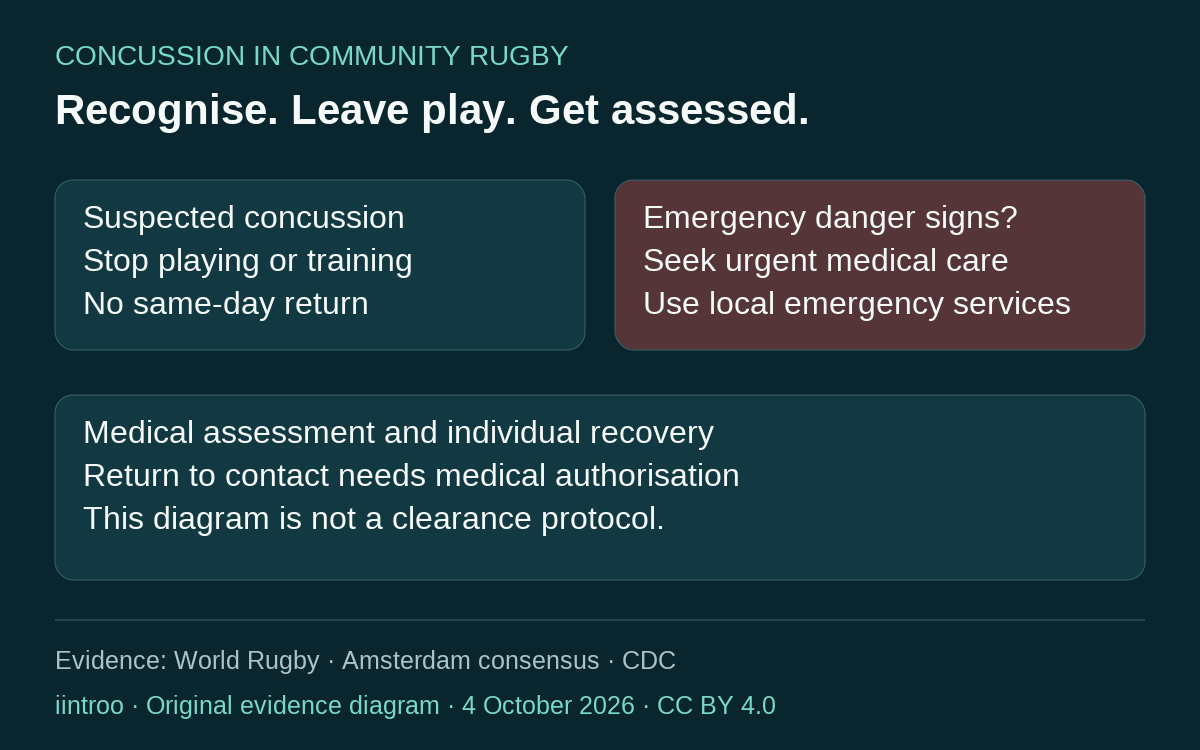
Key points
- Suspected concussion means immediate removal and no same-day return.
- Emergency danger signs require urgent medical care.
- Recovery and return to contact require individual medical oversight.
A decision for the whole touchline
This guide is for community rugby players, parents, coaches and officials. World Rugby requires a player with suspected concussion to leave training or the match immediately and permanently for that day. Feeling better a few minutes later does not provide permission to rejoin. Arrange assessment by an appropriately qualified healthcare professional.
Community rugby does not use the professional Head Injury Assessment pathway. A coach should not copy a televised touchline assessment to clear a player. The practical priority is to recognise concern, stop exposure and activate the club's medical arrangements.
Know when the situation is an emergency
After a head impact, a worsening persistent headache, repeated vomiting, seizures, increasing confusion, weakness, slurred speech, unequal pupils or difficulty waking are danger signs. Seek emergency medical care immediately through local emergency services. This is not a complete first-aid protocol; follow trained responders' directions and the event emergency plan.
Symptoms can include problems with balance, memory or concentration. The absence of a dramatic collapse should not be used to dismiss a concern. A medical assessment is needed to distinguish concussion from other injuries.
Sources: 3
Early recovery is not complete isolation
The Amsterdam consensus recommends a short period of relative rest, typically during the first 24–48 hours, rather than prolonged strict bed rest or isolation. A clinician may guide a gradual return to ordinary activities and light exercise that stays within appropriate symptom limits. That advice is different from returning to rugby contact.
Activities with a risk of another head impact, collision or fall need particular caution. Do not use an online activity chart as a substitute for clinical instructions. Return to learning can also need temporary adjustments for a student-athlete.
Sources: 2
Clearance is a process, not a date on the calendar
Progression back to sport depends on symptoms, examination findings and the athlete's response to exertion. Medical authorisation is required before at-risk activity. For students, unrestricted sport should follow successful return to learning. World Rugby Regulation 10 specifies a minimum 21-day return-to-play period for adults and for children and adolescents following concussion and completion of the rehabilitation programme. That minimum is not automatic clearance. Apply current union and competition requirements and individual clinical advice; the regulation's specified exceptions are not a self-clearance route.
Before the next fixture, a club can identify who arranges assessment, who communicates with the family and who checks the applicable return requirements. These are organisational questions, not a medical clearance checklist.