
Sodium bicarbonate for performance: a possible small gain with a real gut cost
Bicarbonate may help some short high-intensity efforts, but average effects vary and gastrointestinal symptoms are common. Trial it only with expert support.
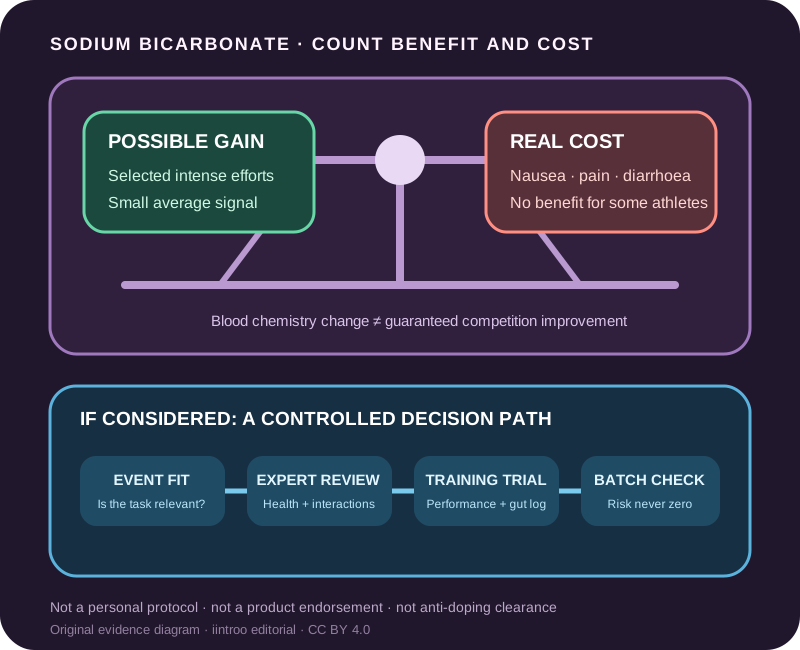
Key points
- The best-supported use is for selected high-intensity exercise, but newer meta-analyses show small or task-dependent average effects and prediction intervals that include no benefit.
- Nausea, abdominal pain, bloating, diarrhoea and vomiting can offset any performance gain; tolerance and response must be established away from important competition.
- A sports dietitian or clinician should consider the event, medical history, sodium load, other medicines and anti-doping risk rather than copying a dose from social media.
Buffering theory is not a guaranteed result
This guide is for adult athletes and support teams evaluating a legal but consequential supplement. Sodium bicarbonate increases extracellular buffering capacity, which may help transport hydrogen ions from working muscle during intense exercise. That mechanism is most relevant to hard efforts where acidosis contributes to fatigue. It does not create fitness, replace pacing or improve every event, and a blood chemistry change is not itself proof of a meaningful performance gain.
A 2026 team-sport meta-analysis of 20 studies and 241 athletes found a small average benefit for high-intensity intermittent exercise, but the prediction interval crossed zero and certainty was low. No clear benefit emerged for several specific performance categories. Most supplement trials are small and frequently overrepresent trained men, so sex, impairment, age, sport and event differences remain incompletely resolved.
Event-specific reviews temper the headline
The continuous-running review included 11 crossover studies and 126 participants. After accounting for gastrointestinal-related withdrawal and publication bias, the overall benefit was negligible and not statistically significant, although male-only studies suggested a small signal. A swimming meta-analysis found higher blood bicarbonate, lactate and pH without a significant improvement in 200 m time. These are not contradictions; they show that physiology, task and study methods do not always translate into faster performance.
An athlete should define the exact question before considering a trial: one maximal effort, repeated sprints, a tournament with several bouts or recovery between rounds are different problems. The average study effect cannot predict an individual's response. A supplement that helps one laboratory test may be irrelevant to another event, and a change smaller than normal performance variability may not matter in practice.
The gut cost is part of the effect
Bloating, belching, nausea, abdominal pain, diarrhoea and vomiting are established adverse effects. In the running review, gastrointestinal symptoms and symptom-related withdrawal were more frequent with bicarbonate than placebo. The performance analysis can therefore look more favourable if athletes who cannot tolerate the supplement disappear from the final comparison. Practical effectiveness includes whether the athlete can warm up, travel and compete without disruption.
Do not first use bicarbonate on race day or during a selection event. Any supervised experiment belongs in representative training, with the same food context and enough observation to record both performance and symptoms. Stop and seek medical advice for severe or persistent symptoms. People with relevant kidney, heart, blood-pressure or gastrointestinal conditions, those on interacting medicines, and younger athletes require particular clinical caution.
Individualise without publishing a prescription
Research and institute fact sheets describe several dose, timing and formulation strategies, but this article deliberately does not convert them into a personal protocol. Body mass, sodium exposure, meal timing, capsule burden, event schedule and tolerance affect the decision. A qualified sports dietitian can first confirm whether the event is plausible for bicarbonate and whether simpler training, pacing or fuelling work has greater value.
Track a pre-agreed performance measure and gastrointestinal symptoms across more than one controlled session rather than interpreting one unusually good workout. Placebo effects, training adaptation, weather and normal day-to-day variation can all influence the result. Discontinue when there is no reproducible benefit, tolerance is poor or the medical and logistical cost exceeds the possible gain.
Legal does not mean contamination-proof
Sodium bicarbonate itself is not presented here as a prohibited substance, but supplement products can be mislabelled or contaminated. No programme can guarantee zero anti-doping risk. Athletes subject to testing remain strictly responsible for what they use and should check the current prohibited list, team policy and recognised batch-testing programme in their country before purchase.
Keep the product name, batch number, receipt and decision record, and avoid multi-ingredient blends that obscure exposure. Food-grade kitchen products do not solve the need for medical suitability or accurate formulation. The safest choice may be not to supplement. This educational review is not a prescription, anti-doping clearance or endorsement of a brand.