
Football · International
Rowe's extra-time header gives England a second straight U21 EURO title
England beat Germany 3–2 after extra time in Bratislava, with substitute Jonathan Rowe scoring the winner after Germany recovered from two goals down.
Event date:
England defend the championship
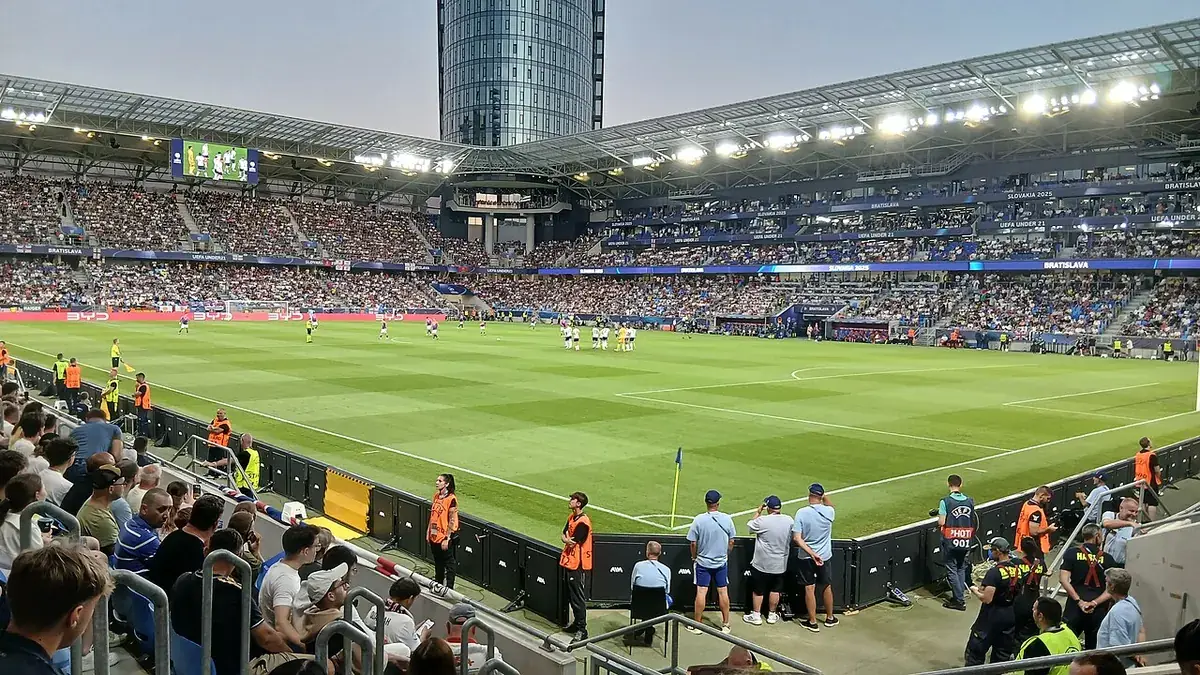
England won the UEFA European Under-21 Championship for the fourth time on 28 June, beating Germany 3–2 after extra time at Bratislava's National Football Stadium. Jonathan Rowe headed the deciding goal early in the added period after Germany had erased England's two-goal advantage. England's successful defence followed their 2023 championship and repeated the back-to-back titles the country won in 1982 and 1984.
Harvey Elliott put England ahead in the fifth minute and Omari Hutchinson extended the lead before the half-hour. Germany replied through Nelson Weiper in first-half added time, then Paul Nebel levelled in the 61st minute. Rowe's 92nd-minute header restored England's lead, which survived to the end of the final.
A final decided by the bench
UEFA's technical observers highlighted England's use of several build-up routes against Germany's midfield press. They could advance centrally, use the sides or play beyond the pressure. Movement involving full-backs and midfielders helped open spaces, making the early scoring sequence part of a broader tactical contest over how England could progress the ball.
Germany's recovery drew on crosses and second balls, with Nebel influential in connections on the left. The winning move involved three England substitutes: Brooke Norton-Cuffy, Tyler Morton and Rowe. Morton's delivery supplied the header. UEFA's analysis also credited England's subsequent defending in a deeper block, including Charlie Cresswell's interventions, and their use of possession to manage the remaining time.
Germany's late threats
Germany continued to threaten even after falling behind again. Nebel hit the crossbar in second-half stoppage time before the match moved into extra time, while Merlin Röhl struck the bar near the end of the added period. Those attempts show how narrow the result remained: Germany were still within one goal of taking the contest to a shoot-out.
The defeat ended Germany's 20-match unbeaten sequence. They had won all five of their earlier games at this tournament, including a 2–1 group-stage victory against England, and reached the final with a 3–0 win over France. England therefore reversed the outcome of the teams' first meeting in Slovakia when the trophy was at stake.
The route and the leading performers
England opened the group stage by beating Czechia 3–1, drew 0–0 with Slovenia and lost to Germany. They then defeated Spain 3–1 in the quarter-finals and the Netherlands 2–1 in the semi-finals. Elliott scored both England goals in that semi-final, and his opening goal in Bratislava took his tournament total to five.
UEFA named Elliott player of the tournament, while Germany's Nick Woltemade finished as the competition's leading scorer with six goals. England captain James McAtee received the player-of-the-match award for the final. Those individual honours accompanied a team outcome decided by both the starters who built the early advantage and the substitutes who combined for the extra-time winner. In the final, England needed both contributions to turn an early two-goal advantage into the championship after Germany had recovered.
Original sources
Read the underlying records.
Explore the official results, organiser reports or original research behind this story.