
Achondroplasia and adaptive sport: build access around the spine, joints and hearing
Achondroplasia can affect the spine, joints, sleep, hearing and access. Sport works best when equipment and load reflect current symptoms and participation goals.
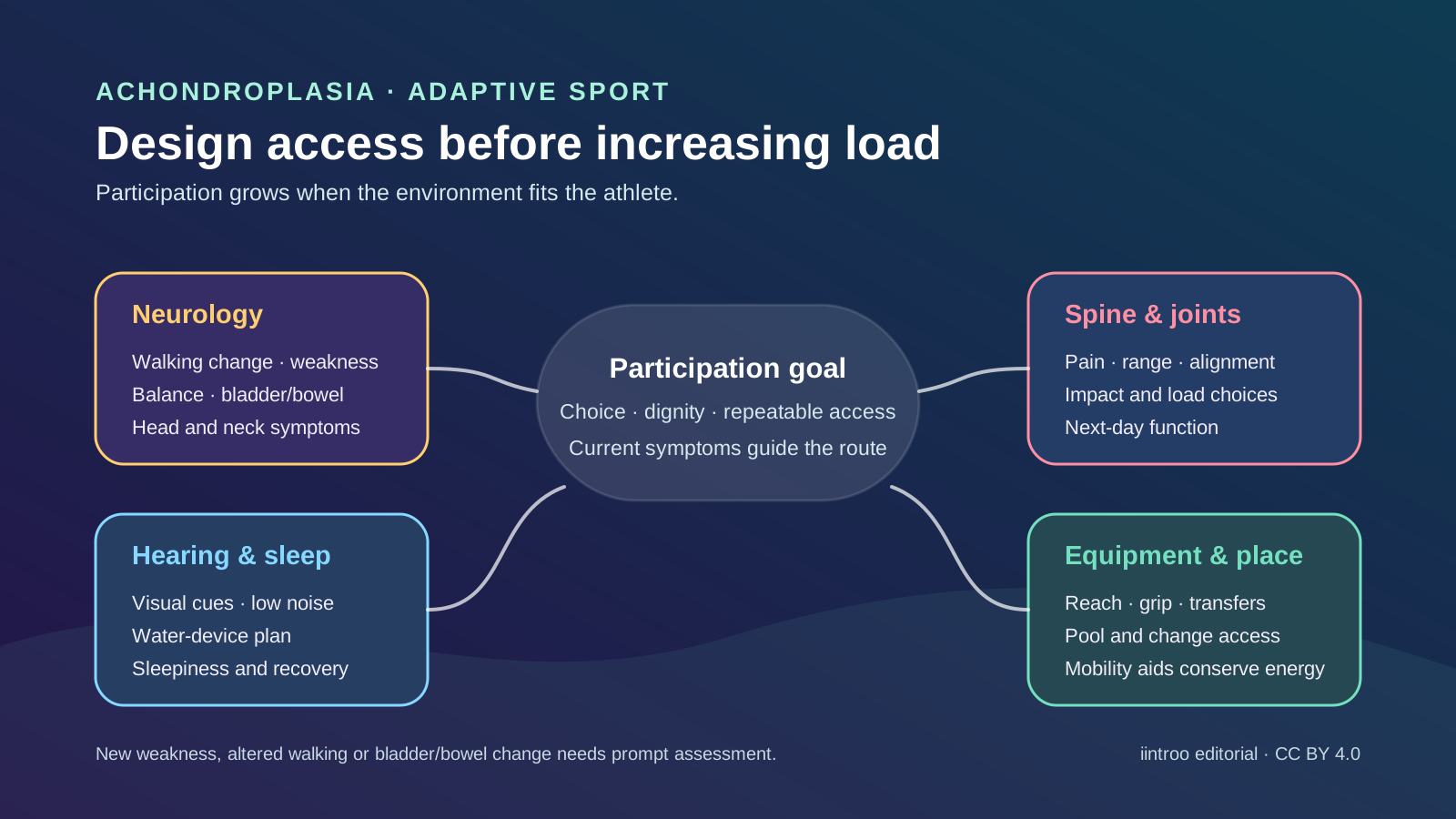
Key points
- International consensus encourages an active lifestyle while emphasizing individualized surveillance for neurological, respiratory, orthopaedic and hearing needs.
- Back or leg pain with weakness, claudication, altered walking, hyperreflexia or bladder or bowel change can signal spinal cord or nerve compression.
- Equipment, pool access, communication, fatigue and mobility support can expand participation without treating adaptation as a lesser form of sport.
Plan from the person's goals and current findings
This guide is for people with achondroplasia, families, coaches, teachers and clinical teams. Achondroplasia is an FGFR3-related skeletal dysplasia with disproportionate short stature and highly variable functional and medical needs across life. Potential considerations include foramen magnum or spinal stenosis, thoracolumbar kyphosis, leg alignment, limited elbow extension, pain, sleep-disordered breathing, recurrent middle-ear disease, hearing loss, blood-pressure measurement challenges and weight-related health. Most people lead independent, active lives; a diagnosis should not be treated as a blanket reason to exclude sport.
Start with the person's preferred activity, usual mobility, pain and fatigue, communication needs, prior spine or limb procedures, sleep and hearing history, and current clinical advice. Ask which transfers, reaches, grips, surfaces or equipment create barriers. For children, confirm whether condition-specific neurological and sleep surveillance is current. For adults, ask about changes in walking distance, leg symptoms, balance, bladder or bowel function and sleep. Coaches can redesign tasks and notice change, but they cannot rule out cord compression, interpret imaging or decide that new neurological symptoms are simply poor fitness.
Use consensus to support activity, not impose a template
The international consensus recommends an active lifestyle and regular attention to pain, weight, blood pressure, hearing, sleep and spinal symptoms. Its newer patient-and-clinician overview notes that many activities need only modest modification, while some high-impact, collision or extreme spinal-loading situations may require particular caution. This is not evidence for one approved sport list. The relevant question is how a specific activity interacts with a person's neurological status, anatomy, symptoms, skill, environment and risk tolerance at that time.
The evidence directly testing sport programmes in achondroplasia is sparse. Reviews document reduced physical function, pain and participation barriers but do not identify a single exercise dose that prevents complications. Recent European guidance focuses on recognizing sleep-disordered breathing and adult spinal, pain, hearing and access needs; the 2026 orthopaedic principles emphasize multidisciplinary decisions and rehabilitation. These are consensus and observational foundations rather than sport trials. They support purposeful adaptation and longitudinal review, not claims that exercise corrects bone growth, that pain is inevitable, or that all contact and gymnastics participation must be prohibited for everyone.
Design the environment before increasing load
Select movements that fit limb proportions, joint range and balance rather than forcing average-stature technique. Adjust bench and step heights, pedal and crank position, bar path, grip diameter, starting blocks, pool entry and changing facilities. Provide a stable way to mount, transfer and recover from the floor. A mobility aid can conserve energy for meaningful participation and is not evidence of failure. In strength work, prioritize control, comfortable range and repeatability; in water, plan safe entry, exit and fatigue support. Progress one variable at a time while tracking pain, neurological symptoms and next-day function.
Communication access matters as much as biomechanics. Reduce background noise, face the athlete, confirm how hearing technology is managed around water and use visual cues where helpful. Sleep-disordered breathing can affect alertness and recovery even when an athlete appears motivated, so new snoring, witnessed pauses or daytime sleepiness warrants review rather than more conditioning. Measure blood pressure with an appropriately fitting cuff and follow clinical advice about location and interpretation. Avoid public weight commentary, using height as a proxy for capacity, or making an athlete repeatedly justify reasonable adaptations.
Treat neurological change as a red flag
Stop activity and seek urgent assessment for new weakness, numbness, loss of coordination, repeated unexplained falls, marked gait change, severe neck or back pain with neurological symptoms, or new bladder or bowel dysfunction. Collapse, severe breathing difficulty, blue or grey colour, significant head or neck trauma and rapidly worsening symptoms also need prompt care. Persistent back or leg pain with reduced walking distance, claudication, spasticity, hyperreflexia or night symptoms should be returned to a spine service experienced in achondroplasia rather than trained through.
After injury, surgery, a neurological investigation or a material change in pain or function, return through comfortable daily movement, controlled conditioning and then activity-specific tasks according to updated advice. There is no universal height, body-mass index, spinal measurement, pain score or symptom-free interval that clears every athlete. This article cannot diagnose spinal stenosis or sleep apnea, interpret imaging, prescribe exercise or equipment, set collision-sport eligibility, or clear competition. It offers a general framework for accessible participation linked to lifelong, condition-informed care.