
Osteogenesis imperfecta and sport: build strength without treating every body the same
People with osteogenesis imperfecta can benefit from activity, but fracture history, mobility, hearing and individual handling needs must shape the plan.
Key points
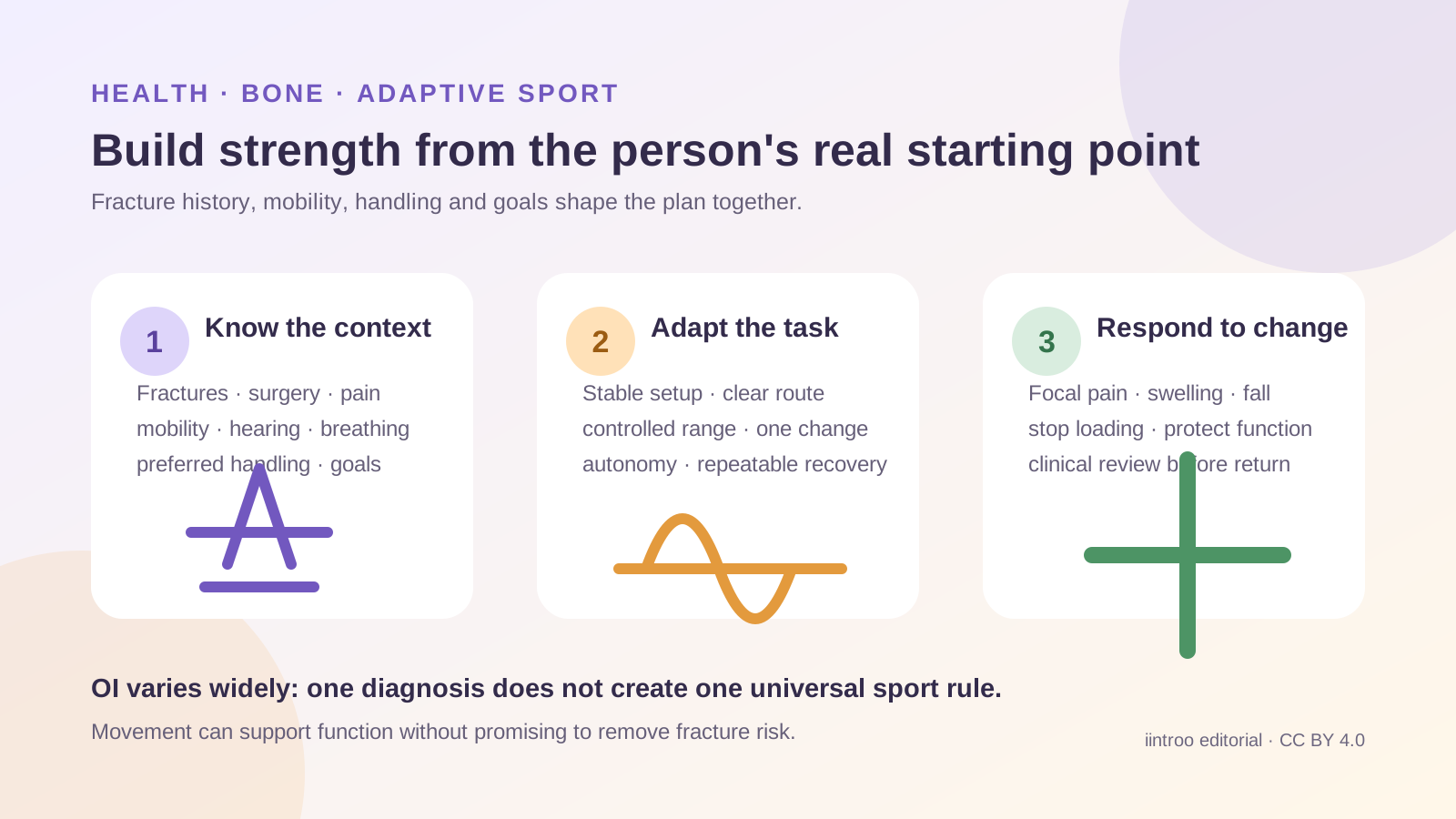
- Osteogenesis imperfecta varies widely; a diagnostic type or bone-density result cannot set one sport rule for every person.
- Appropriate muscle strengthening, movement and weight-bearing can support function, but loading and handling should follow the person's fracture and surgical history.
- New focal bone pain, swelling, deformity, loss of function or symptoms after a fall need assessment rather than repeated testing by a coach.
Start with the person's pattern of OI and current function
This guide is for people with osteogenesis imperfecta, families, coaches, teachers and clinical teams. OI is a group of genetic connective-tissue disorders associated with bone fragility, but severity, stature, alignment, muscle strength, joint mobility, hearing, breathing and fracture history differ substantially. Some people walk and compete independently; others use mobility devices or need assistance for transfers. A diagnostic label therefore cannot decide whether swimming, strength work, wheelchair sport or another activity is suitable.
The 2026 Brittle Bone Society consensus for adults with severe OI and the international paediatric rehabilitation consensus both emphasise multidisciplinary, individual assessment. Useful questions include recent fractures or surgery, pain, fatigue, mobility, falls, spine and joint alignment, hearing or vision needs, breathing symptoms, medicines and the athlete's goals. Ask the athlete how they prefer to transfer or receive assistance. Unplanned pulling, twisting or lifting can create avoidable risk and undermine autonomy.
Use movement to build function, not to promise stronger bones
Physical activity and rehabilitation are core parts of OI care. The paediatric consensus supports participation that develops strength, endurance, mobility and independence with precautions appropriate to the individual. NIAMS and the OI Foundation similarly encourage safe activity planned with clinicians or therapists. Water can make movement easier and reduce fall consequence, while land-based or other weight-bearing activity may provide different functional and skeletal stimuli. No single mode supplies every benefit.
Evidence is constrained by a rare, heterogeneous condition and small studies. Exercise should not be presented as a way to eliminate fracture risk or replace medical and orthopaedic care. A programme can instead target repeatable skills: controlled transitions, trunk and limb strength, balance, propulsion, swimming technique or daily mobility. Progress one variable at a time and judge the response across several sessions. Medication, surgery and rehabilitation decisions remain with the treating team.
Design the environment before increasing load
Reduce preventable collisions and awkward handling. Check the route into the venue, pool hoist or steps, changing space, floor grip, equipment height, emergency access and how mobility devices will be stored. In strength work, choose stable positions and a range that the athlete can control rather than chasing maximal depth or external load. In team sport, modify space, speed, contact and ball choice where helpful. Protective equipment cannot make an unsuitable collision exposure safe by itself.
Bone pain can be difficult to distinguish from muscle soreness without assessment. Stop and seek clinical advice for new focal pain, swelling, bruising, deformity, a crack or pop, inability to use a limb normally, or symptoms after a fall. Do not repeatedly press, rotate or load a painful area to see whether it is fractured. New weakness, numbness, breathing difficulty, severe headache or neck or back symptoms after trauma require urgent evaluation. Follow the person's established emergency and handling plan.
Return from fracture or surgery through agreed functional steps
After a fracture or operation, immobilisation and reduced activity can change strength, range, confidence and equipment fit. Clearance to resume daily movement does not automatically clear falls, contact or maximal loading. With the clinical and rehabilitation team, rebuild comfortable mobility, technique and ordinary training before adding speed, resistance, instability or competition consequence. Review assistive devices, orthoses and seating when body size, alignment or function has changed.
There is no universal number of fracture-free weeks, scan result, repetition maximum or bone-density threshold that clears every athlete with OI. Regular review should also consider hearing, dental, respiratory and cardiovascular issues that may affect communication or exercise. This page provides general education, not diagnosis, fracture testing, handling instruction, exercise prescription or personal sport clearance.