
Lumbar spondylolysis in adolescent athletes: assess, rehabilitate and return by function
Adolescent back pain with extension loading may be lumbar spondylolysis. Early assessment, selective imaging and progressive rehabilitation should guide return.
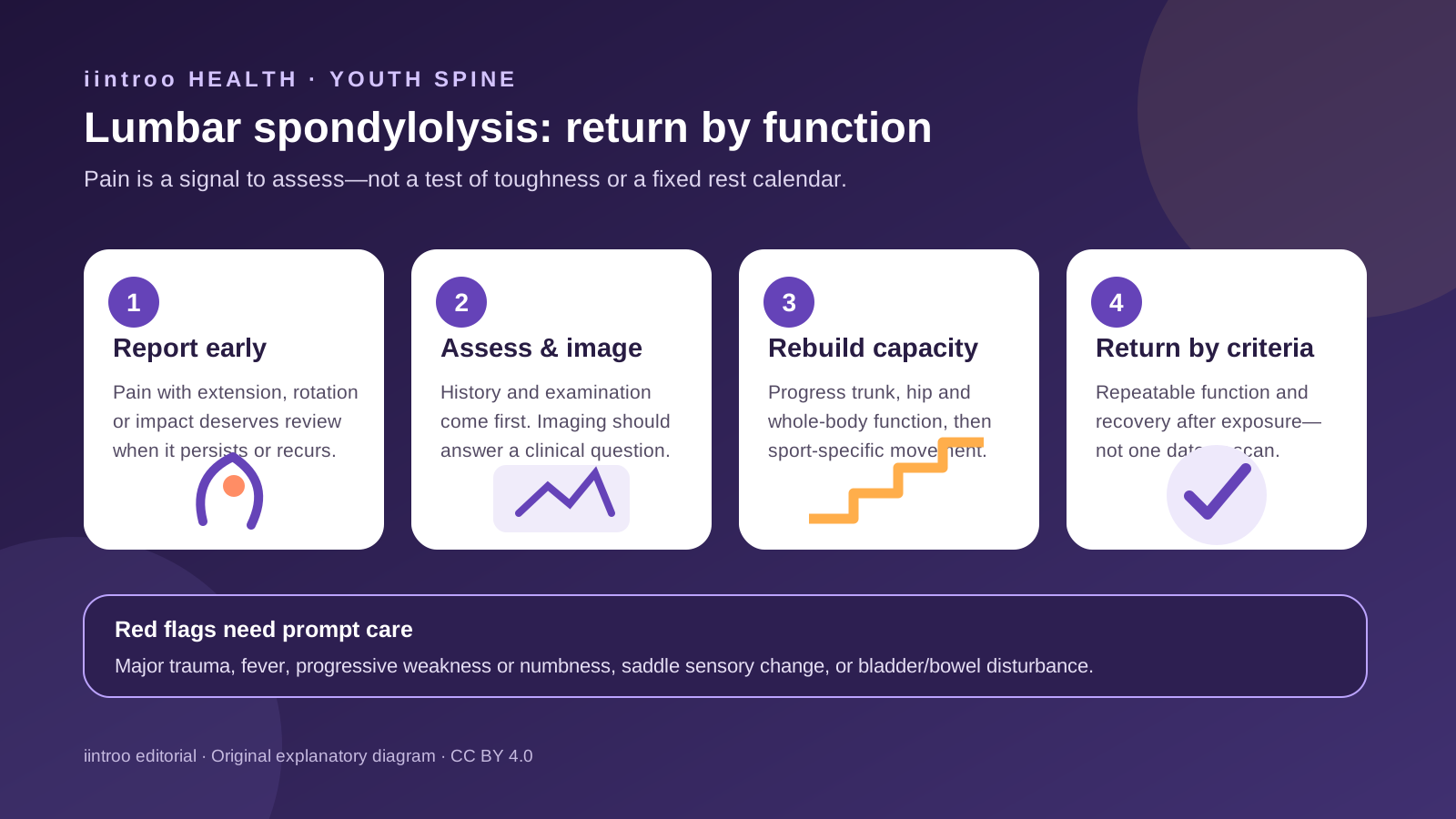
Key points
- Spondylolysis is a stress injury of the pars interarticularis; symptoms and examination raise suspicion but do not confirm it.
- Imaging should answer a clinical question while limiting radiation, rather than being repeated solely to create a return date.
- A 2026 randomized trial supports starting individualized physical therapy promptly instead of requiring a fixed rest period first, but criteria still need personal application.
Recognise a bone-stress possibility without diagnosing pain from a movement
This guide is for adolescent athletes, parents, coaches and clinical teams across gymnastics, diving, cricket, throwing, football, wrestling and strength sports. Lumbar spondylolysis is a stress injury or defect in the pars interarticularis of a vertebra. Repeated extension and rotation can contribute to load, especially during growth, but no single posture proves the diagnosis. Pain may be one-sided or central, worsen with sport or back extension and settle with rest; those clues overlap with several other causes of back pain.
Stop or reduce the painful loading and arrange assessment when back pain persists, recurs with training, changes technique or limits daily activity. Severe pain after trauma, fever, unexplained weight loss, night pain that is not position-related, new weakness or numbness, saddle sensory change, or bladder or bowel disturbance needs prompt medical review. A one-leg hyperextension test, social-media video or tender spot cannot reliably confirm or exclude a pars injury.
Select imaging for the question and avoid radiation as a ritual
Clinical assessment considers the history, neurological findings, hip and spine function, growth, previous injury and alternative diagnoses. Plain radiographs may be used in some pathways, while MRI can identify active bone stress and avoids ionising radiation. CT can show bone detail but adds radiation; SPECT or SPECT-CT has specific uses and should not become routine screening. The American College of Radiology child-back-pain criteria frame imaging by red flags and clinical scenario rather than one test for every young athlete.
Imaging findings also need clinical context. A chronic pars defect can exist without current symptoms, while early stress reaction may appear before a clear fracture line. Healing on an image and readiness for a complex routine are different questions. Repeating CT solely to prove union can expose a young person without necessarily changing a function-based plan. The clinician and family should understand what each scan could change before it is ordered.
Begin progressive rehabilitation instead of waiting for perfect silence
Management is usually non-operative and may include temporary modification of painful sport, education and individualized physical therapy. A 2026 multicentre randomized trial of 64 adolescent athletes with active lumbar spondylolysis found that immediate physical therapy produced better early function, earlier achievement of return criteria and fewer treated recurrences over 12 months than resting before therapy. It does not prove that every athlete should perform the same exercises, ignore pain or skip diagnostic assessment.
Rehabilitation commonly progresses trunk coordination and endurance, hip and whole-body strength, daily function and then sport-specific extension, rotation, impact and speed. The aim is not to keep the spine permanently neutral; athletes need graded capacity for the movements their sport requires. Bracing, bone stimulators and strict rest remain variable practices. A 2022 retrospective series reported high return with a bundled protocol, but its design cannot isolate which component helped or establish a universal three-month rule.
Return when repeated sport function is tolerated—not when a date arrives
Return criteria can include minimal or no pain with daily activity and examination, restored motion and trunk control, running or basic conditioning without symptoms, completion of a progressive rehabilitation stage and tolerance of sport-specific work. A diver may need repeated take-offs, entries and dry-land progressions; a gymnast needs graded tumbling and skill volume; a fast bowler needs coordinated delivery counts across teams. Increase intensity, volume and technical complexity separately and check the response later that day and the next morning.
A 2026 Delphi study found expert agreement around pain-free examination, physical-therapy progress, pain-free running and core stability, while also exposing areas without consensus. Return rates in published cohorts are encouraging, but definitions, imaging protocols and follow-up differ. Recurring pain, neurological symptoms or inability to progress warrants reassessment. This page is general education, not diagnosis, imaging selection, bracing advice, exercise prescription, injection advice, surgery advice or personal return-to-sport clearance.