
Scoliosis and youth sport: keep participation individual, not fear-led
Most adolescents with idiopathic scoliosis can stay active. Symptoms, treatment stage and clinician advice should shape sport-specific decisions.
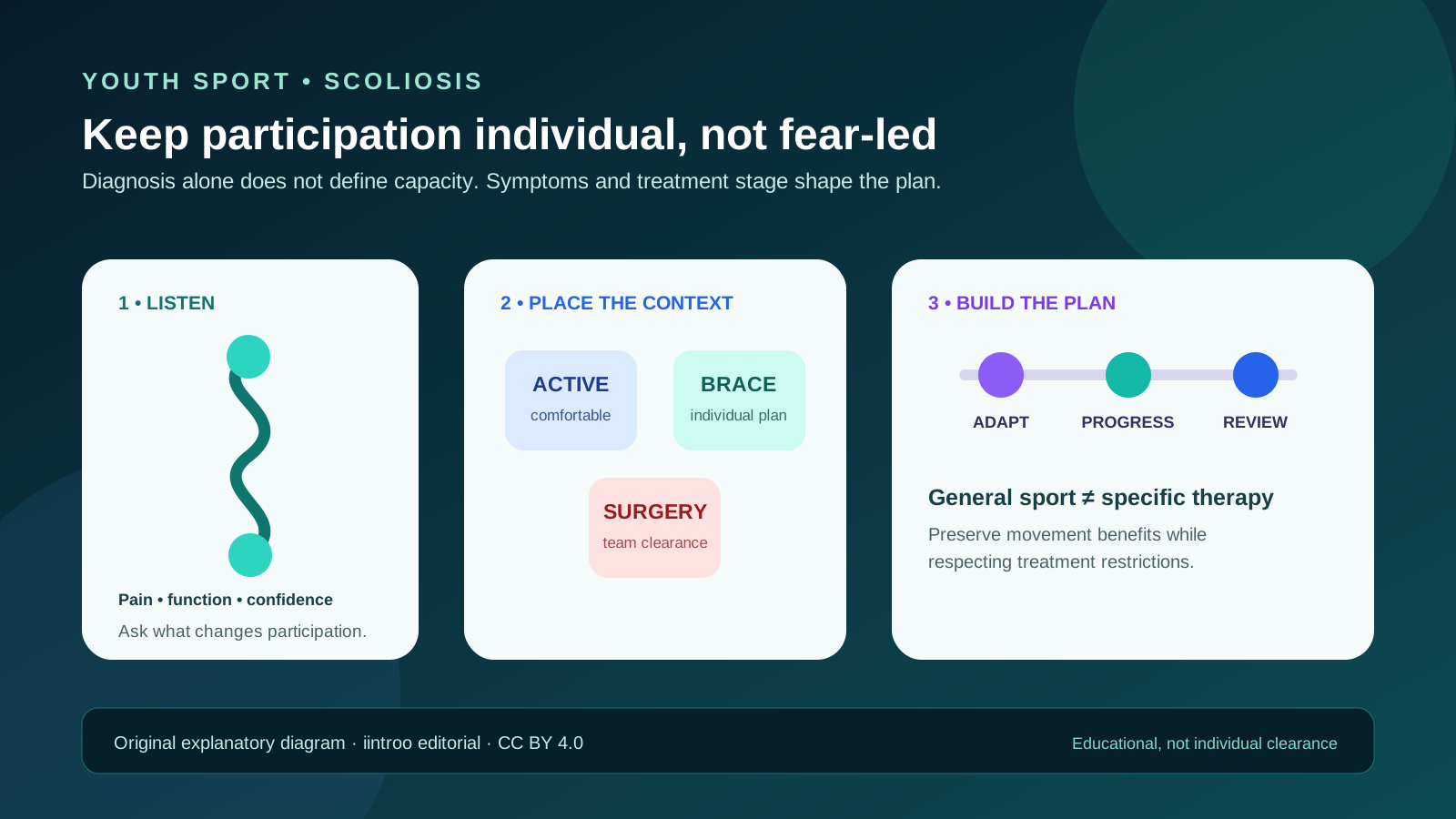
Key points
- Idiopathic scoliosis does not automatically exclude an adolescent from sport; tolerance, symptoms and the individual treatment plan matter.
- General sport and physiotherapeutic scoliosis-specific exercise have different purposes, and one should not be presented as a substitute for the other.
- New neurological symptoms, breathing difficulty, major trauma or severe escalating pain need prompt medical assessment rather than training modification alone.
Start with the person, not the curve label
This guide is for adolescents with idiopathic scoliosis, families, coaches, teachers and health professionals. A diagnosis describes a three-dimensional spinal deformity whose cause is not known; it does not by itself reveal pain, fitness, confidence or sporting capacity. The Scoliosis Research Society and the American Academy of Orthopaedic Surgeons both support physical activity for most young people with idiopathic scoliosis when participation is comfortable. That general reassurance is not a blanket clearance for every athlete, treatment stage or collision exposure.
Ask what is actually limiting participation: pain during a particular movement, fatigue, breathing symptoms, brace fit, fear after diagnosis, an unrelated injury or a restriction from the treating team. Record the sport, position, training volume and competition demands rather than dividing activities into simply safe or unsafe. Severe or rapidly increasing pain, weakness, numbness, altered walking, bowel or bladder change, unexplained breathing difficulty or major trauma deserves prompt medical assessment. Those features should not be attributed to scoliosis without evaluation.
Separate ordinary sport from scoliosis-specific treatment
Running, swimming, dance, strength work and team sport can support fitness, social connection and bone health, but ordinary training is not the same as physiotherapeutic scoliosis-specific exercise. PSSE programmes use individually taught posture, three-dimensional correction, breathing and functional integration as part of conservative care. The 2016 SOSORT guideline encourages general sport while making clear that it does not replace a prescribed treatment plan. A coach should not copy a generic online exercise and claim it can straighten a curve.
Recent systematic reviews report possible benefits from supervised scoliosis-specific exercise for measures such as Cobb angle, trunk rotation, function or quality of life, but trials differ in programme, duration, curve severity and risk of bias. Improvements in a group average do not predict an individual athlete's curve. Exercise decisions therefore belong inside follow-up that considers skeletal growth, curve pattern and progression, not as an alternative to observation, bracing or surgery when those have been recommended.
Adapt around bracing and surgery without inventing a timetable
An athlete using a brace may need help with heat, skin checks, changing clothes, contact with equipment and the timing of wear. Some can remove the brace for approved activity; others have different instructions. The prescribing team should state what applies to that brace and curve. Coaches can offer a private place to change, schedule hydration, prevent teasing and avoid pressuring the athlete to hide symptoms. A brace should not be trimmed, padded differently or left off simply to meet a practice plan without clinical advice.
After spinal fusion, return is a surgical decision based on healing, neurological status, strength, movement, the levels fused and the demands of the sport. AAOS describes typical return windows but also notes that movement is permanently changed and some contact participation may be discouraged. These broad timelines are educational, not a countdown. The surgeon's restrictions take precedence, and progression should rebuild daily function, conditioning and sport skills before unpredictable contact, heavy loading or competition.
Use symptoms and function to keep the plan honest
For an adolescent who is medically cleared, progress volume and intensity in manageable steps and monitor pain during training, later that day and the following morning. Review technique, recovery, sleep and equipment like any other youth programme. Persistent pain that changes movement, repeated absence, declining function or new asymmetry noticed during growth deserves reassessment. Do not use repeated photographs, home angle apps or a performance test to estimate curve progression; clinical examination and indicated imaging answer different questions.
The evidence does not justify blaming a chosen sport for causing idiopathic scoliosis, nor promising that one sport will prevent or cure it. Associations in observational studies can reflect selection, training exposure or incomplete control of growth and other factors. A useful participation plan preserves the benefits of movement while respecting symptoms and treatment-specific limits. This page offers no diagnosis, brace schedule, exercise prescription or post-operative clearance; those require the adolescent's qualified scoliosis team.