
High ankle sprains in sport: test syndesmosis stability before setting a return date
Syndesmosis injuries need stability-focused diagnosis and criteria-based rehabilitation; pooled return times are not personal deadlines for one athlete.
Key points
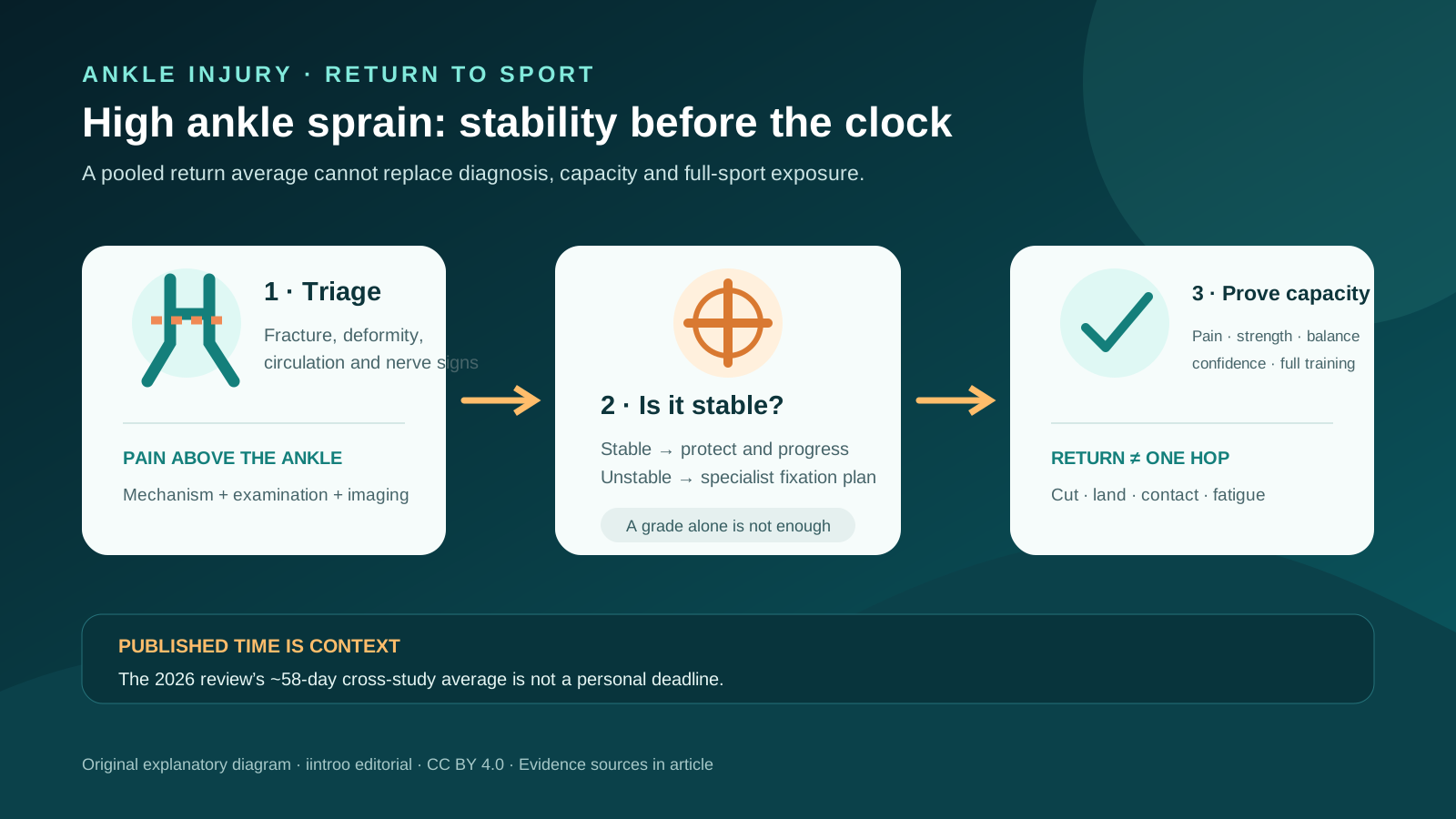
- Pain above the ankle after rotation or contact can suggest a syndesmosis injury, but examination and imaging must determine whether the joint remains stable.
- Stable injuries are often managed without surgery; unstable widening or associated fracture can require fixation, so treatment cannot be selected from a grade name alone.
- Return should test pain response, ankle capacity, confidence and full sport exposure; the roughly 58-day average in a 2026 elite-athlete review is not an individual timetable.
Recognize a different ankle injury without self-grading it
This guide is for athletes in American football, ice hockey, rugby, wrestling, football, skiing and other sports after a twisting or contact injury causes pain above the ankle. The distal tibiofibular syndesmosis is a group of ligaments that keeps the lower tibia and fibula aligned around the talus. External rotation, forced dorsiflexion and collision can injure it. Swelling may be less dramatic than with a lateral ankle sprain, and some athletes can still walk, so appearance or toughness does not establish severity.
A deformity, open wound, inability to bear weight after major trauma, rapidly increasing swelling, numbness, weakness, a cold or discoloured foot or severe pain needs urgent assessment. Fracture, dislocation and neurovascular injury take priority. For less acute cases, record the mechanism, exact pain location, ability to push off and change direction, and whether pain travels upward. Squeeze and external-rotation tests may add information, but no single sideline manoeuvre can reliably prove stability or clear the athlete.
Decide whether the ankle mortise is stable
Clinical assessment looks for syndesmosis tenderness, pain with rotation, swelling, range of motion, weight-bearing and associated medial or lateral injury. Plain radiographs help identify fracture and obvious widening; stress or weight-bearing views, ultrasound, CT or MRI may be selected when the diagnosis or stability remains uncertain. MRI can show ligament injury but an image finding alone does not state how the joint behaves under load. The important management question is whether the ankle mortise remains stable.
Stable injuries are commonly treated without surgery using protection, progressive weight-bearing and rehabilitation. Unstable diastasis, fracture patterns or loss of alignment can require specialist fixation. The label grade II has not been used consistently across studies, so a grade copied from a report should not dictate treatment without the stability and associated-injury context. Surgical and non-surgical groups in return studies also represent different injuries, making simple outcome comparisons vulnerable to selection bias.
Rebuild capacity from walking to chaotic sport
Early rehabilitation protects healing tissue while restoring comfortable weight-bearing, ankle motion and calf function as allowed by the treating team. Progress can then include strength, endurance, balance and controlled hopping before acceleration, deceleration, cutting, contact and fatigue. A skater must tolerate edges, stops and board contact; a lineman needs blocked foot positions and external load; a wrestler needs rotation under an opponent; a court athlete needs repeated landings. Equipment, brace or boot decisions belong with the clinician and sport rules, not a generic web protocol.
Monitor pain during activity and over the next day, swelling, range, calf strength and endurance, dynamic balance, confidence and the quality of sport tasks. The PAASS ankle framework was developed for lateral sprain rather than specifically for syndesmosis injury, but its domains—pain, impairments, athlete perception, sensorimotor control and sport performance—are useful prompts when interpreted with syndesmosis stability and surgical restrictions. Complete training is a stronger exposure test than one hop while fresh, yet even a normal session cannot guarantee against recurrence.
Treat published averages as context, not countdowns
A 2026 meta-analysis pooled 14 studies and 901 elite athletes, reporting a 96% return rate. The authors could not formally pool time because reporting formats and variability measures differed; the simple cross-study average was about 58 days with a range from 13 to 133 days. Funnel-plot asymmetry suggested publication bias. Elite cohorts, different definitions, injury stability and treatment choices limit transfer to youth, recreational, female and Para athletes or to a particular playing position.
Return to modified practice, full training and competition are separate milestones. Persistent pain above the ankle, recurrent swelling, instability, inability to push off, neurological symptoms or a plateau deserves reassessment for healing, fixation, cartilage, tendon or alternative pathology. This page cannot diagnose instability, choose imaging or surgery, prescribe a brace or set a return date. It supports early recognition, stability-focused management, progressive sport exposure and an honest reading of heterogeneous return evidence.