
Basketball ankle sprains: what matters before returning to court
Pain, ankle function, confidence, balance and court demands all matter after a sprain. Understand the evidence for rehabilitation and ankle braces.
Key points
- Being able to walk does not answer every return-to-basketball question.
- A brace does not replace rehabilitation or an individual return decision.
- Persistent giving-way or difficulty progressing deserves professional review.
From an ankle injury to basketball demands
This guide is for basketball players, parents and coaches discussing recovery after a lateral ankle sprain. The diagnosis and severity should be assessed by an appropriately qualified professional. An ankle injury should not be dismissed as a minor interruption simply because the player can walk.
Basketball involves stopping, changing direction, jumping and landing. Returning to those demands raises different questions from getting comfortably through an ordinary day. The decision needs information about both the ankle and the player's ability to participate.
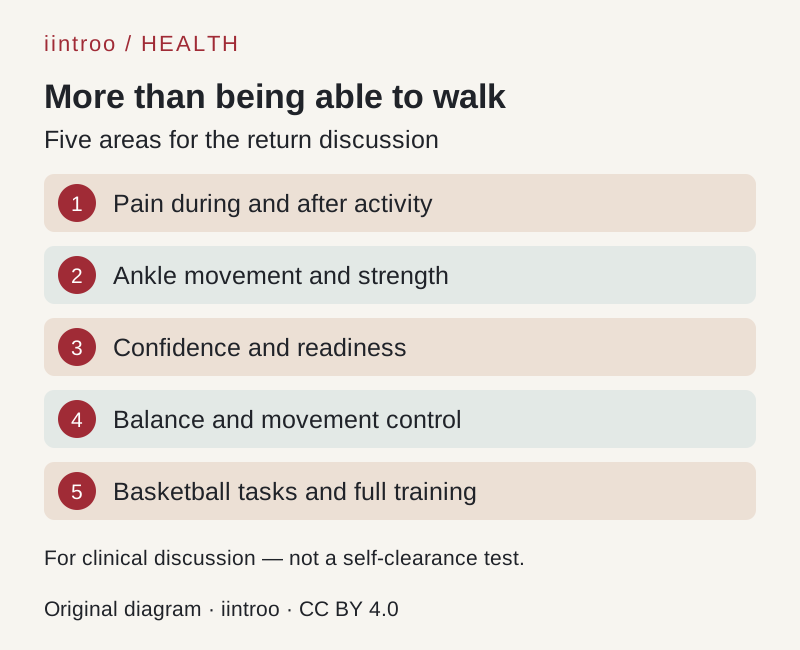
Five areas for the return discussion
The PAASS study gathered three rounds of opinions from 155 health professionals working in elite field and court sports. It grouped assessment into pain; ankle impairments such as movement and strength; the athlete's confidence and readiness; balance and related movement control; and sport-specific function.
For basketball, this makes the response to jumping, direction changes and a full training session relevant to the conversation. These are clinician-assessed domains, not a home test sequence. PAASS is expert consensus about what to assess; it does not promise that checking five boxes prevents another injury.
Sources: 1
Rehabilitation is more than waiting
The 2021 clinical practice guideline recommends a structured exercise component adapted to injury severity and identified impairments. It includes approaches addressing movement, balance and neuromuscular control. External support and progressive loading also require individual decisions about protection, symptoms and healing.
Ask the treating clinician which parts of practice are appropriate, what should prompt reassessment and how the home programme fits school or work. Repeated giving-way, persisting symptoms or difficulty advancing through rehabilitation are reasons to review the plan. A teammate's successful routine is not an individual prescription.
Sources: 2
What the basketball brace trial found
A school-cluster randomized trial followed 1,460 female and male players from 46 Wisconsin high schools during the 2009–10 season. The brace group had fewer acute ankle injuries than the control group. Among injuries that occurred, the study did not find a significant difference in time lost.
The findings concern a particular brace, supervised school setting and one season. They support a prevention discussion, not a guarantee for every age, competition level or product. They also do not establish that an injured player is ready to return simply because a brace is available.
Sources: 3
Make the plan usable at practice
Clarify who communicates permitted activities to the coach and how the player can report a problem during a session. If support is recommended, ask how to fit and use it. Keep rehabilitation and prevention in the same conversation, while recognising that they answer different questions.
For a young player, involve the parent or guardian and the treating professional in that communication. Record the agreed next step and review point rather than assigning a universal number of days away from basketball.