
Artistic swimming breath-hold safety: prevent hypoxic blackout
Underwater skill belongs in artistic swimming, but prolonged breath-holding, pre-dive hyperventilation and unsupervised practice can turn a routine into an emergency. Build observation, rescue and medical clearance into every session.
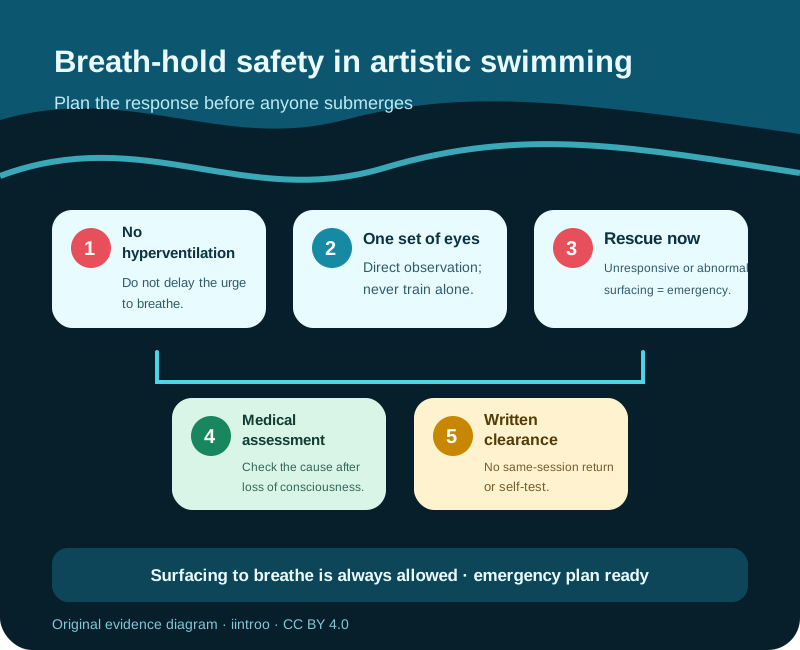
Key points
- Hyperventilating before an underwater effort can delay the urge to breathe without creating a safe oxygen reserve and can increase blackout risk.
- Breath-hold work should never be done alone; direct observation and a trained aquatic emergency response must be in place before the drill starts.
- Any loss of consciousness ends the session and requires an emergency response and medical assessment; return to the pool should follow written clinical clearance, not a same-day self-test.
Treat underwater work as a supervised exposure
This guide is for artistic swimmers, coaches, parents, lifeguards and venue operators. Breath control is part of the sport, but it is not a contest to suppress the urge to breathe for as long as possible. Loss of consciousness in water can be fatal, and the 2025 USA Artistic Swimming policy tells coaches to prevent prolonged breath-holding practice and to favour breath-control training over underwater laps.
The physiological literature is still small. Reviews describe hypoxaemia, bradycardia and rare syncope in artistic swimming, but most studies involve small groups of trained athletes and cannot produce one safe duration for every swimmer. The 2026 scoping review also highlights substantial evidence gaps. A practiced athlete is not immune to hypoxic blackout.
Do not use hyperventilation to extend the underwater phase
Repeated deep or rapid breathing before submersion lowers carbon dioxide and can postpone the normal warning to breathe while oxygen continues to fall. That combination can produce loss of consciousness with little warning. The joint aquatic-safety statement and USA Artistic Swimming policy therefore discourage hyperventilation before underwater activity.
Do not turn underwater distance or breath-hold time into punishment, a qualification test or a team challenge. Athletes must be free to surface and breathe at any time. Fatigue, illness and repeated efforts can change the response, so a previous successful duration is not a personal safety guarantee.
Plan eyes-on observation and rescue before the drill
Never permit solo breath-hold training. The USA policy requires lifeguard and coach awareness and calls for one set of eyes on each swimmer during underwater laps. Teams outside the United States should follow their national federation, facility and World Aquatics requirements; the USA policy's time and distance limits are federation-specific, not universal medical thresholds.
Assign who watches each swimmer, who enters the water, who calls emergency services and where rescue and resuscitation equipment is located. Observation must be continuous rather than divided across routine deck tasks. A teammate buddy can add attention but does not replace a qualified lifeguard or the venue's emergency action plan.
Loss of consciousness ends the session
If a swimmer becomes unresponsive, loses coordinated movement or fails to surface normally, start the facility's aquatic rescue and emergency response immediately. Remove the athlete from further participation, assess breathing and circulation within the responder's training, and activate local emergency medical services. Do not wait for the athlete to 'sleep it off' on deck.
A person who regains awareness still needs medical assessment because the cause may be hypoxia, cardiac disease, seizure, metabolic illness or another condition. Cough, breathing difficulty, chest symptoms or worsening fatigue after a water incident also need urgent evaluation. This article is not a substitute for aquatic-rescue or resuscitation training.
Return only through a documented clinical process
The USA Artistic Swimming policy requires physician evaluation and a clearance letter after loss of consciousness, with modifications or a gradual progression described when full return is not initially advised. Other countries may use different forms, but the core principle is the same: no same-day return and no self-clearance by repeating the underwater element.
After the emergency, review supervision, fatigue, drill design and communication as well as the athlete's medical assessment. A near miss is not evidence that the system worked. Record the incident, update the emergency plan and make sure every swimmer understands that surfacing to breathe is always permitted.