
Blood thinners and sport: map impact risk instead of using one contact label
Anticoagulants can turn an ordinary sporting impact into serious bleeding. Participation needs drug-, athlete- and exposure-specific shared decisions.
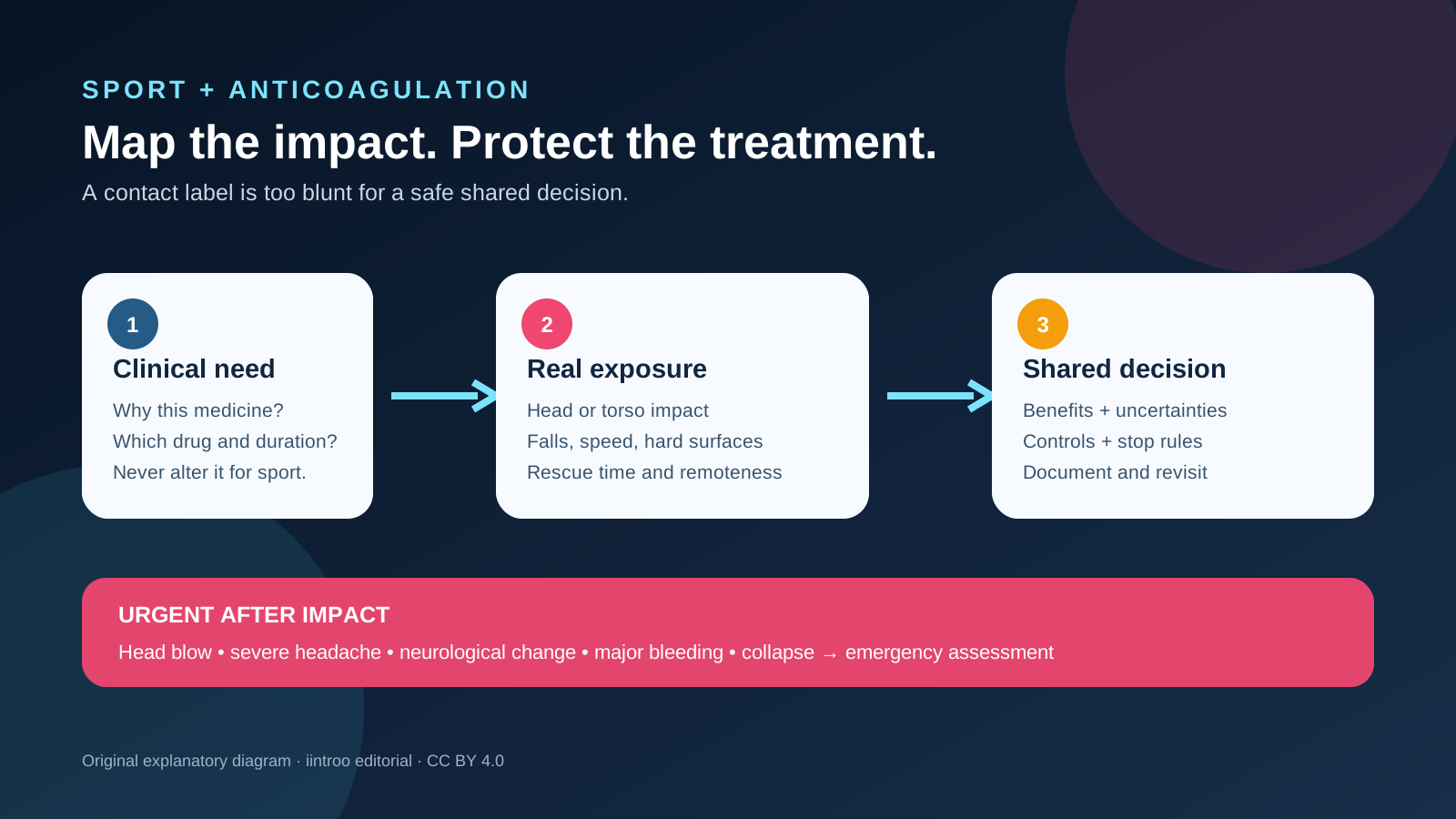
Key points
- Bleeding risk depends on the medicine, dose timing, clinical reason for treatment, other health factors and the real frequency and consequence of impact in the athlete's role.
- A low-contact label does not remove risk: cycling, skiing and other non-collision sports can still involve high-energy falls or remote rescue.
- A head blow, unexplained severe headache, neurological change, major bleeding or collapse while anticoagulated needs urgent medical assessment under the athlete's emergency plan.
Start with why anticoagulation is needed
This guide is for athletes taking an anticoagulant, including people treated for atrial fibrillation, venous thromboembolism, a mechanical heart valve or another condition, and for clinicians and sport staff supporting them. The first question is not simply whether a sport is contact or non-contact. It is why treatment is needed, which medicine and schedule are prescribed, how long treatment is expected, and what could happen if it is interrupted. Those decisions belong with the prescribing team; an athlete should not skip, delay or reduce a dose to fit a match or training session.
The 2025 AHA/ACC competitive-sport statement moves away from blanket eligibility rules and toward clinical assessment plus shared decision-making. For anticoagulation, that means comparing the benefit of preventing a clot or stroke with the chance and consequence of sport trauma. Age, previous bleeding, kidney and liver function, other medicines, the stability of the underlying condition and the athlete's values can all matter. A recommendation for one person cannot be copied to a teammate taking a different drug for a different diagnosis.
Describe the actual impact pathway
Map what really happens in the athlete's discipline and position: deliberate body collision, falls at speed, projectiles, head or torso strikes, sharp equipment, hard surfaces and the possibility that bleeding will not be visible. A cyclist may have no opponent contact yet face a high-energy road crash. A goalkeeper, combat athlete or rugby forward has a different exposure pattern from an official or a non-contact training role. Frequency, energy, body location, protective equipment, supervision and access to imaging or emergency care should be discussed separately.
Protective equipment can reduce some injuries but cannot make anticoagulation-compatible participation risk-free. A helmet cannot prevent all intracranial bleeding, and padding does not stop every deep muscle or abdominal bleed. Intermittent dosing strategies have been discussed for carefully selected athletes using particular short-acting drugs, but published evidence is limited and the margin for error can be serious. Such a plan, if considered at all, requires a specialist who understands the indication, pharmacology and sport; it is not a schedule that can be reconstructed from an article or wearable.
Make the emergency response specific and visible
The athlete and relevant staff should know which events end participation and trigger urgent assessment. A head impact, loss of consciousness, confusion, new weakness, seizure, repeated vomiting, a severe or worsening headache, unusual drowsiness, significant chest or abdominal pain, major swelling, bleeding that will not stop, blood in urine or stool, or collapse requires prompt medical action. Symptoms may be delayed after trauma. Do not let a normal-looking helmet, an apparently minor hit or an early return to conversation substitute for professional assessment.
Carry an accurate medicine list, indication, dose and last-dose information, emergency contacts and the agreed route to care. Venue staff need the response steps, not unrestricted access to private records. In remote, mountain, motor or water sport, evacuation time changes the consequence of injury and should influence the participation discussion before travel. Emergency clinicians decide about imaging, laboratory assessment and any reversal treatment. Coaches must not give extra medicine, advise a missed dose or attempt a field reversal.
Revisit the decision when circumstances change
Review is needed after any significant impact or bleeding event, a new clot, a medicine or dose change, illness affecting absorption or kidney function, pregnancy, a new competition role, or a move to a venue with slower emergency access. Training modification may preserve conditioning and team involvement while a time-limited course is completed, but alternative activity still needs its own fall and impact assessment. The aim is not automatic exclusion or automatic clearance; it is an explicit record of benefits, uncertainties, risk controls and what would prompt a different decision.
Evidence remains limited because randomised trials cannot assign athletes to dangerous collisions, and much guidance combines pharmacology, observational data and expert consensus. Sports categories also hide large differences within the same discipline. This article therefore provides no approved sport list, safe drug interval or personal clearance. It supports a structured conversation among the athlete, prescriber and sports clinician so that stroke or clot prevention is not casually traded against participation, and preventable trauma risk is not dismissed.