
Axial spondyloarthritis in sport: keep moving, but match load to disease and function
Exercise is central to axial spondyloarthritis care, but pain, stiffness, fatigue, bone health and treatment response should shape an athlete’s plan.
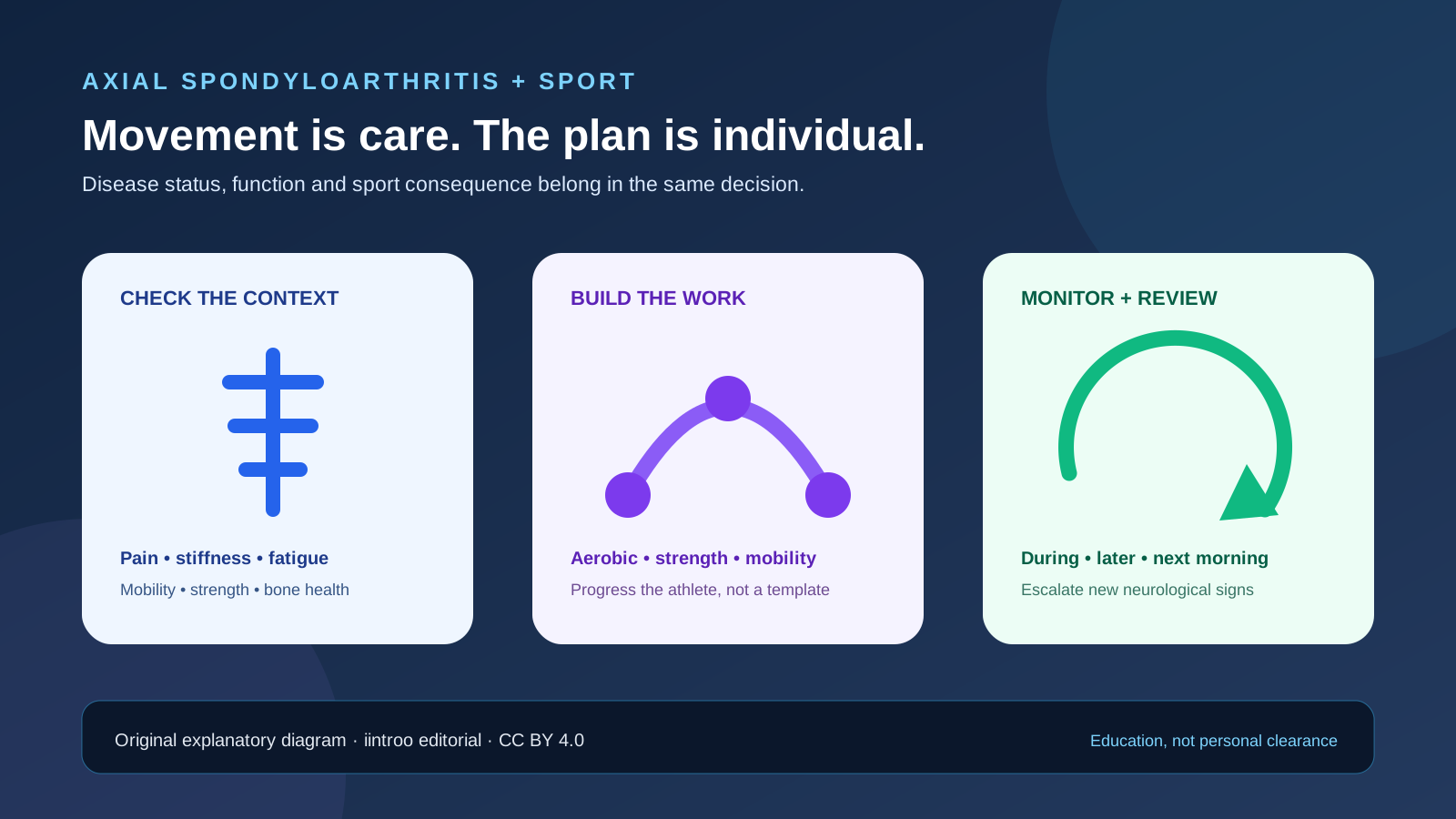
Key points
- Regular exercise is a core part of axial spondyloarthritis management; supervised exercise can add value beyond an unsupervised generic routine.
- Pain during sport is not a reliable stand-alone measure of inflammation, tissue damage or readiness, so new or changing symptoms need context.
- Suspected spinal fracture, new neurological symptoms, chest pain or severe breathlessness requires urgent assessment rather than a training adjustment.
Build the plan around disease status and the athlete’s real demands
This guide is for athletes living with axial spondyloarthritis, including radiographic and non-radiographic disease, plus coaches and health teams working with the athlete’s permission. Axial spondyloarthritis is an inflammatory condition that can involve the sacroiliac joints and spine, with patterns of pain, stiffness, fatigue and function that vary between people and across time. A diagnosis does not by itself define what an athlete can lift, run, throw or tolerate.
The 2022 ASAS-EULAR recommendations describe exercise as a cornerstone of care and place education, regular physical activity and physiotherapy inside the management plan rather than outside medical treatment. NICE similarly recommends specialist physiotherapy with an individualized programme. That support for movement is not a universal clearance for every competition demand. Disease activity, mobility, strength, balance, cardiovascular health, bone density, previous surgery or fracture, other joint involvement and medication effects all belong in the decision.
Use exercise as care, not as a test of toughness
Systematic reviews informing ASAS-EULAR found that education and exercise can improve outcomes such as disease activity, function and spinal mobility, although programmes and effect sizes vary. The evidence largely concerns people receiving therapeutic or general exercise, not elite collision exposure, maximal lifting or one specific sport. A result from a group programme cannot predict an individual athlete’s response or replace assessment of a major symptom change.
A useful programme usually includes aerobic work, strength, mobility and posture or breathing elements chosen for the person. Supervision may help with technique, progression and adherence, especially after a flare, long break or functional decline. Progress the work that matters to the sport while preserving tolerable recovery. Do not force end-range spinal movement because a generic routine calls it mobility, and do not assume that more soreness proves a better anti-inflammatory effect.
Separate ordinary fluctuation from a warning sign
Track morning stiffness, pain pattern, fatigue, sleep, function, medication changes and response later that day and the next morning. Repeated deterioration, swollen peripheral joints, eye pain or redness, new bowel symptoms, unexplained fever or a marked decline deserves clinical review. Sudden severe spinal pain after even modest trauma is particularly important when the spine is rigid or bone health is reduced. New weakness, numbness, walking difficulty or bowel or bladder change needs urgent assessment.
Chest pain, fainting or severe breathlessness also requires appropriate urgent care rather than attribution to poor fitness. Some athletes have restrictions because of active inflammation, osteoporosis, cardiovascular disease, hip involvement or surgery; others do not. Contact, collision, falls and loaded spinal positions have different consequences across sports. A rheumatologist and physiotherapist can help translate medical status into practical limits without turning the diagnosis into a blanket ban.
Return by function and control, not by a copied calendar
After a flare or interruption, rebuild ordinary activity, aerobic tolerance, strength and sport-specific skill in stages. Agree what counts as acceptable symptom fluctuation, what should stop the session and when the medical team should be contacted. Training records can show whether a change follows load, travel, sleep or medication, but they cannot measure inflammation on their own. Avoid changing prescribed medicines or using extra anti-inflammatory medication simply to complete a session without clinical advice.
Most exercise research in axial spondyloarthritis is not designed around competitive athletes, high-risk sports or long-term injury surveillance. Benefits should therefore be presented as support for appropriately designed activity, not proof that exercise will control every flare or prevent structural progression. This page provides general education, not a diagnosis, drug plan, contact-sport clearance or personal return date.