
Running with knee osteoarthritis: manage symptoms without treating every stride as damage
A knee osteoarthritis diagnosis does not automatically end running. Use symptoms, function, strength and gradual load changes to guide an individual plan.
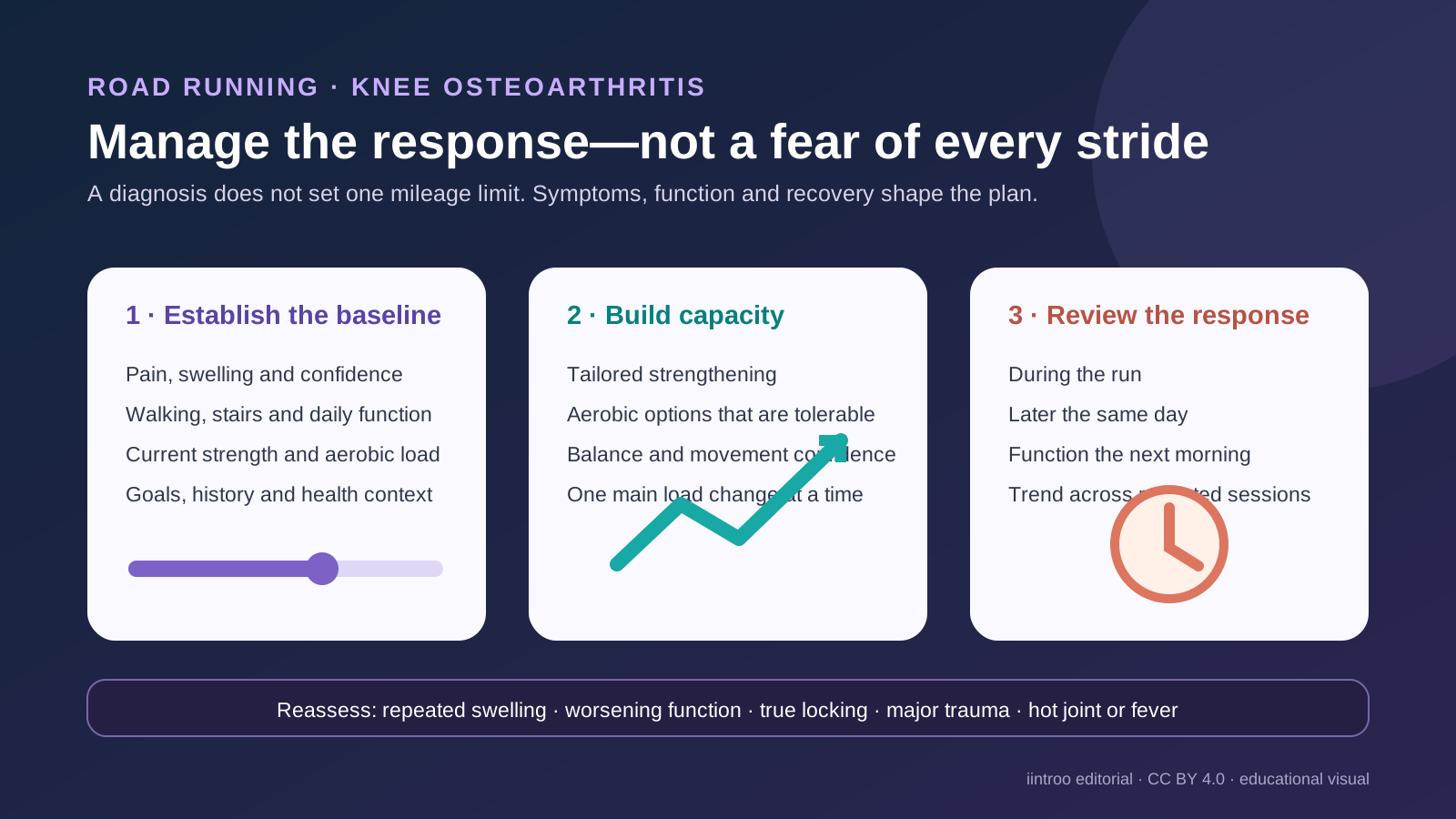
Key points
- Population studies do not show that recreational running inevitably causes or accelerates knee osteoarthritis, but they cannot guarantee safety for every knee.
- Current guidelines recommend tailored therapeutic exercise for osteoarthritis; pain, function, goals and other health conditions shape the programme.
- A sudden swollen knee, locking, inability to bear weight, major trauma or systemic illness needs assessment rather than a self-designed return plan.
A diagnosis is not a verdict on every run
This guide is for adults with diagnosed or suspected knee osteoarthritis who want to start, continue or return to recreational running. Osteoarthritis is a whole-joint condition, and imaging changes do not map neatly onto pain or function. A scan cannot by itself determine how much running a person should do. Equally, knee pain in a runner is not automatically osteoarthritis; injury, inflammatory disease and referred pain can overlap.
Systematic reviews have not found that recreational runners consistently show more knee osteoarthritis than non-runners, and some analyses report lower prevalence. Those findings may reflect selection, lifetime activity, prior injury, body composition and other differences. They are not proof that running prevents osteoarthritis or that high-volume competitive exposure is harmless. The useful conclusion is narrower: a diagnosis does not justify a blanket ban, and individual response matters.
Exercise is treatment, but running is one option
NICE recommends tailored therapeutic exercise, including local strengthening and general aerobic fitness, for people with osteoarthritis. A 2024 Cochrane review found that exercise can improve pain and function compared with usual care or limited education, although certainty and effect size varied. Neither source requires running. Walking, cycling, pool exercise, strength work or a combination may be more acceptable at a particular stage.
A physiotherapist or appropriately qualified clinician can connect the person’s symptoms, strength, range of motion, confidence, previous injury and wider health to a plan. Medication, sleep, recovery, work demands and body-weight goals may also be relevant, but none should be reduced to a moral test. Weight loss can help some people with osteoarthritis, yet care should remain respectful, practical and focused on shared decisions rather than withholding activity until a target is reached.
Build exposure and watch the next-day response
Start from a tolerable baseline and change one main variable at a time: frequency, duration, speed, hills or surface. A run–walk format, shorter routes and predictable terrain can make the response easier to interpret. Pair running exposure with strength and balance work selected for the athlete. Footwear comfort can matter, but no shoe, brace or supplement has been shown to make every osteoarthritic knee safe for any load.
Track pain, swelling, confidence and function during the session and into the following day. A temporary symptom increase can occur when exercise begins and does not automatically mean new structural damage, but persistent escalation, repeated effusion or declining function means the plan needs review. Note whether ordinary tasks such as stairs, rising from a chair or walking are meaningfully worse, because sport tolerance should not be judged in isolation. There is no universal pain score or twenty-four-hour rule that can replace individual clinical guidance.
Separate a manageable flare from a new problem
Arrange assessment for pain that is progressively worsening, repeatedly disturbs sleep, changes gait or does not recover with a sensible load adjustment. Prompt care is warranted after major trauma, a hot or markedly swollen joint, fever, true locking, inability to bear weight, new neurological symptoms or a calf that becomes swollen and painful. Do not attribute every new symptom to a known osteoarthritis diagnosis.
Return to a previous running volume should be based on function and repeated response, not a race date alone. Imaging may be appropriate when the presentation is atypical or management would change, but routine scanning is not the starting point for every flare. Event entry does not equal medical clearance. This article does not diagnose knee pain, prescribe an exercise programme, advise on medication or provide race clearance.