
Masters athletes on statins: separate muscle symptoms from training noise
New muscle symptoms in a masters athlete taking a statin need a timeline, safety check and shared review—not silent training changes or stopping medicine alone.
Key points
- Most muscle symptoms reported during statin therapy are not caused by the medicine.
- Real symptoms still deserve assessment rather than dismissal or self-directed stopping.
- Exercise evidence is reassuring overall but too limited for a universal training rule.
Two valuable goals can coexist
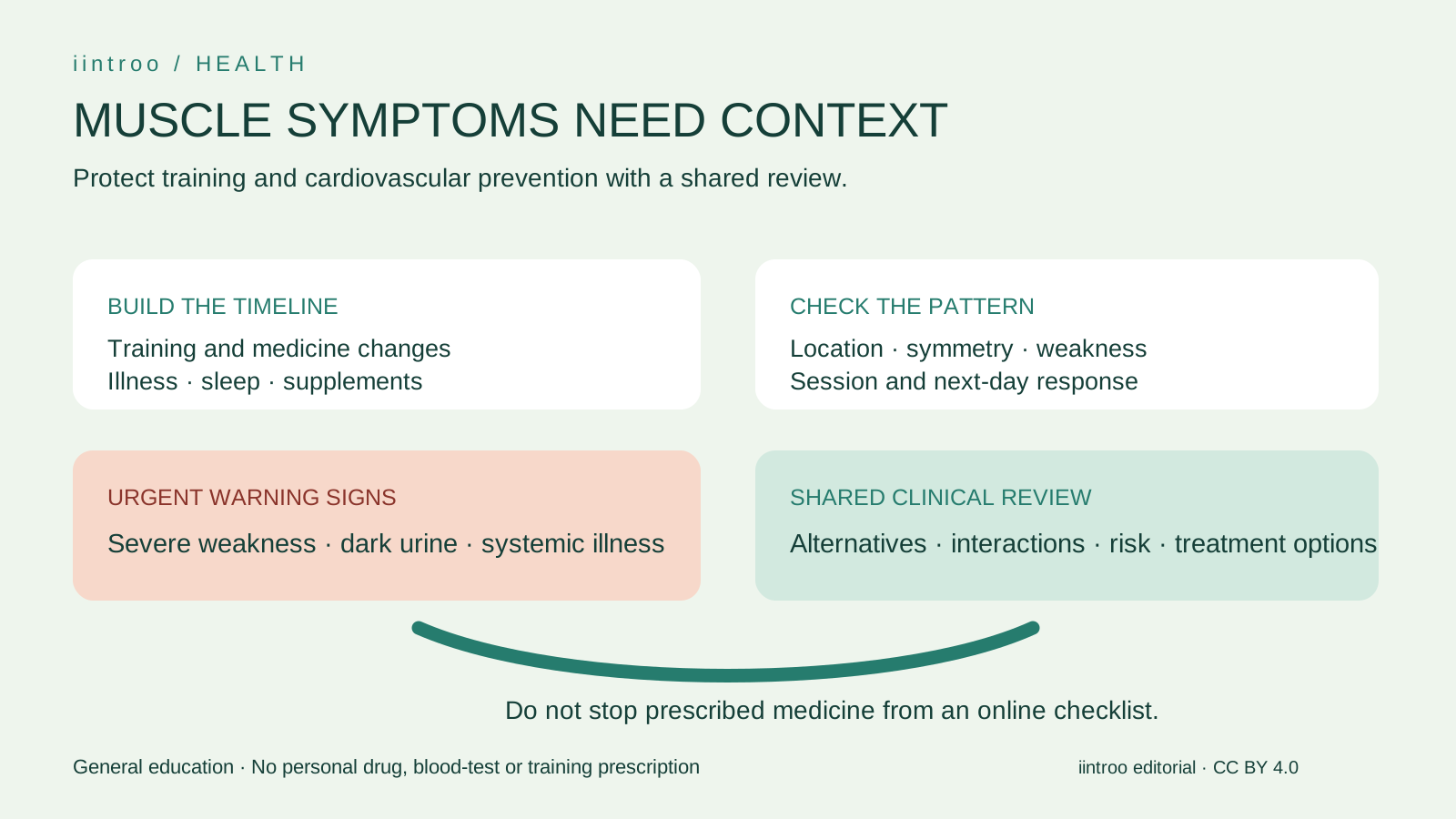
Masters athletes may use statins to reduce cardiovascular risk while also training for health and performance. New aching, cramps, weakness or unusual fatigue can create a false choice between the medicine and sport. The first useful step is a careful timeline: when symptoms began, which muscles are affected, whether they are symmetrical, what changed in training, and whether a statin or another medicine was started or changed.
Do not stop or alter a prescribed statin solely from an online checklist. The cardiovascular reason for treatment matters, and abrupt self-management can leave risk untreated. At the same time, real symptoms should not be dismissed as imagination or ordinary ageing. A clinician can assess severity, alternative explanations and the relationship between symptoms, medication exposure and recent training.
What the best trial evidence says
A 2022 individual-participant meta-analysis combined 19 double-blind placebo-controlled trials with 123,940 participants. Statins caused a small relative increase in muscle pain or weakness, concentrated largely in the first treatment year. More than 90% of reported muscle symptoms among people assigned a statin were not attributable to the statin. This result should reduce fear, but it cannot identify the cause of one athlete's symptoms.
Severe statin-related myopathy and rhabdomyolysis are rare. Trial populations were not designed around competitive masters athletes, and training load, symptom reporting and fitness varied. The finding does not mean every symptom is harmless, nor that an athlete should train through progressive weakness. It supports a measured assessment that preserves proven cardiovascular benefit whenever possible.
Exercise studies are reassuring but incomplete
A 2024 systematic review and meta-analysis of randomised trials examined exercise in people using statins. Self-reported muscle symptoms were numerically more common with statins, but the pooled difference was not statistically conclusive, and the authors called for more trials. Available studies do not support a blanket instruction to avoid exercise, yet they also do not define a safe workload for every athlete taking every statin.
Competitive and highly active people may notice small changes that are difficult to separate from delayed-onset soreness, travel, infection, sleep loss or a sudden increase in hills, speed, lifting or volume. Record session load and next-day response rather than relying only on a single pain score. A stable training period can make a medication-symptom discussion clearer, but deliberately detraining is not a diagnostic test.
A clinical review looks for patterns and alternatives
Assessment can include the symptom pattern, timing relative to treatment, other medicines or supplements, alcohol, illness, thyroid disease, vitamin deficiencies, kidney or liver problems and the training programme. Creatine kinase testing may be appropriate in selected cases, especially with marked symptoms, but a normal result does not erase every complaint and an elevation after hard exercise needs context.
The National Lipid Association defines statin intolerance through symptoms or laboratory abnormalities that improve with dose reduction or discontinuation, after attempts with at least two statins including one at the lowest approved daily dose. That is a clinician-led definition, not a home experiment. Options may include a different statin strategy or non-statin therapy, but choices depend on cardiovascular risk, interactions and shared decision-making.
Know the urgent signs and protect the prevention plan
Seek urgent medical advice for severe or rapidly worsening weakness, dark urine, very reduced urine, fever or systemic illness with significant muscle symptoms, particularly after an unusually hard event or heat exposure. Chest pressure, unexplained breathlessness, fainting or new neurological symptoms require urgent assessment on their own terms and should not be attributed to a statin or training without evaluation.
For non-urgent symptoms, bring a medication list, supplement list and training timeline to the review. Ask what cardiovascular benefit is expected, which alternative causes have been considered, what monitoring is needed and how training can be modified while the cause is clarified. This article does not recommend a drug, dose, supplement, blood-test threshold or personal return-to-training plan.