
Glaucoma and sport: keep moving, protect the eye, monitor the plan
Most people with stable glaucoma can stay active, but sport advice should reflect eye damage, treatment, impact exposure and post-surgery restrictions.
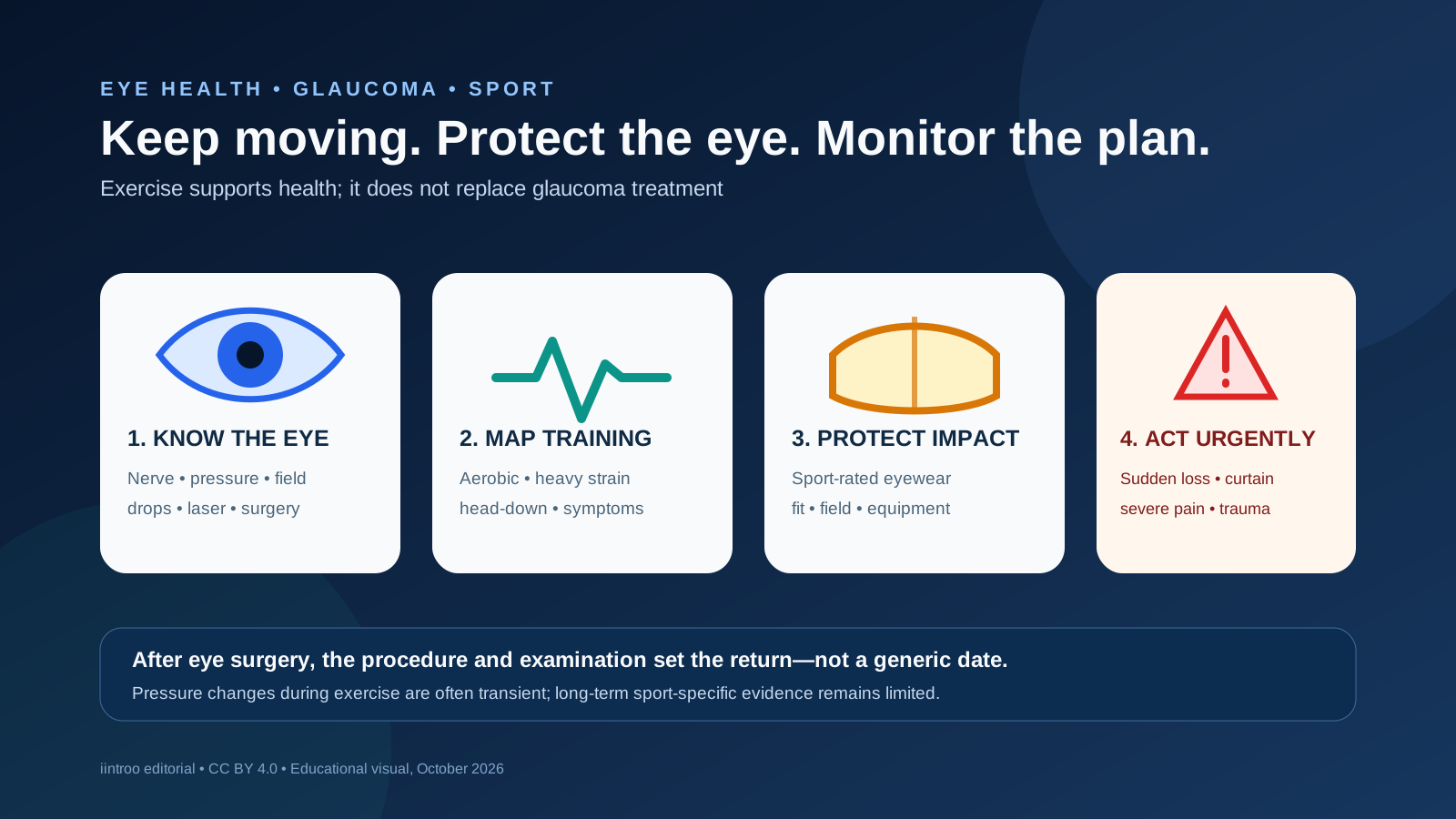
Key points
- Moderate aerobic activity can transiently lower intraocular pressure, but this does not replace prescribed drops, laser care, surgery or monitoring.
- Heavy straining and some inverted positions can transiently raise eye pressure; the long-term importance differs and should be discussed with the eye-care team.
- Sudden vision loss, a curtain or shadow, severe eye pain, coloured haloes, nausea after eye symptoms or direct eye trauma needs urgent assessment.
Use exercise as health support, not as glaucoma treatment
This guide is for athletes and active people with glaucoma or ocular hypertension, plus coaches and training partners. Glaucoma describes optic-nerve damage with different causes and patterns; eye pressure is an important risk factor, not the whole diagnosis. Visual-field loss may be gradual and unnoticed, so feeling fit and seeing the central target clearly do not prove stability. Keep the eye specialist's appointments, testing and treatment while discussing the actual sports and training positions you use.
A 2024 systematic review found that aerobic and resistance exercise often produced an immediate reduction in measured intraocular pressure after activity, but studies were small, methods differed and few assessed disease progression. Another 2024 review notes transient pressure reduction with moderate aerobic exercise and transient increases during high-intensity resistance work. These short measurements do not show that exercise cures glaucoma or that one pressure reading predicts long-term nerve damage. Prescribed drops, laser or surgery should never be replaced by a training routine.
Identify the parts of training that change pressure or safety
Discuss very heavy lifting, repeated breath-holding and prolonged head-down positions with the ophthalmology team, particularly when disease is advanced or pressure control is difficult. Intraocular pressure can rise transiently during maximal straining and inverted yoga positions, but the size and clinical meaning vary. Exhaling through the effort and avoiding an unplanned maximal strain may be reasonable elements of a clinician-agreed technique plan; this article cannot set a safe load, repetition range or pose for every eye.
A small 2025 comparison reported higher post-training pressure among weightlifters than marathon runners, but it was observational, groups differed and one post-session measurement cannot establish future glaucoma progression. Use it as a reason to ask better questions, not to ban strength sport. Record symptoms, training type and medication timing if the specialist asks, but do not repeatedly self-test with consumer devices or change drops around workouts. Blood-pressure medicines and glaucoma drops may also affect heart rate, dizziness or heat tolerance and need individual review.
Prevent trauma and respect surgery-specific restrictions
Eye trauma can cause secondary glaucoma and can be catastrophic in an eye with limited reserve. For racquet sports, court sports, combat training, projectiles or occupational exposure, use sport-specific impact-rated eye protection recommended by an eye professional and permitted by the rules. Ordinary spectacles and fashion sunglasses are not protective sports eyewear. Fit matters: the frame should remain stable, preserve the field of view and work with helmets or face guards without creating a new pressure point.
After laser treatment, injection or eye surgery, follow the surgeon's restrictions rather than a generic return calendar. The American Academy of Ophthalmology advises avoiding exercise, especially contact sport, during the healing period and returning according to the procedure and examination. Swimming adds infection and goggle-pressure questions, while lifting, bending, dust and collision may matter differently. A quiet eye on the outside does not prove the surgical wound, pressure or retina is ready for sport.
Plan for vision change on the field
Stop and seek urgent eye care for sudden vision loss, a new curtain or shadow, showers of flashes or floaters, severe eye pain, a red eye with blurred vision, coloured haloes with headache or nausea, or any penetrating injury. After blunt trauma, new double vision, an irregular pupil, blood in the eye, marked light sensitivity or persistent blur also needs urgent assessment. Do not press, rub or patch a badly injured eye; protect it from further contact and use the venue emergency plan.
For stable disease, adapt contrast, lighting, lane or court orientation and communication when field loss affects navigation. The athlete should decide what teammates need to know, and classification or competition rules remain separate from medical care. This article does not diagnose glaucoma, interpret a visual field, prescribe drops, approve an exercise or set a post-operative return date. Those decisions belong with the treating ophthalmologist or optometrist and, when relevant, the sport's medical and classification teams.