
Keratoconus in sport: protect vision without treating contact lenses as safety eyewear
Keratoconus can alter visual quality and lens needs. Athletes need current eye review, certified protection and a procedure-specific return plan.
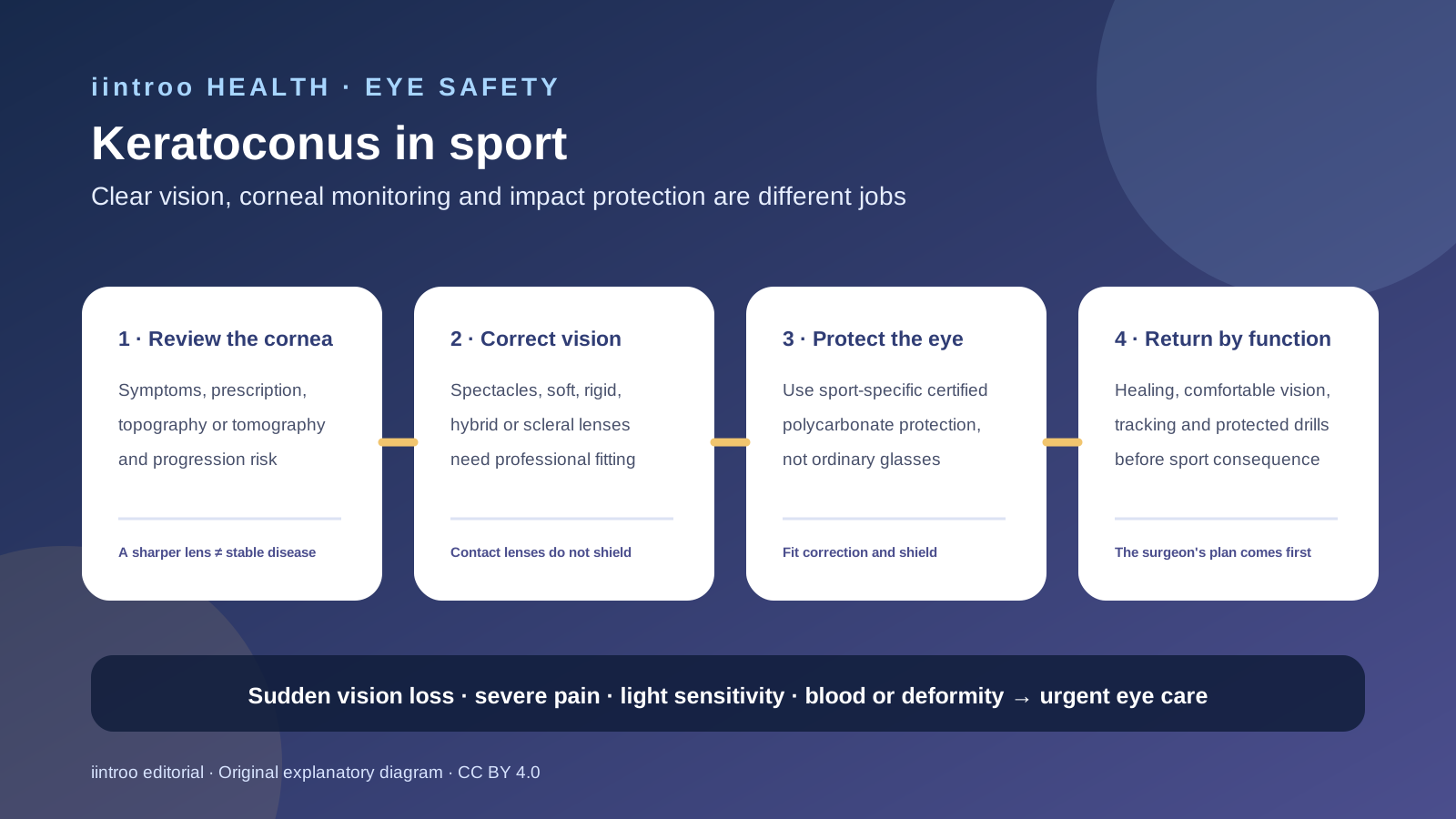
Key points
- Keratoconus changes corneal shape and visual quality; spectacles or contact lenses improve vision but do not by themselves stop progression.
- Ordinary glasses and contact lenses are not certified sports eye protection; the protector must match the sport and fit over the visual correction.
- Sudden vision loss, severe eye pain, light sensitivity, a red eye after impact or a displaced lens with persistent symptoms needs urgent eye assessment.
Separate seeing clearly from monitoring the cornea
This guide is for athletes with keratoconus and teams supporting them. Keratoconus is a corneal ectasia in which thinning and shape change can create irregular astigmatism, glare, ghosting and reduced visual quality. Spectacles, soft, rigid, hybrid or scleral lenses may improve vision, while corneal cross-linking and other procedures address different clinical goals. A sharper view through a lens does not prove that the condition is stable, and a familiar diagnosis does not predict the same visual demands in every sport.
The 2026 evidence-based guideline and updated global consensus recommend clinical examination and corneal imaging to diagnose, stage and monitor progression, while acknowledging low certainty in several areas. Younger age, allergy and eye rubbing can matter. Athletes should keep scheduled eye review and report changing prescription, increasing glare, new ghosting or reduced performance rather than solving every change with a stronger lens bought outside the treating service.
Make visual correction and sports protection work together
The American Academy of Ophthalmology advises sport-specific polycarbonate protection that meets the relevant testing standard for activities such as basketball, racquet sports, soccer and field hockey. Ordinary prescription glasses can shatter and are not a substitute. Contact lenses correct vision but provide no impact shield. Work with the eye-care professional and equipment provider so certified protection fits securely over or alongside the chosen correction without touching the eye, dislodging the lens or creating blind spots.
Combat sports and full-contact martial arts carry a particularly high risk of serious eye injury, and some impacts cannot be made safe by eyewear. Eligibility rules also differ. Check the federation's current equipment requirements and obtain individual ophthalmic advice. Do not interpret cross-linking, a stable scan or successful lens fit as automatic clearance for direct blows, projectile exposure or a sport where protective equipment is prohibited.
Protect the ocular surface and avoid rubbing
Eye rubbing is consistently associated with keratoconus, but available studies are observational and heterogeneous and cannot prove a simple one-way cause. Current guidance still treats avoiding rubbing and managing itchy allergic eyes as sensible risk reduction. After sweat, dust or a minor irritation, wash hands, use the person's agreed eye-care plan and remove from play if vision is affected. Do not press or rub through a glove or towel to reseat a lens.
Contact-lens type, fit, cleaning, wear time and replacement schedule belong with the eye-care professional. Swimming or showering in lenses can add microbial risk, and a red painful light-sensitive eye or discharge needs prompt assessment. Carry clean backup correction and a lens case where appropriate. Do not share drops, use tap water on a lens, or continue with a cracked, displaced or uncomfortable rigid or scleral lens simply because competition has started.
Use procedure-specific healing and functional return
After corneal cross-linking, ring implantation or transplant surgery, restrictions depend on the procedure, epithelial healing, symptoms, infection risk, vision and impact exposure. The surgeon's plan takes priority over a generic calendar. Rebuild from comfortable daily vision and low-risk conditioning to sport-specific tracking, reaction, depth judgement and protected drills before fast projectiles, collision or competition. Recheck equipment after any prescription, lens or ocular-surface change.
Sudden or marked vision loss, severe pain, light sensitivity, a very red eye, new flashes or a curtain-like shadow, blood in the eye, deformity, or persistent symptoms after impact needs urgent eye assessment. Do not push on the eye or attempt to remove an embedded object. There is no universal corneal measurement, number of post-procedure days or visual-acuity line that clears every athlete. This page provides general education, not diagnosis, lens fitting, procedure advice or personal sport clearance.