
Long QT syndrome in sport: build participation around expert care and an emergency plan
Long QT syndrome does not create one sport rule. Expert risk assessment, treatment continuity, trigger review and a rehearsed AED plan shape participation.
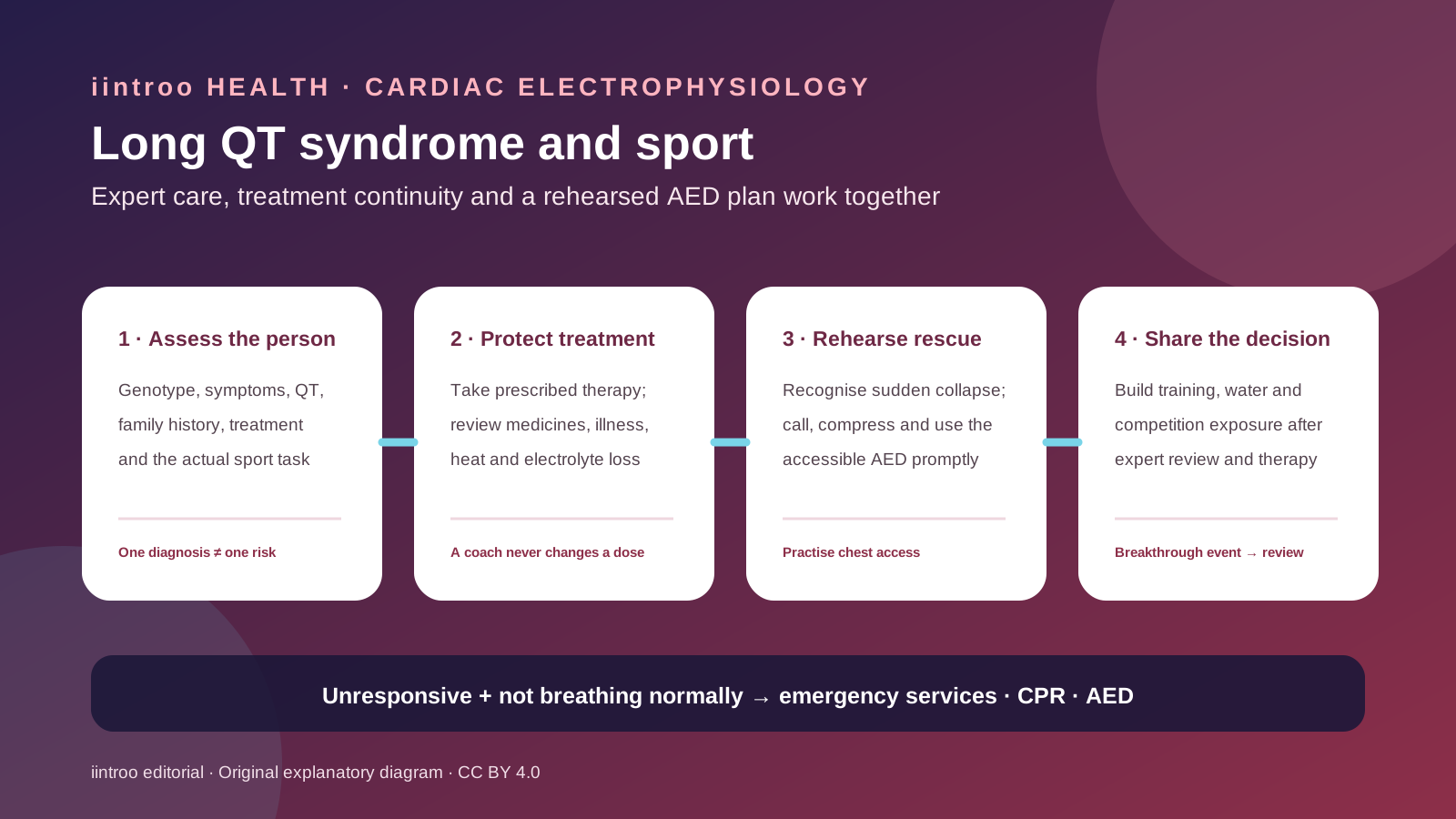
Key points
- Long QT syndrome is an inherited arrhythmia condition with different genotypes, symptoms and treatment needs; a diagnosis alone does not determine sport eligibility.
- Fainting during exercise, a seizure-like collapse or an athlete who is unresponsive and not breathing normally requires the sudden-cardiac-arrest emergency pathway and prompt AED use.
- QT-prolonging medicines, electrolyte loss, illness, heat and missed treatment can change risk and should be reviewed with the specialist team rather than managed by a coach.
Start with specialist diagnosis and the athlete's own risk profile
This guide is for athletes with diagnosed congenital long QT syndrome, families, coaches and health teams. LQTS affects cardiac electrical recovery, but genotype, corrected QT interval, symptoms, family history and treatment response differ. A single ECG, wearable trace or online QT calculator cannot establish diagnosis or sport safety. The 2024 HRS consensus recommends expert genetic-cardiology assessment and shared decisions because older blanket exclusions do not reflect current observational evidence.
Map the athlete's previous fainting, seizure-like events, palpitations, cardiac arrest, breakthrough symptoms and treatment alongside the actual sport. Swimming, diving, sprinting, endurance training, remote venues and heat create different rescue and physiological demands. Access to specialist care and emergency response can change the consequence of the same session. Fainting during exertion, fainting without warning, chest pain with collapse or an unexplained seizure-like episode needs urgent medical assessment. Do not label such an event dehydration until cardiac and other serious causes are considered.
Protect treatment, medicine review and electrolyte stability
Athletes should take prescribed treatment exactly as directed and discuss performance effects with the treating specialist. Coaches must not stop, reduce or time-shift beta blockers or other therapy to improve a session. The HRS and AHA/ACC documents advise reviewing medicines that prolong QT and correcting electrolyte disturbances. CredibleMeds maintains a current drug-risk resource, but the final decision belongs to a clinician who knows the athlete, dose, interactions and alternatives.
Vomiting, diarrhoea, restrictive weight-making, heavy sweat loss, heat illness and some supplements or over-the-counter products can change electrolyte or medication risk. Use ordinary heat and hydration planning, allow illness recovery and provide a route for medication questions before travel. Do not prescribe potassium, magnesium, salt tablets or a sports drink as arrhythmia treatment. A medication list and specialist contact should travel with the emergency plan without being displayed publicly.
Rehearse collapse response and make water precautions specific
Every venue should have a rehearsed sudden-cardiac-arrest plan, trained responders and an accessible AED. If an athlete suddenly collapses, is unresponsive and is not breathing normally, activate emergency services, begin CPR and apply the AED as soon as possible. Do not delay for a pulse check by an untrained responder, move the athlete unnecessarily or wait for a team doctor. Equipment-removal practice matters in sports where chest access may be slow.
Current US guidance says swimming and diving can be considered for appropriately assessed and treated athletes with LQTS, including type 1, when suitable precautions are in place. That is not permission for solo open-water training or a universal clearance. Supervision, rescue capability, water access, distance from the AED and the athlete's genotype and history change the decision. The specialist plan should state which water settings are acceptable and what companions must know.
Return through shared decisions, not a universal QT number
After assessment and guideline-directed treatment, many athletes may participate through a shared decision model. Rebuild ordinary training before maximal intensity, remote competition or high-consequence water exposure. Track symptoms, adherence, illness, heat response and recovery, and review the plan when the athlete changes team, medication, competition level or travel pattern. An ICD should not be implanted solely to create sport eligibility, and a shock or breakthrough event requires specialist reassessment.
Evidence is largely observational and comes from selected athletes managed in experienced programmes; it cannot eliminate risk or predict every genotype. There is no universal corrected-QT cutoff, symptom-free interval, AED distance or beta-blocker dose that clears every athlete. This page provides general education, not ECG interpretation, genetic counselling, medicine selection, electrolyte treatment, device advice or personal eligibility and return-to-sport clearance.