
Myasthenia gravis in sport: train around fatigable weakness, heat and respiratory risk
Stable myasthenia gravis may allow adapted exercise, but fluctuating weakness, heat and breathing or swallowing changes require a clear safety plan.
Key points
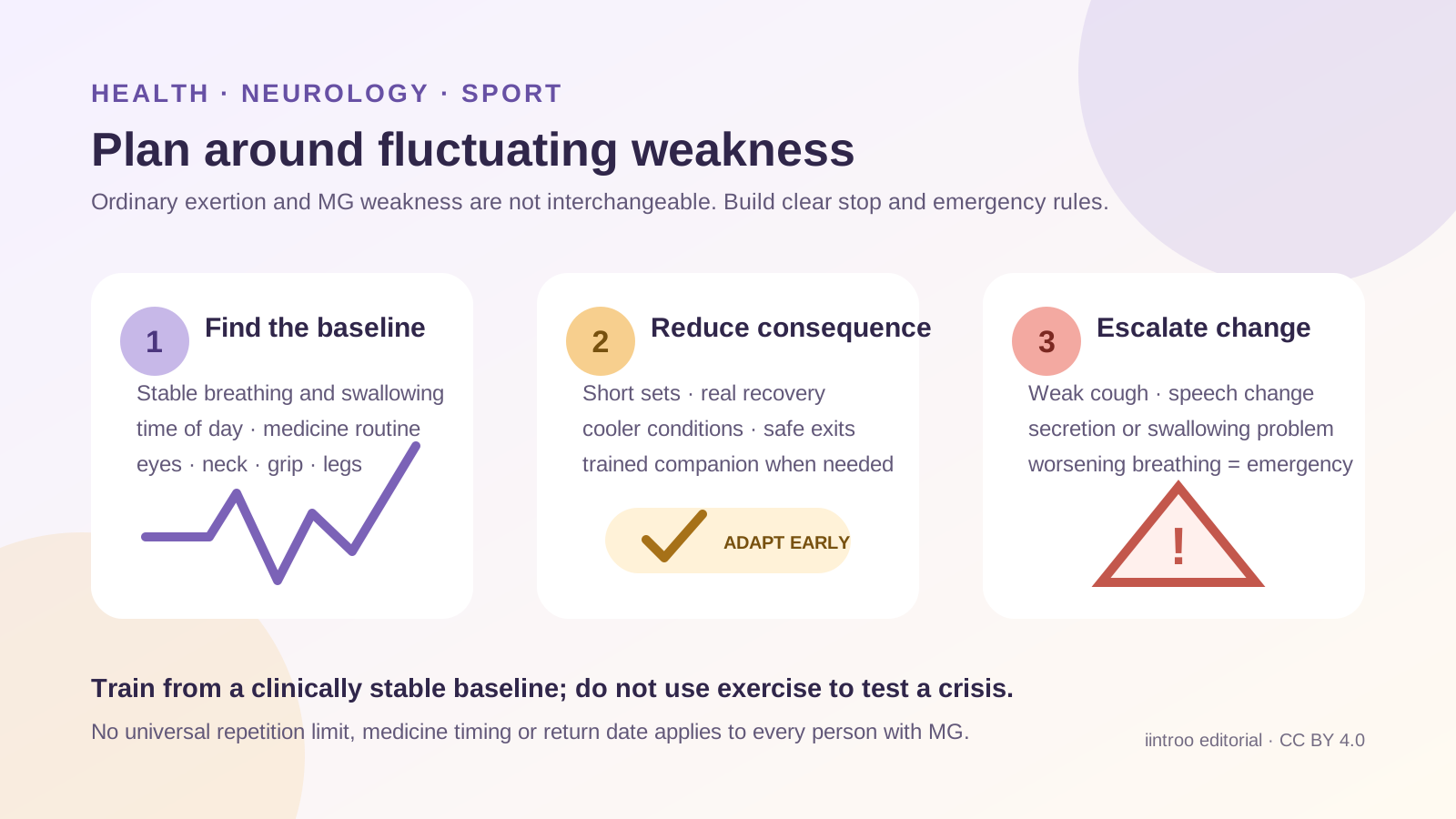
- Myasthenia gravis causes fluctuating, fatigable weakness; a change in breathing or swallowing is not ordinary training fatigue.
- Small trials suggest individually adapted exercise can be feasible in selected people with clinically stable disease, but evidence remains limited.
- Worsening severe breathing or swallowing difficulty can signal myasthenic crisis and requires emergency medical help.
Distinguish fatigable weakness from ordinary effort
This guide is for athletes with diagnosed myasthenia gravis and for support teams working with consent. MG is an autoimmune disorder of neuromuscular transmission. Weakness can fluctuate, worsen with repeated use and improve with rest, often affecting the eyes, face, speech, swallowing, neck, limbs or breathing muscles. That pattern is different from the expected burning or tiredness of a hard set. A coach should record the task, time of day, heat, recovery and affected function, not diagnose the cause or tell an athlete to overcome weakness through effort.
Severe or worsening breathing or swallowing difficulty needs emergency medical help because it may represent myasthenic crisis. A weak cough, inability to handle secretions, rapidly changing speech, marked neck weakness or an unusual inability to count or speak normally can also be important. Do not send the athlete home alone, ask them to complete a session as a test, or rely on a wearable oxygen value to exclude respiratory muscle weakness. The athlete and club should have an accessible emergency plan based on clinical advice.
Use the evidence without overstating it
Two 2026 systematic reviews found that aerobic, resistance, combined and respiratory-muscle programmes were generally feasible or well tolerated in selected participants with predominantly stable, mild-to-moderate MG. Some outcomes in strength, function, respiratory performance or quality of life improved, while several controlled outcomes were null or imprecise. Trials were small, short and heterogeneous. They do not prove safety during unstable disease, significant bulbar weakness, impending crisis or every competitive environment.
International consensus guidance supports considering physical training as part of management rather than treating activity as automatically harmful. The useful question is not whether all exercise is good or bad; it is what the athlete can do safely today, with what recovery and what stop rules. Begin from a clinically stable baseline and use an individual plan. Do not copy a trial's intensity, respiratory device or schedule without specialist input, and do not present exercise as a replacement for pyridostigmine, immunotherapy or another prescribed treatment.
Design sessions around fluctuation, heat and consequence
Schedule demanding work at the athlete's more reliable time of day and around prescribed medicines only as agreed with the neurology team. Break a long task into shorter sets, allow real recovery and keep technique-sensitive or high-consequence drills away from the point at which weakness usually appears. Heat can worsen symptoms for some people, so use shade, cooling, lighter kit and a lower environmental load. Fatigue is also affected by sleep, infection and travel; changing symptoms deserve review rather than an automatic increase in conditioning.
Sport-specific consequence matters. Sudden neck, grip, leg, eye or respiratory weakness creates different hazards in open-water swimming, road cycling, climbing, free weights or a supervised machine exercise. NHS guidance specifically advises against swimming alone when sudden weakness is possible. Use a trained companion, accessible exit and communication plan where a loss of function could become dangerous. Double vision can affect depth judgement; swallowing problems change the safety of eating or drinking quickly during exercise. These adaptations should be private, practical and reviewed as symptoms change.
Protect treatment and make return criteria functional
MG medicines can be time-critical, and infections or some medicines can worsen symptoms. Athletes should carry an accurate medication list and make treating clinicians aware of MG before new prescriptions, surgery or urgent care. A coach must not advise delaying pyridostigmine, changing immunosuppression, using stimulants to mask weakness or adding a supplement. The athlete should discuss anti-doping administration separately with an official medication-checking service; medical appropriateness and sport eligibility are different questions.
After an exacerbation, infection or treatment change, return should be based on stable breathing and swallowing, reliable daily function, repeatable low-consequence exercise and recovery without progressive weakness. Add duration, intensity and technical consequence separately. There is no universal heart-rate zone, repetition limit or number of rest days for MG. This page provides general education, not diagnosis, medication timing, respiratory training, emergency clearance or a personal return-to-sport decision.