
Parkinson's disease in sport: train with a plan for freezing, falls and changing function
Exercise can support function in Parkinson's disease, but freezing, falls, blood-pressure changes and medication response require an individual safety plan.
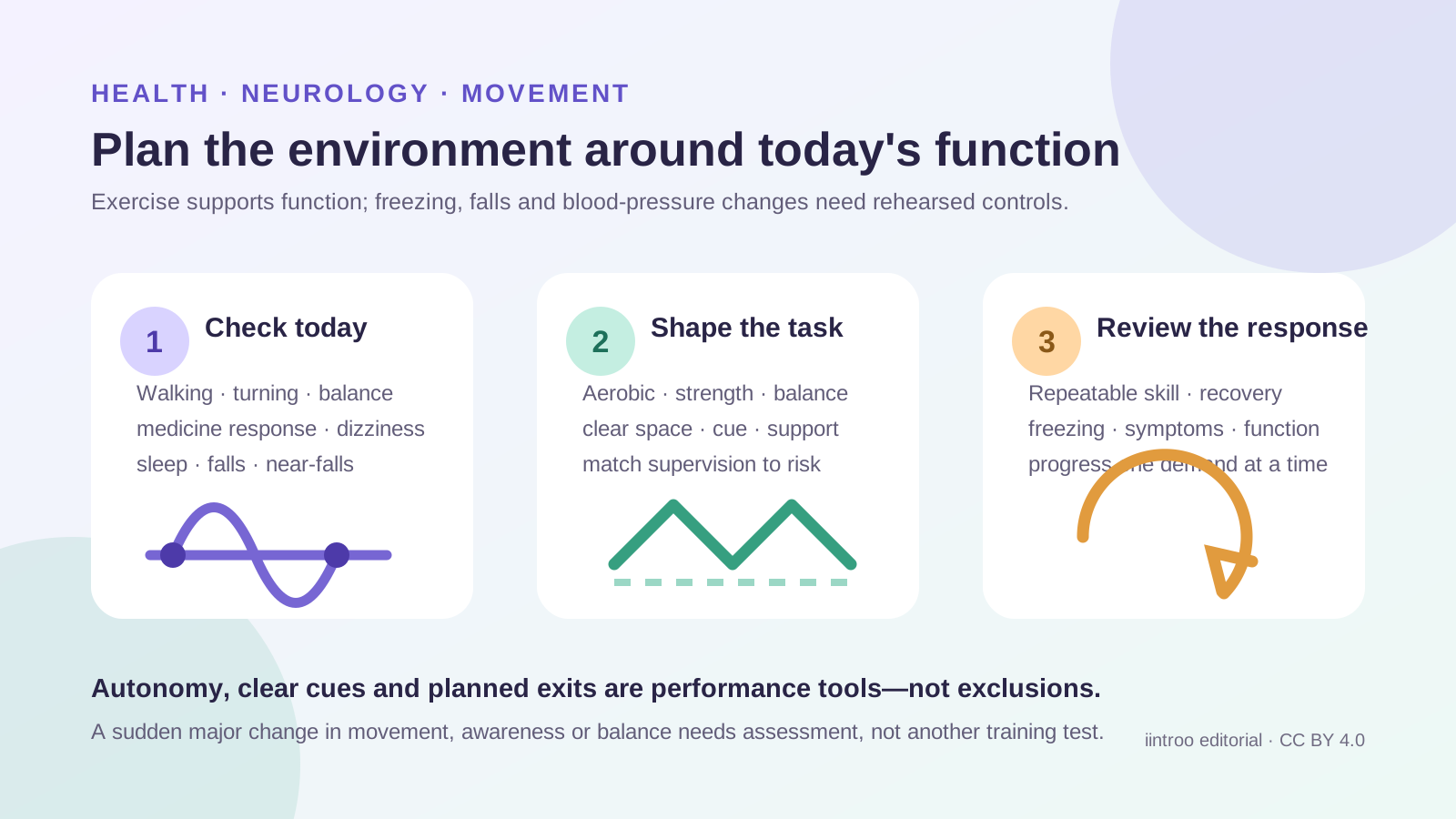
Key points
- Aerobic, resistance, balance and task-specific exercise can support function in Parkinson's disease, but they do not replace prescribed treatment.
- Freezing, falls, low blood pressure and an inconsistent response to medication change the consequence of cycling, water, heights and busy training spaces.
- A sudden or marked change in movement, consciousness, speech, weakness or balance needs medical assessment rather than being labelled routine Parkinson's fluctuation.
Start with today's function, not the diagnosis alone
This guide is for people with Parkinson's disease who want to keep training or competing, and for coaches working with the athlete's permission. Parkinson's can affect movement speed, stiffness, balance, gait, speech, thinking, sleep, mood and automatic body functions. Symptoms may fluctuate across the day and with medicine response. One diagnosis therefore does not produce one permanent exercise ceiling, and a good day does not prove that every environment is safe without adaptations.
The 2026 Parkinson's Foundation and American College of Sports Medicine recommendations include aerobic, strength, balance, agility, multitasking and stretching work, while the APTA clinical practice guideline supports aerobic exercise, resistance training, balance work, external cueing and gait training. These are categories for an individual programme, not a competitive clearance test. A Parkinson-specialist physiotherapist can assess walking, turning, transfers, balance, cardiovascular response and the practical demands of the chosen sport.
Use the exercise evidence without promising disease control
A 2024 Cochrane network meta-analysis found evidence that many types of physical exercise may improve motor signs, quality of life, functional mobility or balance compared with inactive control. However, studies differed in intervention, duration and participants, adverse-event reporting was incomplete, and people with advanced disease or cognitive impairment were underrepresented. The review was amended in April 2024 after an error in earlier continuous-outcome analyses was corrected. That history is a reason to use the current version and communicate uncertainty clearly.
Exercise should sit beside neurologic care, not replace levodopa or another prescribed treatment. The timing and reliability of an 'on' period may influence when a technical session is practical, but a coach should not change medicine timing or dose. Record the activity, time, symptoms, falls or near-falls and recovery so the clinical team can see patterns. Claims that boxing, dance, cycling or another single activity halts neurodegeneration go beyond the evidence; the useful goal is sustainable participation and function.
Build controls for freezing, falls and automatic-function symptoms
Freezing can feel as though the feet are stuck, especially when starting, turning, approaching a doorway, changing surface or managing stress. It increases fall risk. Agree simple cueing and stop rules with the athlete and therapist, keep turning space clear, reduce time pressure and avoid pulling a person who has frozen. Low blood pressure, blunted heart-rate response, heat intolerance or fatigue can make a standard wearable target misleading. Use symptoms, perceived effort and the clinician's plan rather than assuming a predicted maximum heart rate is accurate.
Match supervision to consequence. A fall on a studio floor is different from freezing beside traffic, on stairs, near free weights or at a pool edge. Tandem or stationary cycling, a lane position, visible floor cues, hand support, a trained partner or a quieter session may reduce risk without excluding the athlete. Swimming and open water need an exit and supervision plan. New fainting, chest pain, severe breathlessness, confusion, one-sided weakness, a major head impact or inability to recover normally calls for urgent assessment.
Progress from repeatable function and review the whole plan
Progress one demand at a time: duration, resistance, speed, dual-task complexity, unstable surface or environmental consequence. Review whether the athlete can repeat the session with acceptable recovery, not merely complete it once. A fall, infection, medicine change, increasing freezing or a decline in daily function should trigger reassessment. Equipment and instruction should support autonomy: concise cues, time to respond, accessible routes and consent before physical assistance are part of good coaching, not special favours.
There is no universal heart-rate zone, medicine schedule, balance score or number of fall-free days that clears every person with Parkinson's disease. NICE recommends access to Parkinson-specific physiotherapy when balance or motor problems occur, and the exercise plan should evolve with function and goals. This page provides general education, not diagnosis, medication advice, emergency clearance, a fall-prevention prescription or an individual return-to-sport decision.