
Masters athletes: strength and balance still need deliberate training
Endurance or competition experience does not automatically preserve strength, power or balance. Review the gaps, progress the work and separate public-health guidance from an individual sport programme.
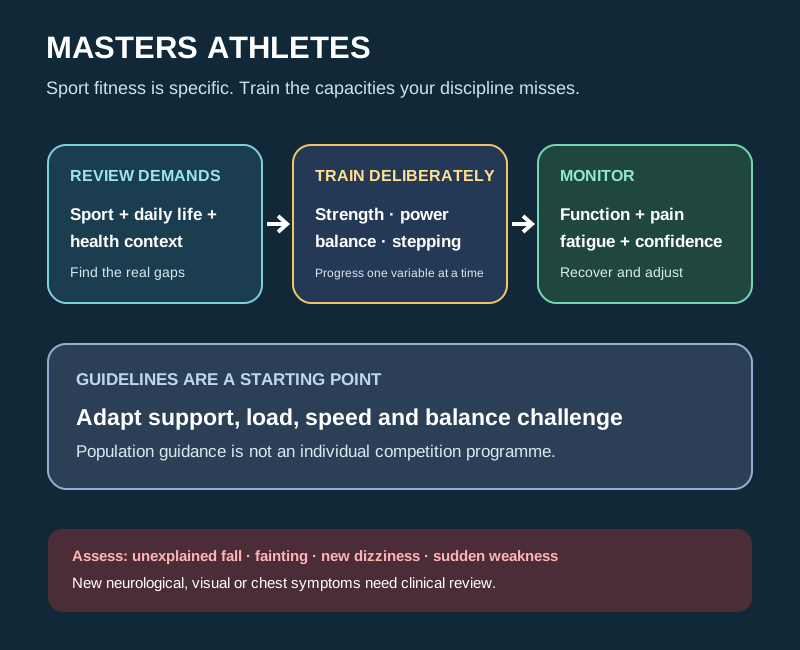
Key points
- Regular sport participation does not guarantee that an older athlete trains strength, rapid force, balance and bone-loading capacities needed outside their main discipline.
- WHO guidance supports multicomponent activity with strength and functional balance work for older adults, but it is a public-health framework rather than a personal competition programme.
- A recent fall, unexplained weakness, dizziness, new neurological symptoms or pain that changes movement needs assessment before simply adding harder drills.
Sport fitness is specific
This guide is for older competitive and recreational athletes, including people returning after a long break. A cyclist may have excellent endurance but little practice recovering from a trip. A swimmer may train frequently without loading the legs or skeleton in the same way as land-based work. A thrower may be strong yet avoid single-leg balance tasks.
Start with the actual demands: accelerating, decelerating, stepping over obstacles, carrying equipment, getting up from the ground and tolerating daily-life tasks as well as sport technique. Chronological age alone does not describe capacity, and a masters category includes wide differences in health, training history and disability.
Use guidelines as a floor for discussion
WHO recommends that older adults include muscle-strengthening activity and varied multicomponent work emphasising functional balance and strength, alongside aerobic activity. For people with poor mobility, regular balance-focused work is especially relevant. These are population recommendations, not a set-and-repetition prescription or a rule that every athlete must add the same sessions.
A useful programme identifies what the main sport already provides and what it misses. The missing dose might be lower-body strength, rapid but controlled force production, multidirectional stepping or recovery from perturbation. A qualified strength and conditioning professional or physiotherapist can adapt exercises to equipment, pain, vision, hearing, prostheses and competition goals.
Progress resistance rather than chasing exhaustion
Meta-analyses of supervised trials show that resistance training can improve strength, physical function and muscle size in older adults. The 151-trial network meta-analysis found benefits even with lower training volume for several functional outcomes, while greater volumes were not automatically best for every result. Most evidence concerns general older-adult samples rather than seasoned masters competitors.
Technique, load, range, speed, weekly exposure and recovery can be progressed separately. Begin at a level that allows repeatable movement and leaves room to learn. Persistent joint pain, a marked loss of function or accumulating fatigue should trigger review rather than automatic load increases.
Power and balance require their own practice
Avoiding a fall can require force to be produced quickly, but high-velocity training is not simply moving a heavy load as fast as possible. A 2023 systematic review found broadly similar functional effects to traditional resistance training, with low-quality evidence and uncertainty for many outcomes. That supports careful inclusion where appropriate, not a claim that one method is superior.
Balance practice should match the athlete's environment without creating unmanaged fall risk. Stable support, a spotter, handhold or harness may be appropriate during progression. Dual-task, uneven-surface or fatigue challenges belong later, if at all, and should not be copied from social media without assessing the person and the consequence of a missed step.
Know when training is not the only answer
A recent unexplained fall, fainting, new dizziness, sudden weakness, altered sensation, new visual disturbance, chest symptoms or pain that changes walking needs clinical assessment. Medication effects, blood pressure, neurological conditions, vision, vestibular function and footwear can matter; more balance drills cannot resolve every cause.
After illness, surgery or a fall, return to sport should integrate medical recovery, strength, confidence and the hazards of the event. This article does not diagnose fall risk, provide a personal exercise prescription or promise that training will prevent every fall or injury.