
Rheumatoid arthritis in sport: adjust joint load without prescribing permanent rest
Exercise belongs in rheumatoid arthritis care, but active joints, systemic symptoms, treatment and sport demands should shape each training decision.
Key points
- Exercise is recommended as part of rheumatoid arthritis care, alongside—not instead of—disease-modifying treatment.
- A flare calls for changes based on the affected joints and systemic health, not an automatic permanent ban on impact or strength work.
- A hot swollen joint with fever or feeling acutely unwell needs urgent assessment because infection can mimic or accompany a flare.
Put movement beside disease control, not in its place
This guide is for athletes with rheumatoid arthritis and for coaches or support staff working with permission. RA is a systemic inflammatory disease that can cause joint pain, swelling and stiffness as well as fatigue and effects beyond the joints. Early and effective disease-modifying treatment matters because inflammation can damage joints. Exercise can improve health and function, but it is an adjunct to medical care; a training plan cannot diagnose a flare, suppress disease activity or replace a disease-modifying antirheumatic drug.
The American College of Rheumatology's 2022 integrative guideline strongly recommends consistent exercise for people with RA, with type, frequency, intensity and duration tailored to the person. The 2026 EULAR update likewise treats physical activity as integral to care for inflammatory arthritis and osteoarthritis. These recommendations include aerobic, resistance, aquatic and mind-body options, but they are not elite-sport selection rules. An athlete's disease activity, joint structure, cardiovascular health, bone health, medicines, experience and competitive goal still need individual consideration.
Map the flare and the joint before changing the whole programme
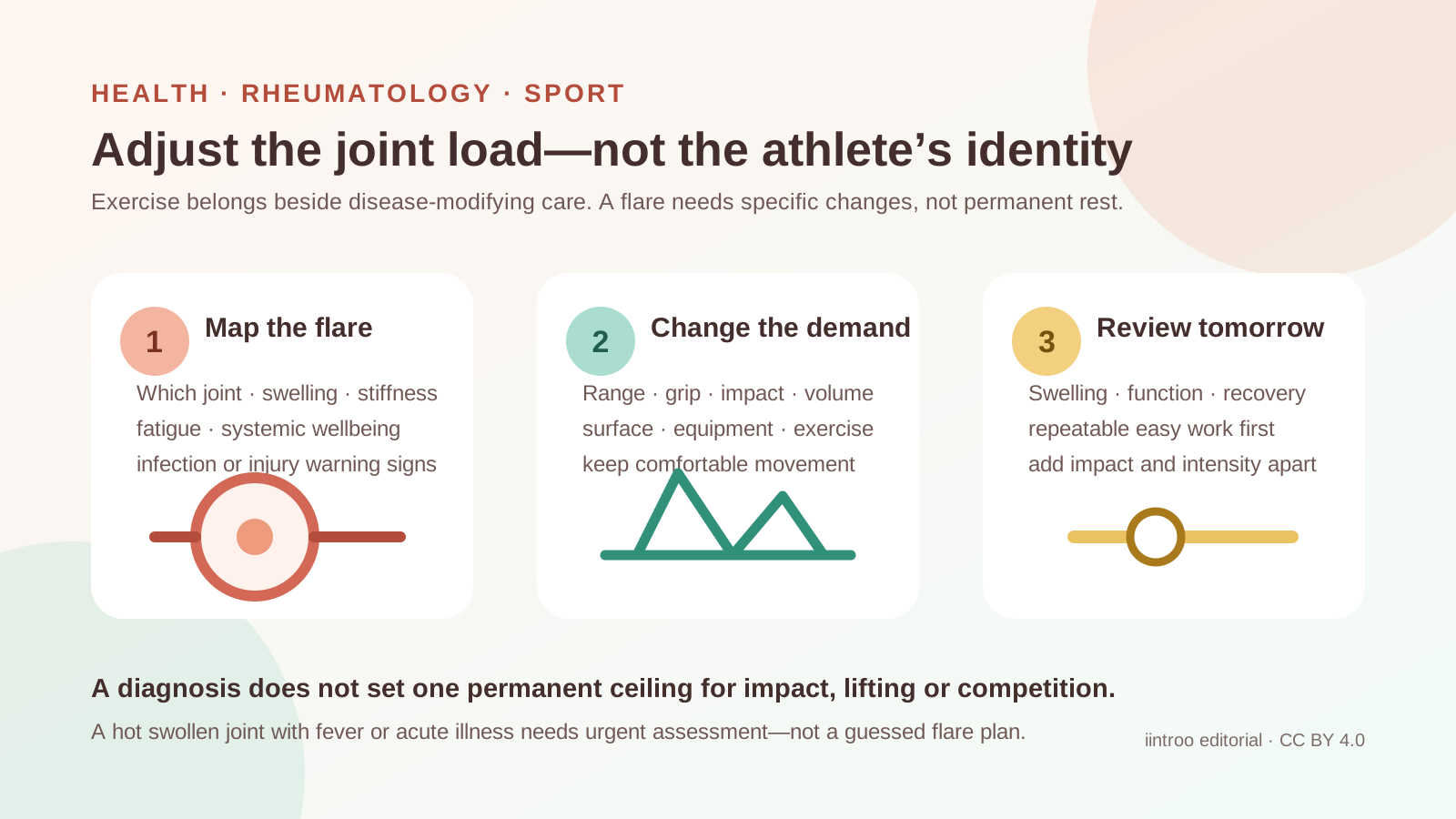
A flare may involve increased joint swelling, stiffness, pain, fatigue or a general unwell feeling. Identify which joints and tasks are affected. A swollen wrist changes a barbell, racket or hand-cycle decision; an inflamed forefoot changes running and jumping; marked fatigue may change total load even when one joint feels acceptable. Reduce the provocative range, impact, grip or volume, use another movement pattern where appropriate and keep comfortable movement rather than declaring indefinite rest. One symptom score cannot represent every tissue or sport consequence.
Do not assume that every hot, swollen joint is simply RA. Fever, chills, acute illness, a very painful hot joint, a wound or recent procedure can raise concern for infection and needs urgent assessment, particularly when immune-modifying treatment is used. New neurological symptoms, major trauma, chest pain, severe breathlessness or fainting also need prompt care. Steroids should not be started, increased or injected on a coach's advice; they can have important adverse effects and may mask or aggravate infection.
Progress load by response and preserve sport-specific capacity
When disease is controlled, build training with the same principles used elsewhere: a repeatable baseline, gradual progression, adequate recovery and attention to technique. Resistance work can support strength, function and bone health; aerobic work supports cardiovascular health, which is especially relevant in RA. Low-impact options may be useful during a symptomatic period, but they are tools rather than a permanent ceiling. If the athlete wants to run, jump or lift, assess the actual joint response and progress the relevant capacity instead of assuming that diagnosis alone prohibits impact.
Track next-day swelling, stiffness, pain, fatigue and function, not only how a joint feels while warm. A brief symptom increase is not automatically joint damage, but a persistent step-down in function or progressive swelling warrants load reduction and clinical review. Equipment, grip size, footwear, range, surface and exercise order can redistribute stress. A physiotherapist or occupational therapist can help where hand function, splinting, joint protection or technique adaptation matters. Evidence in competitive and para athletes is sparse, so transfer from general RA studies should remain cautious.
Coordinate medicines, infection risk and return decisions
Follow prescribed RA treatment and monitoring. Some medicines alter infection risk, vaccination planning, wound care or perioperative decisions; the rheumatology team should advise on illness and medication changes. Do not skip a dose to compete, double a dose after travel, use another person's anti-inflammatory medicine or add a supplement promoted as a replacement for DMARDs. Tested athletes should verify current anti-doping rules through an official medication-checking service without letting the administrative check substitute for medical review.
Return after a flare or infection should combine systemic wellbeing, control of swelling, useful range and strength, tolerance of easy sport-specific work and recovery over repeated sessions. Add high-load, impact, contact or technical consequence separately. There is no universal pain score, inflammatory-marker value or waiting period that clears all athletes with RA. This page provides general education, not diagnosis, medicine or steroid advice, imaging interpretation, anti-doping ruling or a personal training and return prescription.