
von Willebrand disease in sport: plan impact, bleeding and menstrual health together
Sport can support people with von Willebrand disease, but bleeding pattern, collision exposure, treatment access and menstrual health need one shared plan.
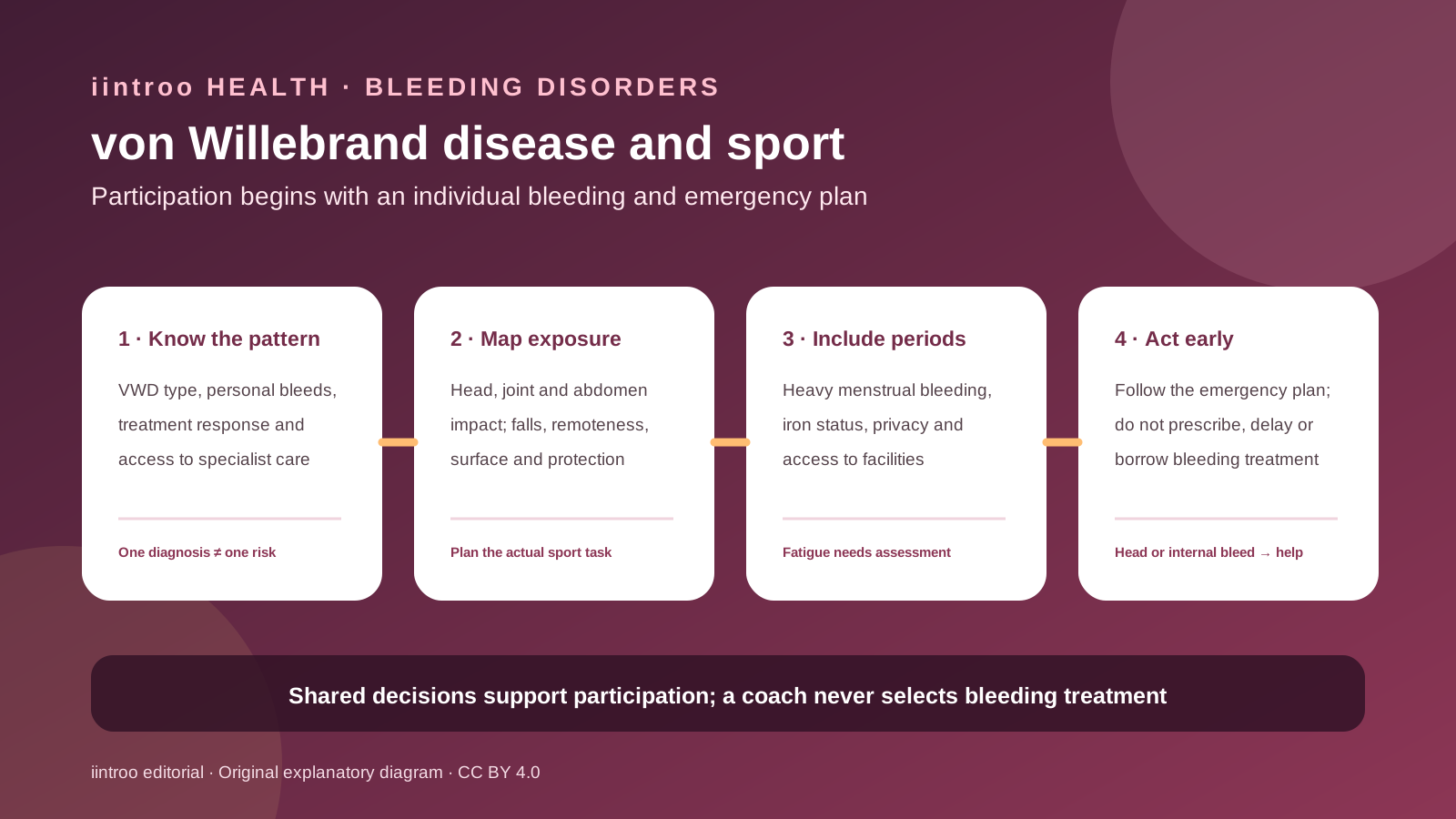
Key points
- von Willebrand disease varies by type and bleeding phenotype; a diagnosis alone does not create one list of permitted sports.
- A significant head, abdominal or joint impact, persistent bleeding or neurological change needs the athlete's emergency pathway, not a coach's test.
- Heavy menstrual bleeding and iron deficiency can affect health and performance and deserve confidential clinical assessment.
Start with the person's bleeding pattern and actual sport exposure
This guide is for athletes with diagnosed von Willebrand disease, families, coaches and health teams. VWD is an inherited bleeding disorder involving von Willebrand factor, but type, laboratory pattern and bleeding experience vary. Some people mainly report nose or menstrual bleeding; others have prolonged bleeding after injury, dental work or surgery. The athlete's own history, current treatment and access to specialist care therefore matter more than a generic label of contact or non-contact sport.
The ASH, ISTH, NHF and WFH guideline repeatedly emphasises individualized treatment and shared decisions because evidence certainty is limited for many questions. A sport review should map the probability and consequence of head, abdominal, joint, mouth and skin impacts; remoteness from care; protective equipment; travel; and the athlete's usual response plan. Swimming, cycling and basketball do not carry one fixed risk for every setting. Surface, speed, traffic, falls, opposition and supervision change the exposure.
Build an emergency plan before an impact happens
The athlete should have a clinician-developed plan stating whom to contact, where prescribed treatment is kept and which events require urgent assessment. A significant head or neck impact, severe or worsening headache, vomiting, confusion, weakness, seizure, loss of consciousness, increasing abdominal pain, a rapidly enlarging swelling, persistent bleeding or a painful swollen joint should not be managed by repeated sideline testing. Emergency services and the treating haemophilia centre may both be needed according to the local plan.
Coaches must not advise desmopressin, factor concentrate, tranexamic acid or another medicine, and they must not change timing to fit a match. Treatment response differs by VWD type and person; desmopressin is ineffective or unsuitable in some circumstances. Avoid aspirin and non-steroidal anti-inflammatory drugs unless the treating clinician has specifically advised their use. Record the injury and symptoms, remove the athlete from further risk and provide the emergency information to qualified clinicians.
Treat menstrual bleeding and iron status as athlete health
Heavy menstrual bleeding can be a major part of VWD and may contribute to iron deficiency or anaemia. The 2021 management guideline recommends regular assessment and treatment of iron deficiency and supports joint haematology and gynaecology care where feasible. Fatigue, breathlessness, dizziness, reduced recovery or falling performance should not be dismissed as poor conditioning, but those symptoms are not specific and require proper assessment rather than an automatic iron supplement.
Provide a private way to report symptoms, access toilets and changing facilities, carry supplies and leave a session without public explanation. Menstrual history should not be demanded in front of teammates or used to question selection. Hormonal therapy, tranexamic acid, an intrauterine system and iron treatment are clinical choices that depend on bleeding, goals, contraindications and preferences. The sport team can protect access and confidentiality without prescribing care.
Progress participation with evidence limits in view
Physical activity supports fitness, strength, confidence and participation, while research specifically in VWD remains limited. Observational work shows people with VWD take part across low-, intermediate- and higher-impact activities, but sport categories cannot predict an individual's bleed. Build conditioning and technique, use sport-appropriate certified protection, teach safe falling or landing where relevant and review the plan after a bleed, treatment change or transition to a new competition level.
Return after a significant bleed or injury should follow the treating team's assessment and restore ordinary function before higher impact, speed, fatigue or competition consequence. There is no universal factor level, number of symptom-free days or protective item that clears every athlete. This page provides general education, not diagnosis, medicine selection, menstrual treatment, iron dosing, emergency treatment instruction or personal eligibility and return-to-sport clearance.