
Testicular impact in ball and contact sports: severe pain needs urgent assessment
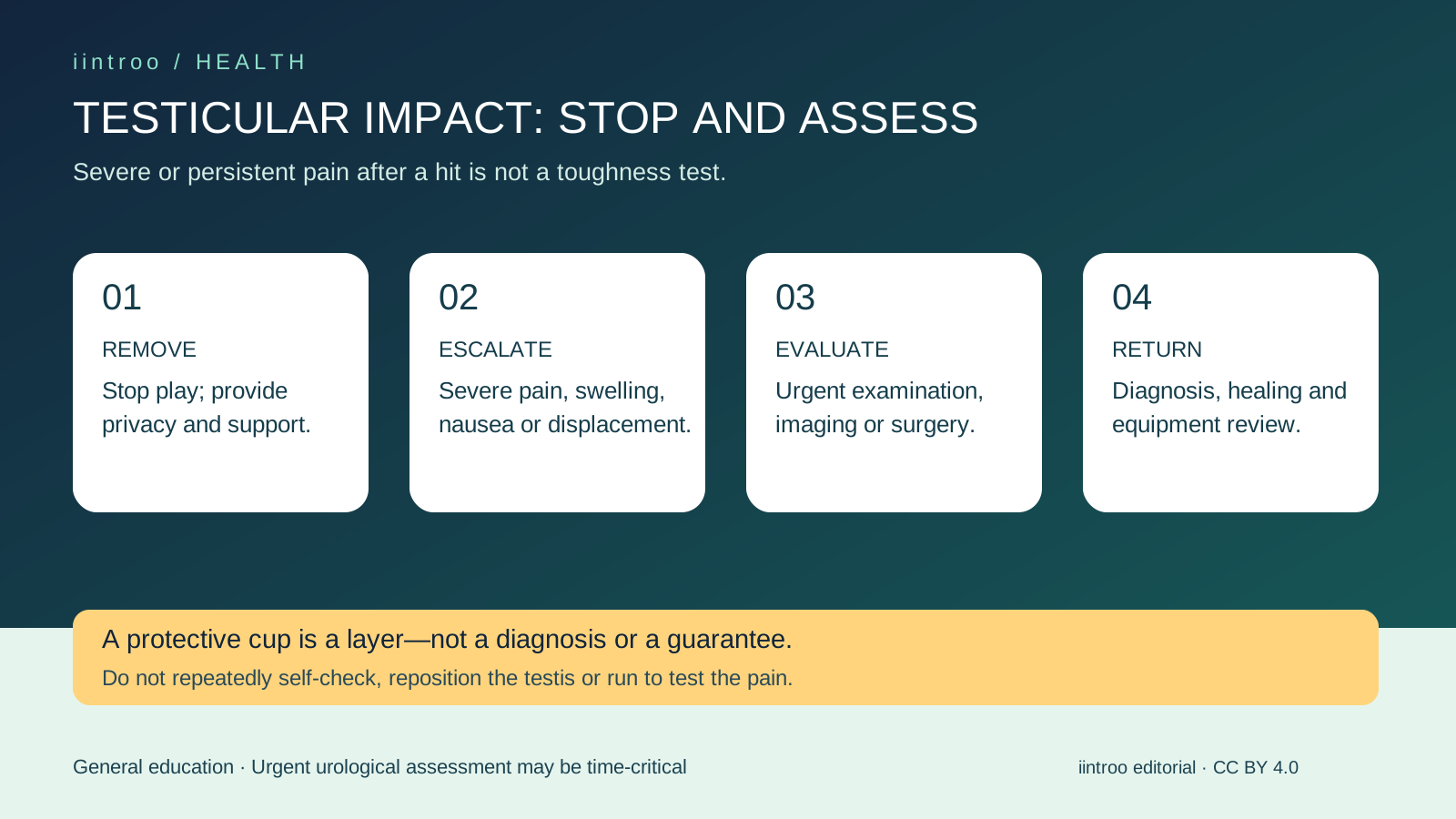
A direct blow can cause more than temporary groin pain. Stop play, avoid repeated self-checking and seek urgent assessment for severe or persistent symptoms.
Key points
- Severe or persistent testicular pain and swelling after impact require urgent assessment.
- Examination and ultrasound may help, but suspected rupture can still require surgical exploration.
- A protective cup is a reasonable layer for exposed sports, yet direct effectiveness evidence is limited.
Do not normalise pain after a direct hit
This guide is for athletes, parents, coaches and first-aiders in cricket, baseball, lacrosse, hockey, combat sports and other activities where a ball, stick, opponent or equipment can strike the groin. Pain may settle after a minor impact, but the early appearance does not reliably show whether the testis, its covering, blood supply or surrounding structures are injured. Embarrassment must not delay reporting.
Stop play and provide a private, respectful assessment area. Severe pain, rapidly increasing swelling, marked bruising, nausea or vomiting, a testis that seems displaced, an open wound, blood in the urine, difficulty urinating, faintness or pain that persists rather than clearly improving needs urgent medical evaluation. Do not repeatedly squeeze the area, attempt to reposition a testis or ask the athlete to run as a test.
Why time and specialist assessment matter
The 2026 European Association of Urology guideline recommends ultrasound for testicular trauma and surgical exploration when rupture is present or imaging is inconclusive. Ultrasound can assess structure and blood flow, but interpretation depends on technique and the clinical picture. A normal-looking scrotum or partial relief after ice and support does not independently exclude a significant injury.
Trauma can also resemble or coincide with testicular torsion, in which blood flow is compromised. Both are time-sensitive problems. Sideline staff do not need to decide which diagnosis is present before arranging care. The practical task is to recognise symptoms that are too severe, persistent or abnormal for watchful waiting and to communicate the mechanism, timing and changes during transport.
Use survey data without exaggerating the risk
A 2014 survey of 731 male high-school and college athletes found self-reported testicular injury across several sports, while reported athletic-cup use was uncommon. The response rate, retrospective recall and broad definition of injury limit precision. The percentages should not be presented as the probability that one cricketer, baseball player or wrestler will be injured this season.
A published college baseball case illustrates that a high-speed ball impact can cause presumed rupture and require urgent surgery. A case report demonstrates possibility and clinical decision-making, not incidence. Together, these sources support prompt reporting and preparedness. They do not prove that every painful impact is a rupture or that one equipment choice prevents all serious outcomes.
Treat protection as a layer, not a guarantee
A well-fitting athletic cup or sport-specific groin protector is a reasonable protective layer when rules allow and impact exposure is foreseeable. It should be the correct size, remain in position during the sport and be checked for cracks, sharp edges or deformation. Youth athletes need fit reviewed as they grow. Equipment should not interfere with movement or create pressure that the athlete feels unable to report.
Direct evidence that cups reduce the incidence or severity of testicular injury is limited, and the 2014 survey did not test effectiveness. Do not turn a sensible precaution into a guaranteed claim. Technique, rules, safe spacing, ball control, coaching and prompt medical response remain important. A cup also does not make severe pain after an impact safe to ignore or provide clearance to continue.
Return only after the actual injury is defined
Return depends on the diagnosis, treatment, healing, pain, swelling, examination and sport demands. There is no evidence-based universal number of days for every contusion, haematoma, torsion or repaired rupture. The treating urology or surgical team should explain activity limits and follow-up. An athlete who still needs pain medicine to tolerate running, contact or protective equipment has not established readiness by finishing a drill.
Before resuming exposure, review protector fit, communication and the route to urgent care at training and competition venues. Recurrent pain, new swelling, fever, urinary symptoms or a change in testicular position needs reassessment. Teams should make private reporting routine and avoid jokes or pressure. This article provides general education; it does not diagnose an injury, prescribe treatment or set an individual return date.