
Pointe readiness in ballet: age alone cannot clear a dancer
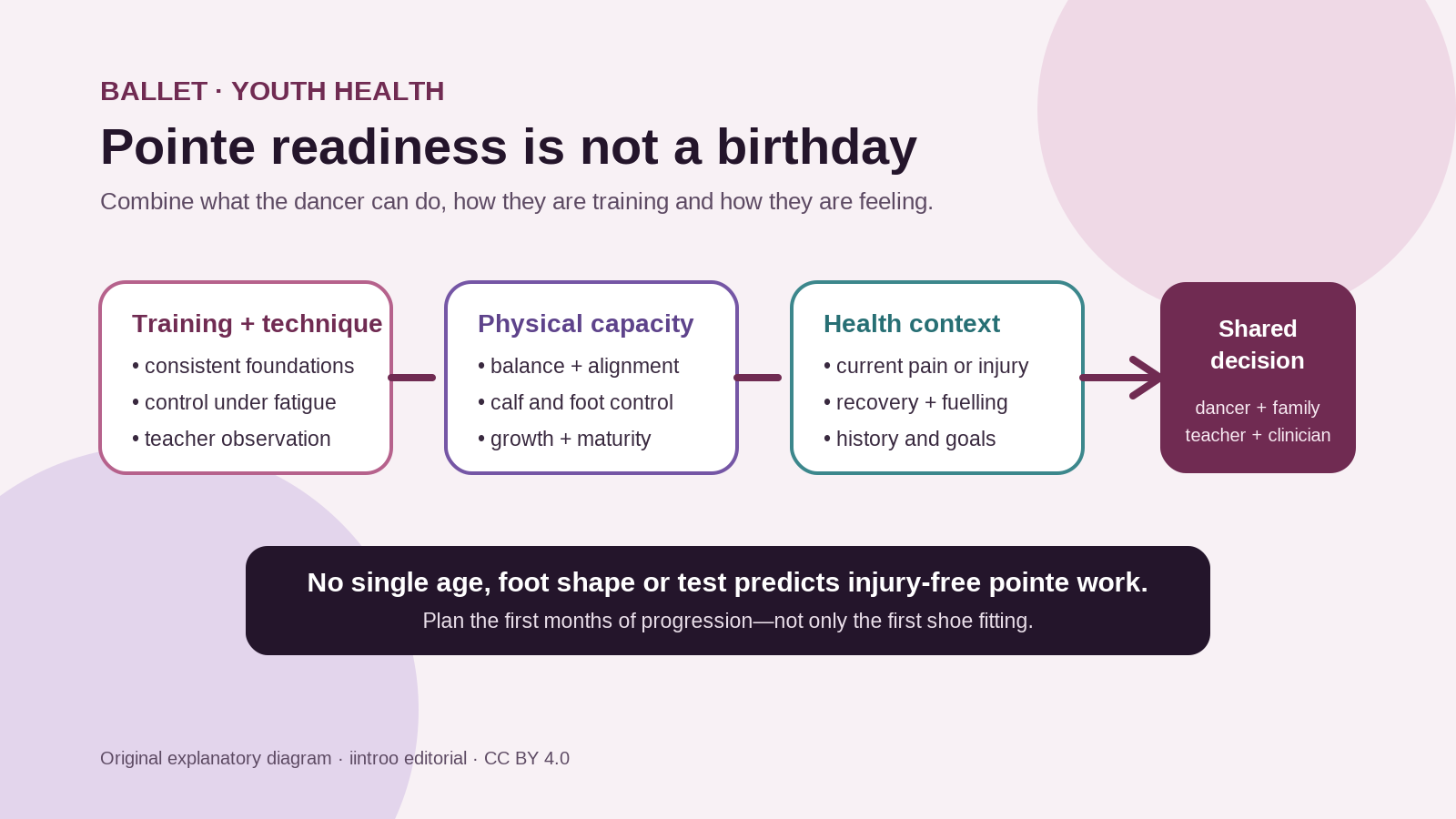
Starting pointe work should combine training history, technique, strength, control, health and injury context. No single age or test can provide clearance.
Key points
- Chronological age is one part of readiness; training quality, technique, physical capacity, maturity, health and injury history also matter.
- A 2026 expert consensus identified many relevant criteria, but no validated universal test battery or cut-off predicts injury-free pointe work.
- The teacher decides technical progression while a qualified health professional assesses pain, injury and medical concerns; neither role replaces the other.
Treat pointe as a training progression, not a birthday
This guide is for young ballet dancers, parents, teachers, school leaders and health professionals discussing a first move to pointe shoes. Pointe work concentrates load through the foot and ankle while demanding alignment, control and technique across the whole body. The decision is therefore about readiness for a particular training demand, not whether a dancer has reached a universally safe birthday. Age can inform maturity and training context, but dancers of the same age can differ greatly in experience, growth, strength, coordination and current health.
The recent consensus study grouped readiness into technique and skill, balance and control, training and experience, range of motion, strength, alignment, general health, age and maturity, injury history and dancer goals. Forty-eight of 99 proposed criteria reached expert consensus. That breadth is useful because it prevents a single ankle measurement or classroom impression from becoming the whole decision. It also shows why a web checklist cannot clear a child to start pointe.
Use tests as information, not pass-or-fail prophecy
Functional studies have examined heel raises, single-leg balance, sauté, airplane, relevé passé and other dance tasks. In a study of 37 pre-pointe students, three dynamic tests were associated with teachers' readiness ratings. A later pilot screen involved only 17 dancers aged 9 to 17 and two physician raters; it found good agreement for the overall screen. Agreement means the raters applied that tool consistently in that small setting. It does not prove that passing prevents injury or establishes a universal threshold.
The 2026 consensus found strong agreement around calf capacity, balance and control and injury history, yet recommended repetition counts varied substantially. The authors explicitly noted inconsistent assessment methods and the need to validate measures against meaningful outcomes. A systematic review similarly found a limited and heterogeneous evidence base. Schools should avoid presenting an adult-company heel-rise number, foot-shape rule or social-media test as a scientifically proven gate for every adolescent.
Combine teacher judgement with health assessment
A dance teacher can evaluate class attendance, foundational technique, movement quality, ability to follow corrections and control during fatigue. A physiotherapist, sports doctor or other appropriately qualified clinician can assess current pain, previous injury, growth-related concerns, range, strength and other health factors when needed. The consensus found that teachers tended to prioritise technique and posture while health professionals prioritised physical capacity. A coordinated conversation uses both perspectives rather than allowing either to claim complete authority over the other.
Pain is not a normal entry fee. Focal foot or ankle pain, swelling, limping, night pain, repeated giving way, neurological symptoms or a recent injury should be assessed before loading is increased. Menstrual disturbance, restrictive eating, fatigue, repeated bone injury or concern about growth and development also warrants confidential professional support. These signs do not automatically prohibit dance; they indicate that health needs should be addressed instead of hidden to secure a place in pointe class.
Plan the first months, not only the first fitting
Readiness is not completed when shoes are purchased. A school can define the initial class content, floor, supervision, frequency, progression and stopping rules; record the shoe fitting; and keep jumps, centre work, rehearsal density and other weekly load visible. Progress may begin with supported barre tasks and controlled exposure according to the teacher's programme. It should not be accelerated because a performance date, peer group or shoe cost creates pressure.
Ask what will trigger review: new pain, loss of control, a growth spurt, a training break, changed shoes or increasing class volume. The dancer should be able to report difficulty without punishment or loss of dignity. This page does not prescribe exercises, a heel-rise count, a starting age, shoe model or individual clearance. The practical decision belongs to the dancer and family with an experienced teacher and, when health questions exist, a qualified clinician.