
Baseball UCL injury: rebuild throwing by criteria, not a date
Elbow UCL rehabilitation varies by diagnosis and treatment. Pain reporting, strength, graded throwing and baseball-specific readiness matter more than copying one timeline.
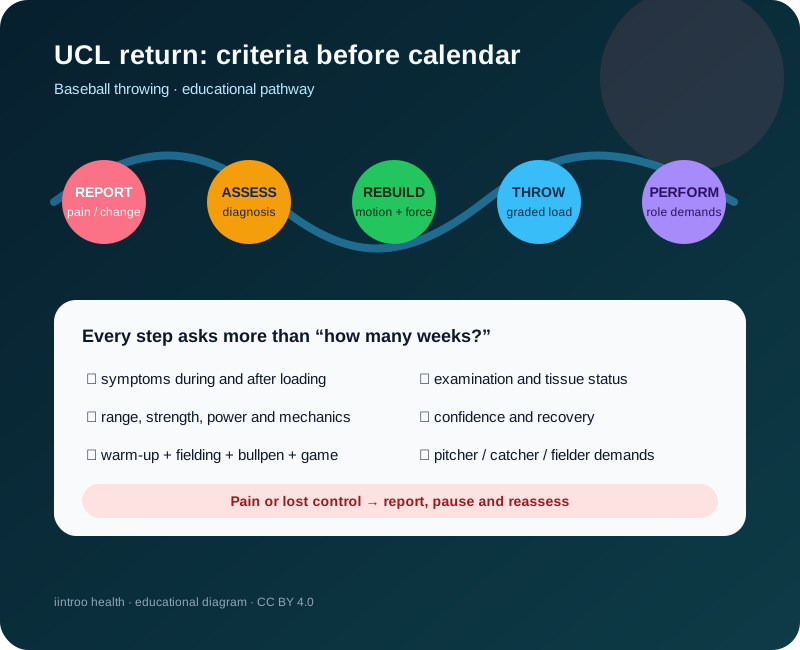
Key points
- Medial elbow pain, loss of control or falling velocity is a reason to report symptoms and obtain qualified assessment, not to throw through the problem.
- Systematic reviews find wide variation and incomplete reporting in UCL rehabilitation and return criteria; no calendar date alone proves readiness.
- A graded throwing programme must account for position, distance, intensity, pitch type, total team load and the athlete's response between sessions.
Report the elbow problem before changing the pitch
This guide is for baseball and softball throwers, families, coaches and support teams responding to medial elbow pain, loss of command, reduced velocity or an inability to recover between throwing sessions. Those features do not diagnose an ulnar collateral ligament injury. Bone, growth plate, nerve, tendon and muscle problems can overlap, particularly in younger athletes.
Stop painful high-intensity throwing and arrange assessment by a clinician familiar with throwing athletes. Sudden pain with a pop, major swelling, deformity, new numbness or weakness, colour change, or inability to move the arm needs prompt evaluation. Do not use painkillers, a brace or a few accurate pitches as permission to continue.
Diagnosis and treatment route change the plan
History, examination and appropriately selected imaging help define the injury, the athlete's skeletal maturity and whether nonoperative care, repair, reconstruction or another approach is being considered. A scan finding alone does not decide treatment or predict a successful return. Position, competitive level, previous injury, goals and the rest of the kinetic chain also matter.
The 2024 rehabilitation review covered 105 articles and 15,928 elbows, but 98% of participants were male and most were treated operatively. Protocols differed substantially. Its pooled milestones describe what published studies reported; they are not a schedule to copy into an individual plan.
Use milestones without pretending they are universal
A clinician-led programme may restore comfortable range of motion, strength, power and whole-body throwing capacity before an interval throwing progression. The 2021 review found that most studies still relied heavily on time after surgery and none completely defined return-to-sport criteria. A 2026 review likewise found inconsistent use of physical, imaging, performance and psychological measures.
Useful decisions can combine symptoms during and after loading, examination findings, strength and power, throwing mechanics, confidence, recovery and completion of progressively representative baseball tasks. Each result answers only part of the question. Normal strength in the clinic does not recreate repeated high-velocity pitching under fatigue.
Count every throw in the progression
Track warm-up, long toss, flat-ground work, bullpen, fielding throws, showcases and innings across every team. Progress distance, volume and intensity deliberately rather than changing several at once. Pitchers then need mound work, pitch-shape and game-like exposure; catchers, infielders and outfielders require different distances, footwork and repetition patterns.
Pain, stiffness, loss of control, altered mechanics or poor recovery should be reported before the next increase. The coach and medical team may pause, step back or reassess. Completing one interval-throwing session without symptoms is useful information, not clearance for unrestricted competition.
Separate prevention advice from a return prescription
Pitch Smart and the American Sports Medicine Institute emphasise rest, workload communication and avoiding fatigued pitching. Those principles can support arm health, but no workload rule guarantees that a UCL injury will not occur, and youth pitch-count guidance is not a post-injury rehabilitation protocol.
This article provides general education. It does not diagnose an elbow injury, choose surgery, prescribe throwing volume or clear an athlete. Return decisions belong to the athlete and a qualified treating team using the current rules and demands of their competition.