
Youth baseball pitch counts: the limit is not the whole safety plan
Age-based counts and required rest matter, but teams must also track throwing across squads, notice fatigue and respond early to arm pain.
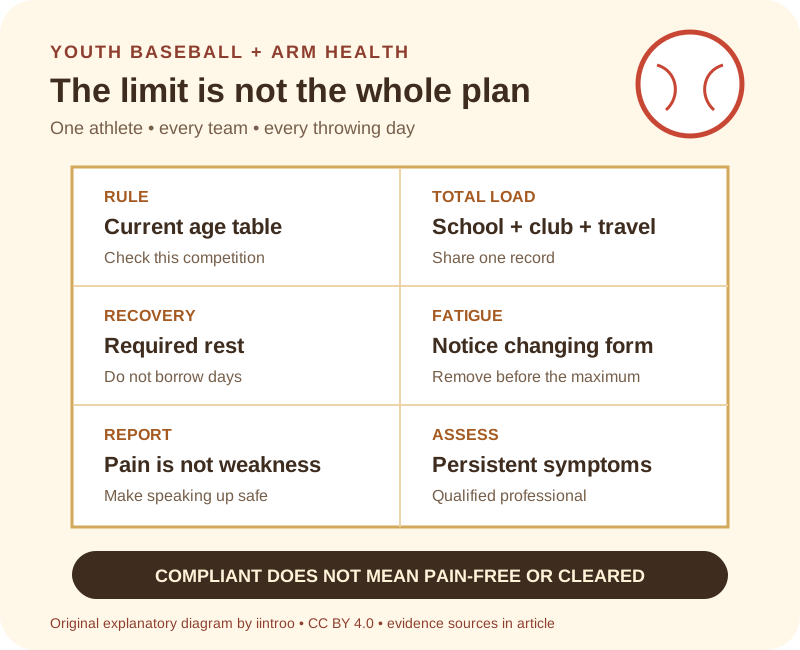
Key points
- Use the current age-specific rule for the competition being played.
- Workload follows the athlete across school, club, travel and showcase teams.
- Pain or loss of function should not be managed by hiding behind an allowable count.
Who this guide is for
This guide is for youth pitchers, parents, coaches, tournament organisers and medical staff. Pitch Smart publishes age-specific daily limits and required rest, while WBSC rules apply defined limits at designated youth World Cups. The controlling rule is the current rule for the athlete’s age and competition—not a table copied from memory or another league.
Counts are an organisational safety measure, not a medical test. A player can develop pain, fatigue or altered mechanics before reaching a permitted maximum. Conversely, staying under the number does not prove that the arm is healthy or ready for another team’s session.
One athlete can have several scorebooks
Pitch Smart advises following limits across leagues, tournaments and showcases, avoiding simultaneous teams, and protecting months without competitive pitching or overhead throwing. The practical challenge is that a school coach may not see the travel-team workload, bullpen pitches, private lessons, warm-up throws or time spent at catcher and another field position.
Create one shared record owned by the family and athlete, with every team contributing. Record the official game count and required rest under the applicable rule, plus other throwing exposure and symptoms. The purpose is coordination, not surveillance or punishment for reporting soreness.
What research supports—and where it remains limited
A 2024 clinical review identifies workload guidance, strength and conditioning, mechanics and throwing analysis among current prevention strategies. A 2026 US high-school cohort study found no overall before-and-after reduction simply from state policy mandates, but some policy components—including consecutive-day rest rules and defined daily maxima—were associated with lower shoulder and elbow injury rates.
This was an observational analysis of 295 injuries over more than 1.5 million athlete-exposures, not random assignment of individual pitchers. Policies also differed by state, practice and competition. The associations support carefully designed rules, but do not identify one perfect count or prove that a specific rule alone caused every difference.
Fatigue and pain change the decision
Pitch Smart explicitly asks adults to monitor fatigue. A drop in control or velocity, visible effort, shortened stride, altered arm action or the player saying the arm feels tired should prompt removal and review even if the official maximum has not been reached. Children should know that honest reporting protects playing time over a season rather than costing their place.
Shoulder or elbow pain, swelling, loss of motion, weakness, numbness or pain that persists away from throwing deserves assessment by a qualified healthcare professional. Do not mask pain to finish an outing, teach a child to pitch through it, or use an online age table as return-to-throw clearance.
Build a season, not just a compliant inning
Before the season, agree who tracks counts across teams, which rule governs each event, how rest is calculated, and who can remove a pitcher without pressure. Allow progressive preparation, appropriate warm-up, varied athletic activity and genuine time away from competitive pitching. Mechanics instruction and conditioning should be age-appropriate and supervised.
After injury, return to throwing should follow an individual clinical and rehabilitation plan. There is no universal timetable in this article. The strongest routine is transparent workload information, enforceable rest and a culture where symptoms stop the session.