
BCAA supplements: less soreness does not necessarily mean better performance
BCAA research sometimes finds less muscle soreness, but strength and endurance benefits remain uncertain. Learn what the studies mean for resistance training.
Key points
- BCAAs are three amino acids already present in dietary protein.
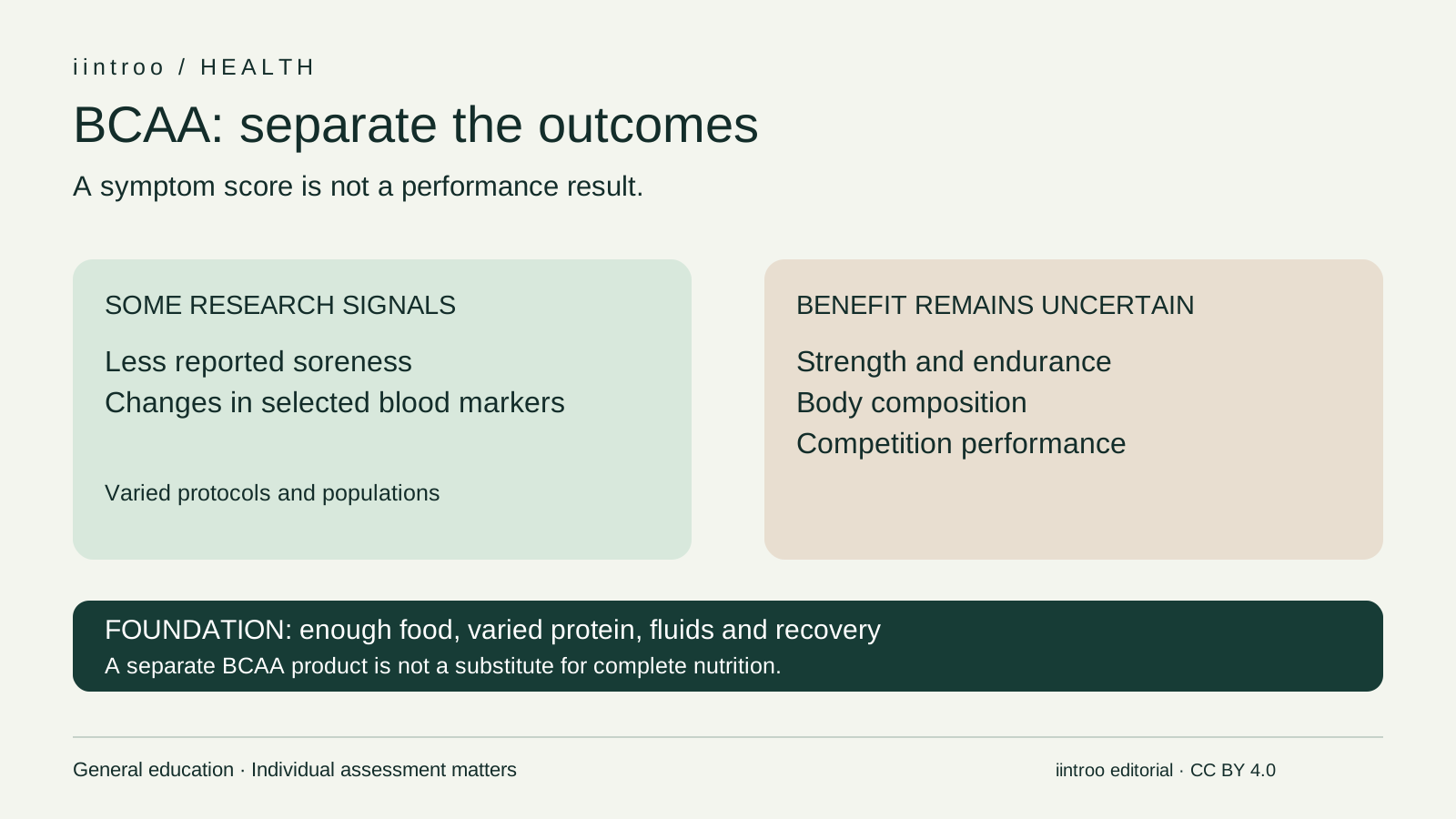
- Soreness scores and blood markers are not the same as strength or sporting performance.
- Evidence does not establish a universal BCAA dose or timing strategy.
Start with the claim on the tub
BCAA means branched-chain amino acids: leucine, isoleucine and valine. They are essential amino acids, but essential in nutrition does not mean that a separate supplement is essential. Foods containing protein already supply them. This guide is for adults doing resistance training who are deciding whether recovery claims justify another product.
A label may promise less soreness, more muscle and improved performance as though these were one outcome. They are different questions. The Australian Institute of Sport lists BCAA in its Group C supplement framework, where evidence is not supportive of routine benefit or is insufficient. That is a practical evidence classification, not a claim that amino acids have no biological role.
What the soreness research actually measured
A 2024 systematic review combined 18 randomized trials of exercise-induced muscle damage in healthy, active participants. It found reductions in reported delayed-onset soreness at several follow-up times, and differences in some creatine-kinase measurements. Lactate dehydrogenase did not show a clear benefit. These are selected symptoms and laboratory outcomes, not proof of better lifting performance.
Studies varied in training status, exercise protocols, supplement exposure and methods. The review searched literature through September 2022 despite being published in April 2024. Associations between study-level dose or duration and outcomes cannot identify the best personal dose. A pooled signal should not be converted into a guaranteed effect for a particular athlete.
Sources: 3
A newer review still found inconsistent performance effects
A November 2025 systematic review included 22 randomized studies with 511 participants, split between trained and untrained populations. It examined pure combined BCAA supplements, not every multi-ingredient recovery product. Evidence for strength, endurance and body-composition improvements remained inconsistent, although some findings favoured soreness reduction.
The authors did not conduct a meta-analysis because several studies had unclear or high risk of bias. Ages, intervention lengths and dietary controls differed substantially. Reviews can also include overlapping trials: their publication dates do not make them independent replications. This evidence does not establish that adding BCAA to an already adequate diet reliably improves competition results.
Sources: 4
One small trial illustrates the distinction
In a 2025 trial, 24 untrained male college students were assigned to BCAA or placebo and completed pre-exercise and post-exercise supplementation experiments. Some soreness and inflammatory-marker findings favoured supplementation, but countermovement-jump performance did not differ significantly between groups during the assessed recovery period.
That distinction matters: feeling less sore is not equivalent to restoring every aspect of muscle function. A small, short study in untrained young men cannot establish benefits in trained women, older lifters or elite competitors. It also cannot provide return-to-training clearance after an injury. Do not use a lower soreness score as permission to ignore weakness or persistent pain.
Sources: 5
Make the decision about your diet and needs
Before buying, consider whether meals provide enough energy and a varied protein supply, alongside carbohydrate, fluids and sleep appropriate to training. A sports dietitian can help when dietary restrictions, poor appetite or demanding schedules make that difficult. BCAA alone is not a substitute for complete nutrition or for investigating unexplained fatigue.
Ask which outcome a product is meant to improve, whether the research tested that exact formulation and what uncertainty remains. Mixed-ingredient products can have effects and risks not established by studies of BCAA alone; contamination and misleading claims are additional supplement concerns. Discuss use with a qualified professional, especially with a medical condition or medicines. This article offers education, not a supplement prescription.