
Behçet disease in sport: organ involvement—not the label—shapes the plan
Behçet disease can affect skin, joints, eyes, blood vessels or the nervous system. Training decisions need the active organ problem, not one generic ban.
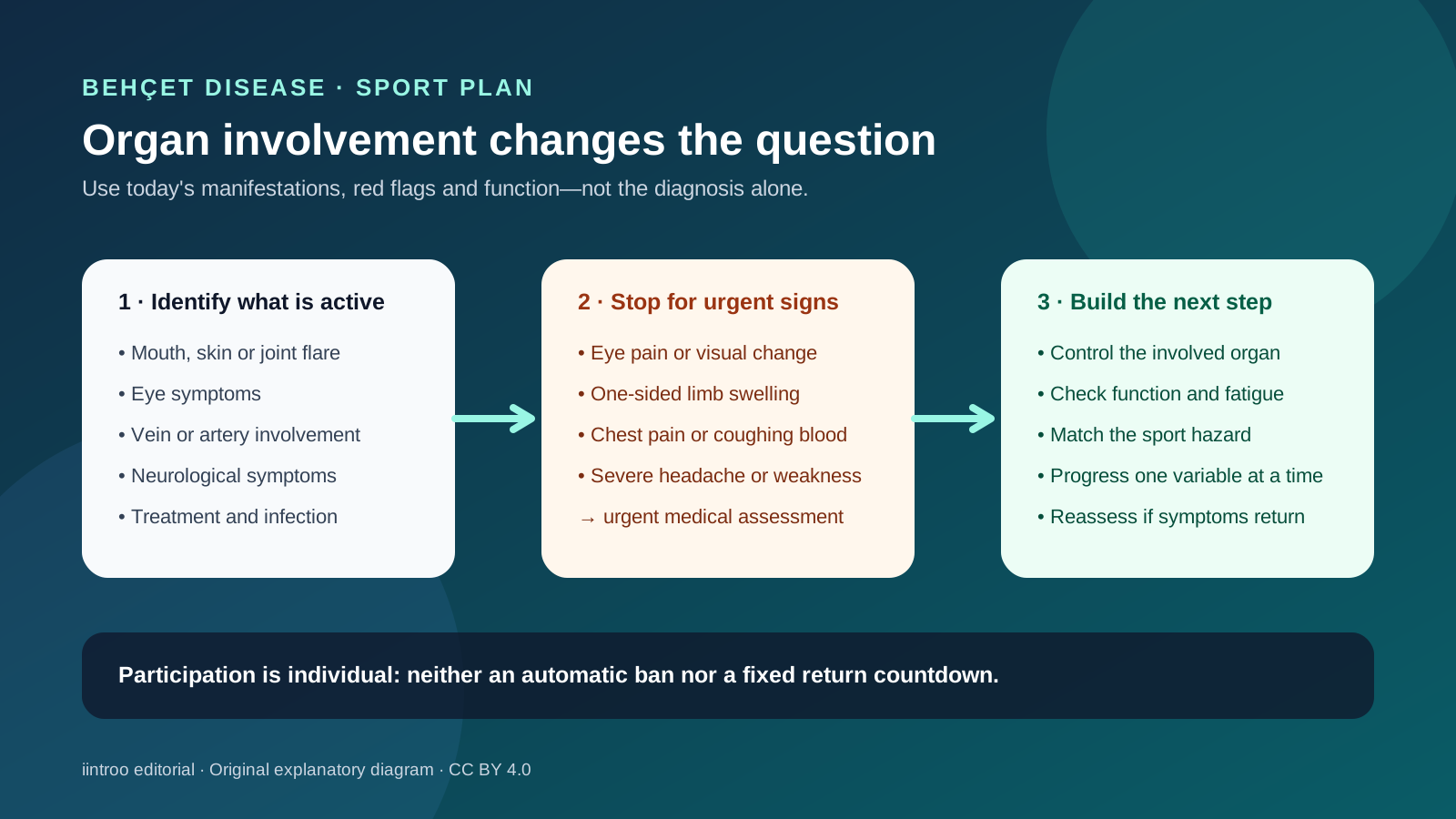
Key points
- Behçet disease is relapsing and can involve different organs, so a mouth ulcer, inflamed joint, eye problem and vascular event do not carry the same sport implications.
- New eye pain or visual change, one-sided limb swelling, chest pain, severe headache or a new neurological deficit needs urgent medical assessment rather than a training modification.
- Direct exercise trials in Behçet disease are sparse; a graded plan should follow current disease activity, treatment effects and the demands of the athlete's sport.
Start with the organ involved today
This guide is for athletes living with Behçet disease and the clinicians, coaches and families who support them. Behçet disease is a relapsing inflammatory disorder that can cause recurrent oral or genital ulcers, skin lesions and arthritis, but it can also involve the eyes, veins, arteries, gastrointestinal tract or nervous system. The 2025 EULAR update therefore organizes management around organ involvement and severity, not a single treatment or activity rule. A diagnosis alone does not tell a coach whether an athlete is safe to train today; the active manifestation, recent course, examination and treatment do.
Mouth ulcers or a limited skin flare may change eating, hydration, comfort and equipment tolerance without automatically making all exercise unsafe. An acutely inflamed ankle or knee can make running, jumping and change of direction inappropriate until pain and function recover. Eye, vascular and neurological disease require a much more cautious approach because loss of vision, thrombosis, aneurysm or nervous-system involvement can be serious. The athlete's rheumatology team should coordinate with ophthalmology, vascular, neurology, rehabilitation or other specialists when those organs are involved.
Know which symptoms end the session
New eye pain, marked redness, light sensitivity, floaters or blurred vision needs urgent ophthalmic assessment; do not test vision by returning the athlete to a fast ball, combat, cycling or traffic environment. New one-sided limb swelling, unexplained chest or back pain, coughing blood, severe breathlessness or collapse may signal vascular or cardiopulmonary danger and requires urgent care. A severe or unusual headache, weakness, numbness, loss of coordination, confusion, seizure or other new neurological change is also a stop signal. Local emergency pathways take priority over the competition schedule.
Oral ulcers, genital ulcers and skin lesions can still deserve clinical review when they prevent drinking or eating, become infected, rub under equipment or are accompanied by fever and systemic illness. Do not assume every symptom is Behçet disease: infection, heat illness, medication effects and unrelated injury remain possible. An athlete using immunosuppressive treatment should follow their clinician's infection plan. They should not stop corticosteroids, anticoagulation or immune therapy abruptly, change a dose for a match, or borrow a teammate's anti-inflammatory medicine.
Build load around function, fatigue and treatment
Fatigue and pain are common, but the available Behçet-specific exercise evidence is limited. A Turkish cross-sectional study of 123 patients found fatigue associated with active disease, physical dysfunction, anxiety and depression; it did not prove that exercise caused or cured fatigue. More recent small observational studies report reduced functional capacity or movement confidence in some patients, yet their designs cannot prescribe one safe intensity. The practical response is to record symptoms, sleep, perceived exertion and next-day recovery alongside clinical disease activity, then adjust volume, contact, heat exposure and recovery with the care team.
When disease is stable and the responsible clinician agrees, training can begin at a tolerable level and progress one variable at a time. Non-impact conditioning may be useful during recovery from a joint flare, but it is not automatically suitable during active eye, vascular or neurological disease. Medicines can affect infection risk, blood pressure, bone health, glucose, bleeding or heat tolerance depending on the treatment; these effects need an individual review. General physical-activity guidance from inflammatory rheumatic disease can support shared planning, but it is indirect evidence and cannot override Behçet-specific organ risk.
Make participation flexible without hiding risk
A useful sport plan names the athlete's usual manifestations, current medicines, urgent warning signs, who to contact, and which training alternatives are acceptable during a flare. It can also specify how an athlete reports genital ulcers, bowel symptoms, mood or fatigue privately. Coaches need only the information required for safety and adjustments; the diagnosis should not be announced to the team. For youth athletes, parents, the clinical team and authorised school or club staff should agree how medication, emergency escalation and missed training will be handled.
Return after a significant flare or organ event is not a fixed-day countdown. It depends on control of the involved organ, treatment stability, objective function, sport hazards and specialist advice. This page cannot diagnose a flare, interpret imaging or blood tests, decide whether anticoagulated contact sport is acceptable, or clear an athlete after eye, vascular or neurological disease. Evidence supports individualized, multidisciplinary decisions; direct trials that define sport-specific thresholds remain scarce. The goal is neither automatic exclusion nor symptom denial, but proportionate participation with a plan that can change when the disease changes.