
Beta-alanine for athletes: small possible gains, tingling and product risk
Beta-alanine may help high-intensity efforts, but effects are not universal. Evidence limits, paraesthesia and supplement contamination belong in the decision.
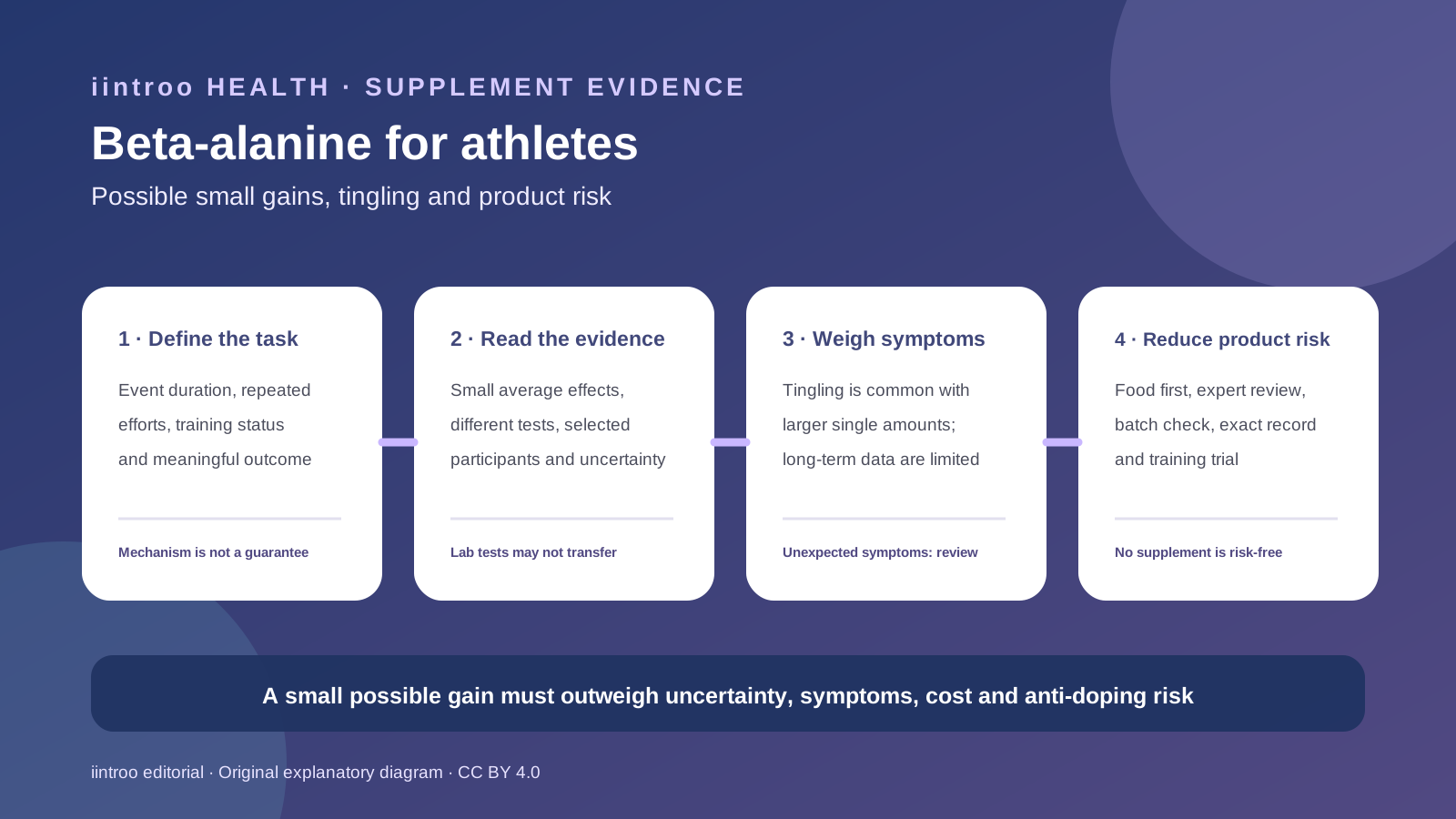
Key points
- Beta-alanine increases muscle carnosine over time; it is not an immediate stimulant and does not replace training, carbohydrate or recovery.
- Research suggests small average benefits in some sustained high-intensity tasks, with substantial variation by test, athlete group and study quality.
- Tingling is common with larger single doses, long-term safety evidence is limited, and every supplement product carries contamination and mislabelling risk.
Separate the ingredient's mechanism from a guaranteed result
This guide is for adult athletes, coaches and sports-nutrition teams considering beta-alanine. Beta-alanine is an amino acid used to increase muscle carnosine, which contributes to buffering during intense muscle work. That mechanism develops with repeated intake over time; taking a scoop immediately before competition is not equivalent to a stimulant effect. A plausible mechanism and higher carnosine do not guarantee a faster performance in every sport, athlete or event.
The IOC supplement consensus lists beta-alanine among a small group that may provide marginal benefits in specific scenarios, particularly sustained high-intensity work. The US National Institutes of Health describes the evidence as inconsistent enough that expert agreement remains limited. Start with the performance question: duration, repeated-effort pattern, training status, sex, age, event rules and the outcome that matters. Do not turn a laboratory time-to-exhaustion change into a promised medal or recovery benefit.
Read the performance evidence at the size it was studied
A 2024 systematic review of 18 randomized, double-blind trials included 331 trained men aged 18 to 40 and reported a small pooled benefit across varied maximal-intensity protocols. Subgroup findings favored some efforts lasting several minutes and several weeks of supplementation, but the studies used different tests and outcomes. The result does not establish the same effect for women, youth, para athletes, endurance events, strength alone or team performance under real competition conditions.
A 2026 review focused on women included 12 reports from 11 trials and 312 participants. It found a pooled improvement in time to exhaustion, while estimates for peak power, anaerobic performance and aerobic capacity were imprecise; certainty was rated very low. Time to exhaustion is also not the same as a fixed-distance time trial. The honest conclusion is that beta-alanine may offer a small, task-specific gain for some athletes, with uncertainty about who responds and whether the laboratory outcome transfers.
Plan for tingling and acknowledge the long-term evidence gap
Paraesthesia — tingling, prickling or burning of the skin — is the characteristic reported side effect, especially when a larger amount is taken at once. A systematic risk assessment found it more frequent than placebo and did not identify evidence that the sensation itself was harmful in the studied healthy participants. Divided or sustained-release approaches reduced symptoms in research, but this page does not prescribe a personal dose or formulation. Severe or unexpected symptoms should not automatically be labelled a supplement effect.
Most safety evidence covers weeks or months, not years, pregnancy, childhood, kidney or liver disease, multiple supplements or complex medication. The NIH fact sheet notes the absence of long-term safety data beyond a year. Multi-ingredient products make attribution harder because the label may contain stimulants, proprietary blends or different quantities. An athlete with a medical condition, symptoms or prescribed treatment should discuss the product with a qualified clinician and sports dietitian rather than copying a protocol from a teammate.
Make a food-first, clean-sport and cost-aware decision
Before using a supplement, confirm that training design, energy and carbohydrate availability, protein distribution, sleep and recovery address the actual limitation. A marginal possible benefit can be irrelevant if the event does not match the evidence or the athlete cannot tolerate the product. Trial any professionally supported strategy away from an important competition and record the exact product, batch, timing, symptoms and relevant performance outcome. Stop if the expected benefit is absent or the cost and side effects outweigh it.
The International Testing Agency warns that supplements may be contaminated or mislabelled and that no product is completely risk-free. Independent batch testing can reduce, not eliminate, anti-doping risk; Global DRO does not verify supplements. Athletes remain responsible under applicable rules. There is no universal dose, blood test, carnosine target or event type that proves beta-alanine is worthwhile. This page provides education, not a supplement recommendation, medical assessment, anti-doping guarantee or individualized nutrition prescription.