
Blind football concussion: use substitution, not guesswork
Blind football's temporary concussion substitution creates assessment time. Communication can reduce collisions, but suspected injury still needs medical care.
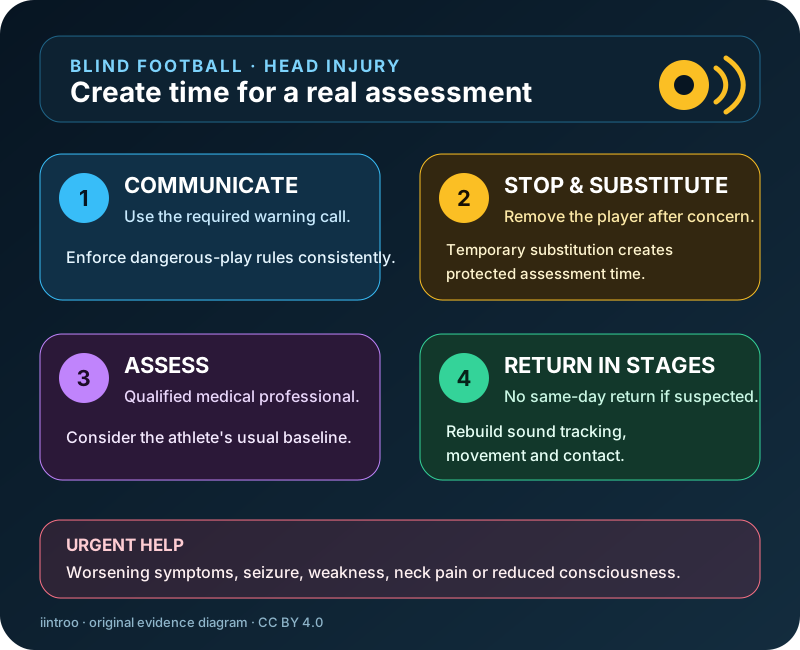
Key points
- IBSA's temporary concussion substitution is designed to create assessment time without pressuring a player back into the match.
- A three-Games cohort recorded head, face and neck injuries but no confirmed concussions, highlighting uncertainty rather than proving that concussion does not occur.
- A suspected concussion requires removal, assessment and an individual return process; blindness or familiar balance strategies should not be used to explain symptoms away.
Build safety into the soundscape
This guide is for blind-football players, coaches, guides, officials, families and medical teams. The sport depends on reliable sound: the ball, the goalkeeper or guide and player communication all support orientation. The current IBSA laws and officiating structure should be taught before intensity rises, including the required warning call when challenging for the ball.
Communication does not eliminate contact. Crowd noise, fatigue, speed, a late call or two players approaching the same space can still create a collision. Coaches should rehearse stoppages and medical access as deliberately as attacking patterns, and officials should enforce dangerous-play and communication rules consistently.
Sources: 1
Use the temporary substitution to protect the assessment
IBSA provides a temporary concussion substitution process so a player with a suspected head injury can leave the field while a qualified team medical professional assesses them. The substitute prevents the team from having to choose between playing short and rushing the assessment. It is a competition process, not an automatic medical clearance.
If concussion remains suspected, the player should not return that day. The assessment environment should be quiet enough for communication and adapted to the athlete's baseline vision, orientation, balance and communication style. A coach, guide or teammate cannot replace the medical decision simply because they know the player well.
Read the surveillance evidence cautiously
A 2026 cohort combined injury surveillance from the London 2012, Rio 2016 and Tokyo 2020 Paralympic Games. It recorded 60 injuries among 49 athletes, with head, face and neck the second-highest anatomical incidence after the lower limb. Direct contact was the leading reported mechanism. No confirmed concussion was recorded.
That zero is not proof that concussion risk is absent. The authors and a separate narrative review describe concern about recognition and reporting in Para sport and blind football. The cohort spans only three short elite tournaments, uses event surveillance rather than lifetime follow-up and cannot estimate the risk for every league, age or sex.
Protect emergency warning signs
After a head or body impact, worsening headache, repeated vomiting, seizure, increasing confusion, unusual behaviour, weakness, neck pain, deteriorating consciousness or breathing difficulty needs urgent medical care through the event emergency plan. Do not leave the athlete alone, and do not move a player with possible neck injury unless trained responders direct it or immediate danger requires movement.
Concussion symptoms can include headache, dizziness, nausea, light or sound sensitivity, memory difficulty and feeling slowed. Baseline balance or orientation differences must be understood without dismissing a new change as part of visual impairment. The medical history and examination determine what further assessment is needed.
Return to football is individual
The Amsterdam consensus supports a short period of relative rest followed by gradual, symptom-limited activity under clinical guidance. Return to blind football should later rebuild running, changes of direction, ball tracking by sound, team communication, controlled contact and match demands. Progress depends on the diagnosis and response, not a fixed number of days.
Persistent symptoms, repeated head impacts or uncertainty about baseline function warrants specialist reassessment. This article does not diagnose concussion, reproduce a sideline test or clear anyone to play. Teams should apply the current IBSA policy, local medical requirements and the athlete's individual care plan.