
BPPV in sport: treat positional vertigo before testing balance under load
Brief spinning with head movement may be BPPV. Positional testing, targeted repositioning and hazard-specific balance checks should precede return.
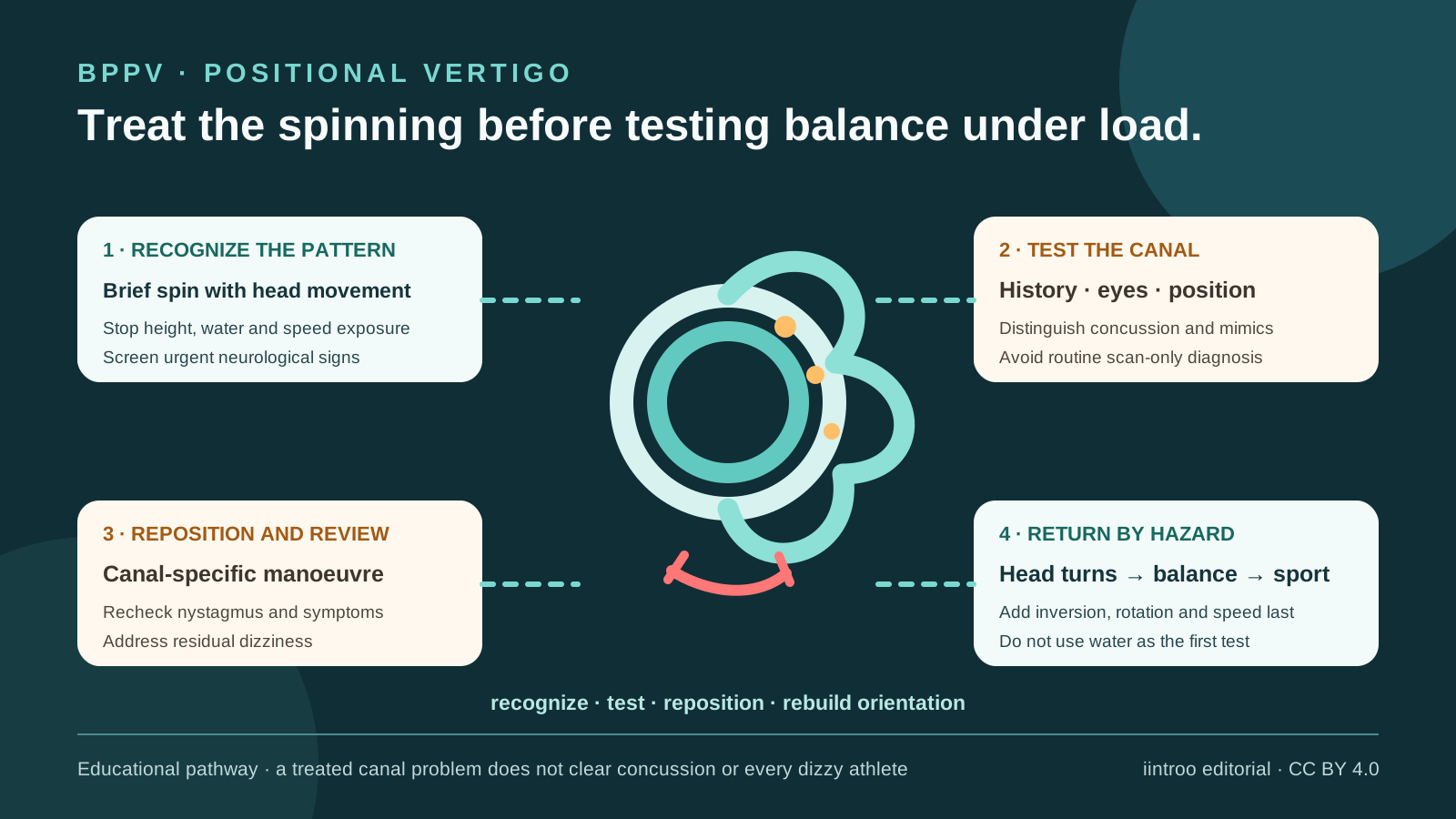
Key points
- BPPV causes brief, position-triggered vertigo when displaced inner-ear particles stimulate a semicircular canal, but dizziness after sport has other possible causes.
- The diagnosis depends on a characteristic history and positional examination; imaging and vestibular-suppressant medicine are not routine substitutes for the examination.
- Return should confirm symptom control, balance and sport-specific orientation under safe progression, especially after concussion or in water, aerial and speed sports.
Recognize positional spinning without assuming the cause
This guide is for athletes, coaches, families and clinicians dealing with short bursts of spinning when rolling in bed, looking up, bending, tumbling or changing head position. Benign paroxysmal positional vertigo, or BPPV, occurs when inner-ear particles move into a semicircular canal and create an abnormal movement signal. Episodes are often brief and position-linked. Light-headedness, continuous imbalance, fainting, motion sensitivity and dizziness after concussion are not interchangeable descriptions, and a label based only on the word vertigo can miss another problem.
Stop the session and seek urgent assessment when dizziness is accompanied by new weakness, numbness, double vision, severe headache, inability to walk, fainting, chest symptoms, persistent vomiting, sudden hearing loss or a significant head or neck injury. A diver, gymnast, skater, cyclist or climber can face a high consequence from even seconds of disorientation. Do not provoke repeated spins on a board, beam, platform or underwater to see whether the episode passes. First separate a medical emergency, concussion and other vestibular causes from a suspected positional disorder.
Use a canal-specific examination, not a generic balance test
Current AAO-HNS guidance recommends diagnosing posterior-canal BPPV when a positional manoeuvre provokes the characteristic vertigo and nystagmus pattern, with a roll test when the history is compatible but the first test is not diagnostic. The clinician also reviews hearing, neurological findings, eye movements, neck mobility and factors that make positioning unsafe. Routine imaging, broad vestibular testing or long-term vestibular-suppressant medicine is not recommended when the presentation clearly meets uncomplicated BPPV criteria, but atypical or persistent findings change that decision.
Sport-related concussion can coexist with BPPV. A 2026 adolescent concussion cohort and earlier clinical series show that positional vertigo is present in a subset of dizzy young athletes, but these observational data do not make BPPV the explanation for every post-impact symptom. Concussion assessment continues even when a canalith problem is identified. Neck injury, migraine, central neurological disease and other peripheral vestibular disorders can mimic or accompany the pattern, so an athlete should not self-diagnose from a video or ask a teammate to perform a forceful manoeuvre.
Reposition the affected canal and reassess the result
The guideline recommends an appropriate canalith-repositioning procedure for posterior-canal BPPV and allows observation with follow-up in selected cases. A 2026 network meta-analysis of 20 randomized trials found strong short-term support for established repositioning manoeuvres, while recurrence evidence remained low quality. The correct technique depends on the affected canal and side, the athlete's neck, vascular and mobility considerations and the examiner's competence. Treatment is not the same as repeatedly practising a home manoeuvre until symptoms are suppressed.
Reassessment matters because positional nystagmus can resolve while residual dizziness, visual motion sensitivity or balance limitation remains. Recent reviews report wide variation in residual symptoms and uncertain benefit from routine drug add-ons; the evidence does not support one universal prescription. Vestibular rehabilitation is a valid option for persistent imbalance when selected by an appropriately trained clinician. Recurrence is possible, so the athlete needs a plan for recognizing the familiar pattern while still treating new neurological, hearing or post-impact symptoms as a fresh assessment problem.
Return through orientation, balance and real venue hazards
Return begins after the diagnosis has been addressed and the athlete no longer has unsafe positional spinning. Progress from ordinary head turns and walking to gaze control, single-leg balance, direction change and controlled sport tasks before adding speed, inversion, rotation, height, open water or collision. A normal static balance score does not prove readiness for repeated flips, a diving entry, pack cycling or figure-skating rotation. The plan should test symptom response during the task and later that day, without using a dangerous environment as the first exposure.
After concussion, BPPV treatment can remove one symptom generator but does not replace the broader return-to-sport process. Persistent imbalance, recurrent positional vertigo, new hearing symptoms or a different dizziness pattern requires reassessment. This article cannot diagnose a canal, demonstrate a manoeuvre, prescribe medicine or clear diving, aerial or speed sport. It supports prompt recognition, competent positional examination, targeted treatment and a staged return that matches the consequences of momentary disorientation in the athlete's actual discipline.