
Ménière's disease in sport: plan for vertigo, hearing and fall risk
Ménière's disease causes episodic vertigo and fluctuating ear symptoms. Sport planning should separate acute attacks from chronic imbalance and recovery.
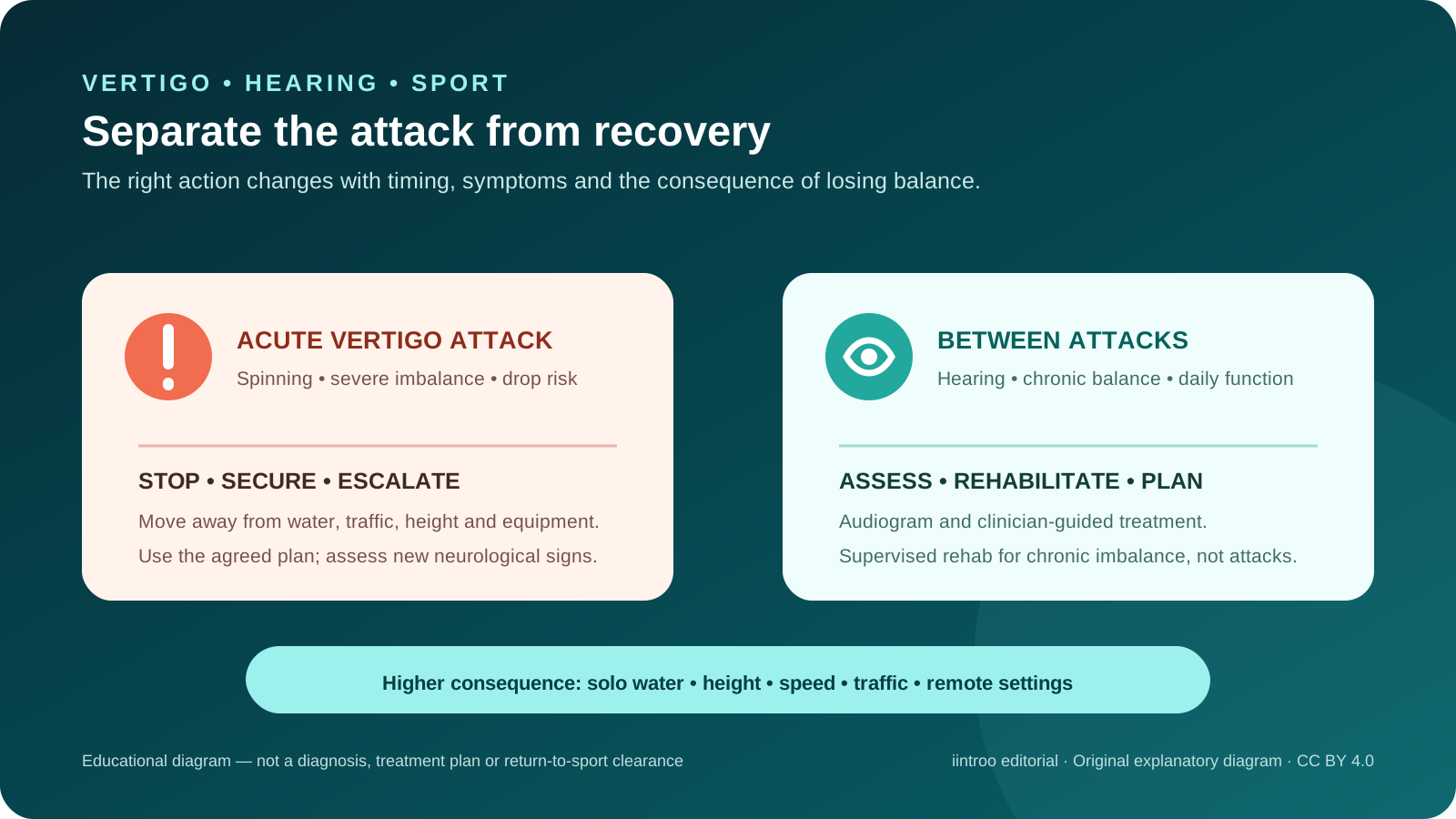
Key points
- Ménière's disease is diagnosed from a characteristic history, documented hearing assessment and exclusion of other causes—not dizziness alone.
- An acute vertigo attack is a stop signal for sport; water, height, speed, traffic and remote settings can magnify the consequence of sudden imbalance.
- Vestibular rehabilitation is recommended for chronic imbalance, not as a treatment for an acute Ménière's attack.
Name the pattern without self-diagnosing every dizzy spell
This guide is for adult athletes with suspected or diagnosed Ménière's disease and for coaches and event teams working with consent. The condition can cause spontaneous episodes of vertigo with fluctuating hearing loss, tinnitus or a feeling of pressure in the affected ear. Definite disease requires a characteristic history and audiometrically documented sensorineural hearing loss, with symptoms not better explained by another condition. Dehydration, low blood pressure, migraine, medication effects, infection, heart rhythm problems and neurological disease can also cause dizziness or imbalance.
Sudden facial weakness, speech difficulty, one-sided weakness or numbness, new double vision, inability to walk, a severe new headache, collapse, chest pain or persistent vomiting needs urgent medical assessment rather than an ear-disease assumption. Sudden hearing loss also requires urgent evaluation. An athlete with spinning, severe imbalance or a drop attack should stop immediately, move away from water, traffic, height and equipment, and follow the venue emergency plan. Do not let the athlete drive, swim back alone or complete a descent unaided.
Separate acute attacks from the work between attacks
The AAO-HNS guideline recommends an audiogram and assessment for vestibular migraine. MRI may be considered in selected people with asymmetric sensorineural hearing loss, while routine vestibular testing is not required to make every diagnosis. Recording the onset, duration, ear symptoms, headache features, falls, medicines and recovery can help the specialist distinguish patterns. A watch, balance app or normal training session cannot confirm that the inner ear is stable.
During an acute attack, the priority is safety and the person's agreed symptom-management plan. Vestibular suppressants may be prescribed for limited use during attacks, but some can cause drowsiness and slowed reaction; only the prescriber can advise on timing and participation. Vestibular rehabilitation is different: the guideline recommends it for chronic imbalance and recommends against using it to manage an acute attack. Hearing aids or other assistive technology may improve communication but do not prevent vertigo.
Map consequence as well as probability
There is little direct research on Ménière's disease in competitive sport, so planning should examine what would happen if balance or hearing changed suddenly. Solo open-water swimming, diving, climbing, cycling in traffic, motor sport, equestrian activity and remote or night events can have high consequences even when attacks are infrequent. Pool access, a spotter, a partner, an exit route, visible communication and avoiding unaccompanied high-consequence exposure may be discussed with the athlete and clinicians. These are risk controls, not a promise that an attack will not occur.
Hearing fluctuation can affect a starting signal, whistle, radio or warning from behind. Agree on visual or tactile signals and check that a hearing device, helmet or water protection works with the sport. Salt, fluid, caffeine or medicine advice should come from the treating team; generic online restrictions can conflict with heat, endurance and other medical needs. No supplement has established value as a sporting shortcut, and the 2023 Cochrane review found substantial uncertainty around commonly used systemic medicines.
Rebuild stable movement while acknowledging evidence limits
For chronic imbalance between attacks, a vestibular physiotherapist can assess gaze stability, balance, walking and motion sensitivity and build an individualized programme. A 2023 meta-analysis found an immediate quality-of-life benefit, but included only three studies, all at high risk of bias, with severe heterogeneity and no long-term follow-up. A 2025 French guideline also supports supervised rehabilitation for uncompensated chronic deficit rather than self-directed exercise during unstable attacks. Neither source establishes a sport-specific clearance test.
Return can move from ordinary walking and controlled balance work to low-consequence conditioning, then sport-specific tasks with agreed safeguards. The athlete's attack pattern, residual imbalance, hearing and vision, medicine effects, fatigue, sleep and the environment all matter. New or different neurological symptoms, sudden hearing change, repeated falls or a worsening pattern needs reassessment. This page is general education, not diagnosis, dietary or drug advice, vestibular exercises, equipment selection or personal clearance for water, height, speed or competition.