
Breaststroke knee pain: change the load before guessing the tissue
Medial knee pain in breaststroke is linked with repeated kick load, but evidence is mostly observational. Adjust exposure and assess persistent symptoms.
Key points
- Breaststroke is repeatedly associated with medial knee symptoms, but pain location alone cannot identify the injured structure or rule out another diagnosis.
- Older biomechanical and survey studies link symptoms with kick mechanics and breaststroke volume; newer reviews emphasise that certainty and intervention evidence remain limited.
- Return should rebuild kick volume, speed, turns and race demands according to symptoms and function rather than a universal rest period.
Recognise the pattern without naming a diagnosis
This guide is for breaststroke and individual-medley swimmers, coaches, parents and clinical teams. The familiar pattern is pain on the inner side of the knee during or after the whip kick, sometimes building as breaststroke distance or intensity rises. Yet breaststroker's knee is a descriptive label, not a tissue diagnosis. The medial collateral ligament, meniscus, patellofemoral region, tendons and other structures can produce overlapping symptoms, and pain may also reflect an acute twist, growth-related problem or condition unrelated to swimming.
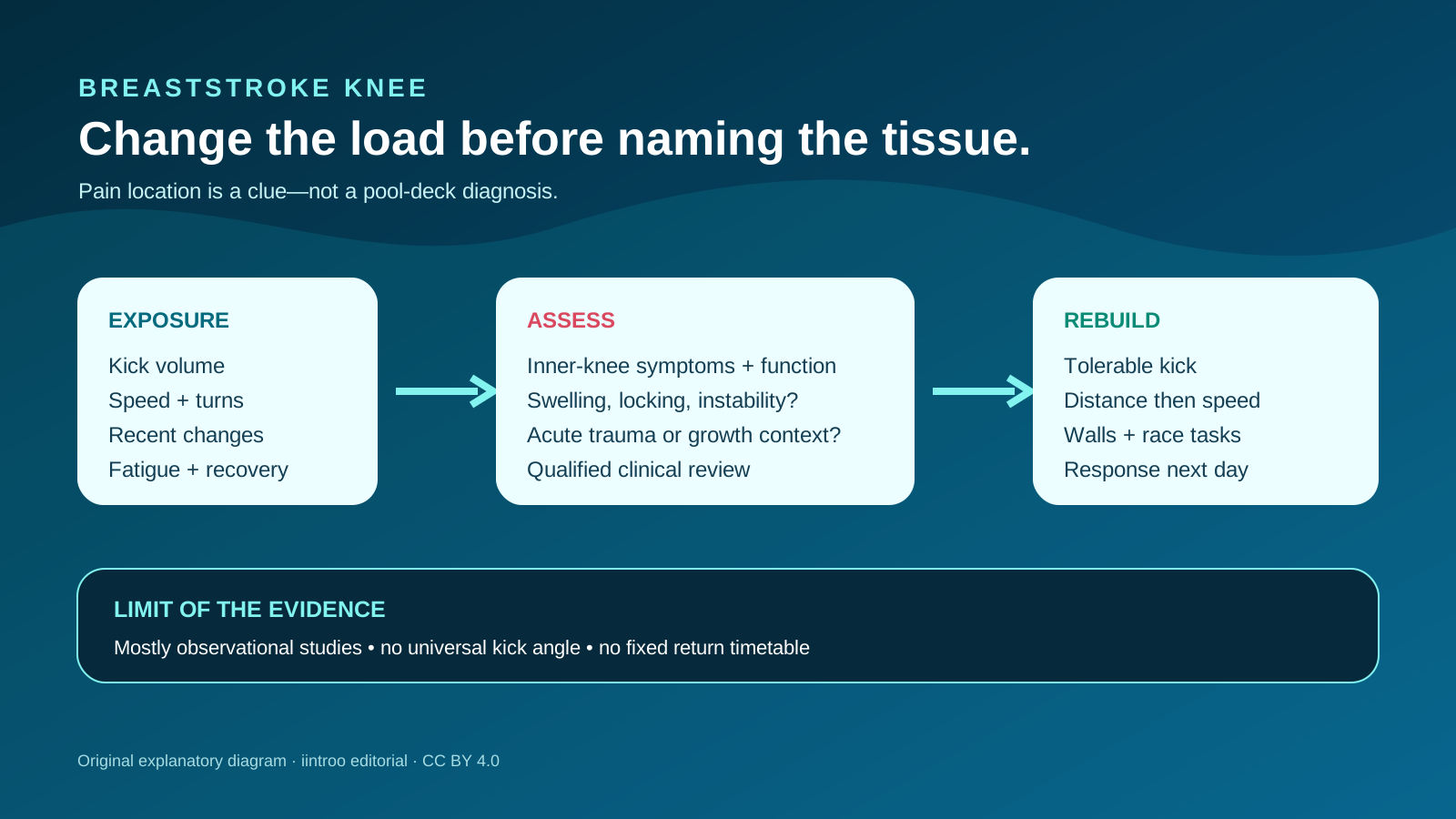
A sudden pop, rapid swelling, locking, inability to bear weight, obvious instability, fever, a hot swollen joint or pain after significant trauma needs prompt assessment. Recurrent pain that changes technique, persists between sessions or fails to settle with sensible load adjustment also deserves evaluation by an appropriate clinician. Coaches can record stroke, distance, pace, fins, turns and when symptoms appear, but should not press on the joint or run a pool-deck test to decide which structure is injured.
Use the evidence without overstating it
Classic small studies reported associations between knee pain, larger breaststroke exposure and particular hip or knee positions during the kick. They help explain a plausible load pathway: repeated rotation and valgus-related stress can concentrate force around the medial knee. They do not establish one dangerous angle for every swimmer. Samples were small, methods were often retrospective, equipment and technique have changed, and pain was not always confirmed with the same clinical diagnosis.
A 2021 systematic review of non-shoulder swimming injuries found limited evidence and uncertainty around proposed risk factors. A 2025 review and 2026 scoping review again identified the knee as an important site while noting heterogeneous methods and sparse intervention trials. The useful conclusion is modest: breaststroke-specific exposure and technique belong in the assessment, but no screening measurement, warm-up or single correction has been proven to prevent all knee pain. A coach's visual cue should remain a performance observation, not a medical verdict.
Modify load while keeping the swimmer active
When no urgent feature is present, the immediate training question is which tasks provoke symptoms. Reducing painful breaststroke kick distance, maximal efforts, repeated wall work or resistant kick equipment may lower the specific load while comfortable pull work, other strokes, strength training or aerobic alternatives maintain conditioning. The exact substitution depends on the diagnosis and response. Replacing every pool session with hard dry-land leg work can simply move the load rather than reduce it.
Review recent changes in weekly distance, breaststroke proportion, race-pace sets, gym loading, growth, competition density and recovery. Video may help a qualified coach compare technique at easy and fatigued speeds, but forcing the knees into a narrow or wide position without assessing hip mobility and symptom response can create another problem. General hip, trunk and lower-limb capacity work may be appropriate in rehabilitation, yet the evidence does not support a universal exercise list. Painkillers should not be used to pass a kick tolerance test or preserve a race entry.
Return through stroke-specific tasks
A staged return can begin with a tolerable breaststroke exposure and progress one variable at a time: easy kick, distance, speed, starts and pullouts, turns, race-pace combinations and finally competition density. Track symptoms during the set, later that day and the next morning together with swelling, confidence and technique. A single pain-free length does not establish full readiness, and a fixed number of rest days cannot account for diagnosis, age, training history or event demands.
The clinician and coach should agree on what response is acceptable, which signs mean step back, and when reassessment is needed. Competition rules define a legal stroke, not a medically safe joint position, and a legal kick can still be intolerable during recovery. This article does not diagnose the painful structure, prescribe rehabilitation or provide clearance. It turns a broad label into a practical sequence: record breaststroke exposure, rule out urgent problems, reduce the provoking load and rebuild the exact tasks the swimmer must perform.