
Bronchiectasis in active people: keep exercise inside the airway-clearance and exacerbation plan
Exercise can support function in bronchiectasis, but airway clearance, changing sputum, breathlessness and haemoptysis need an individual respiratory plan.
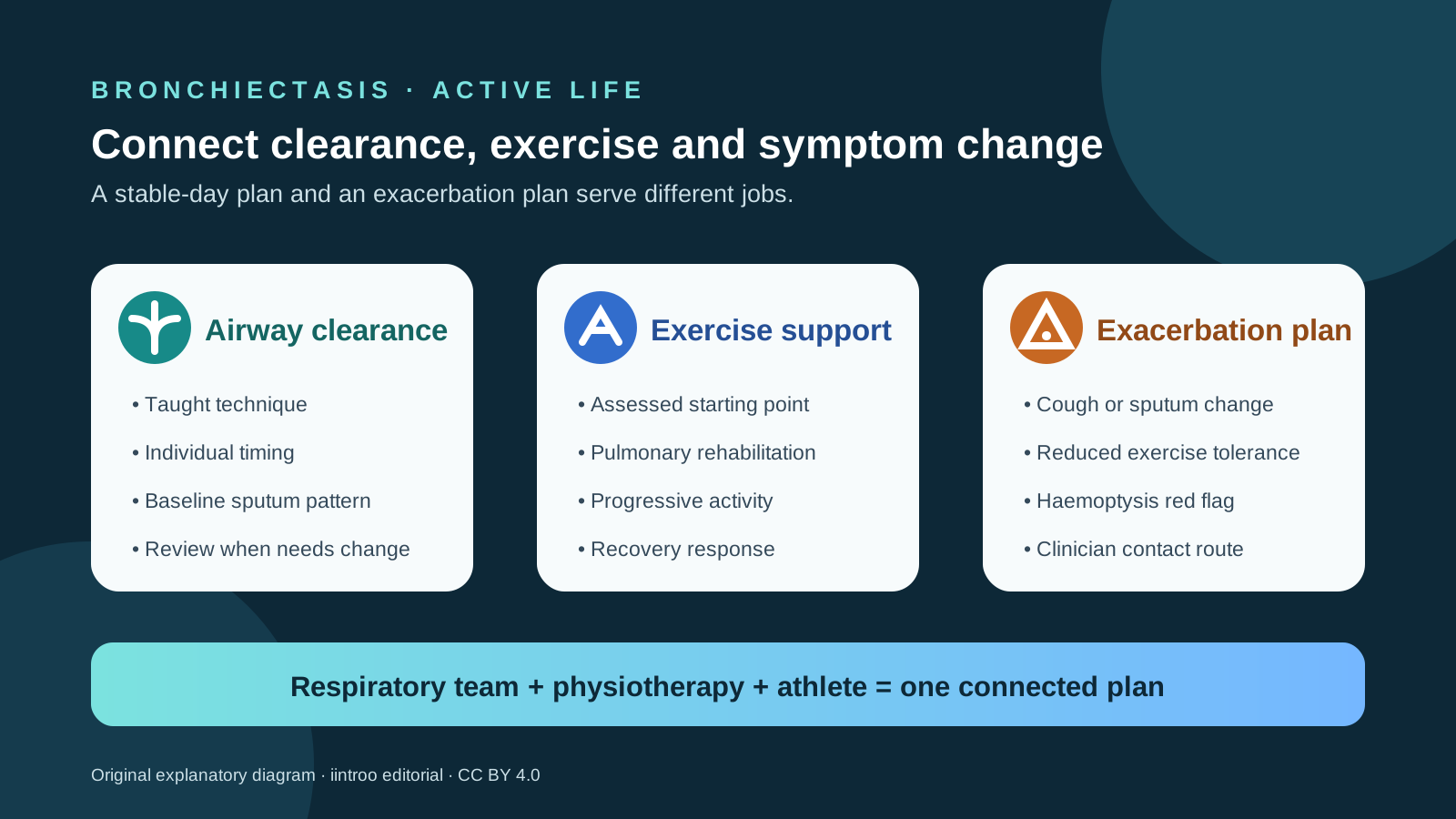
Key points
- The 2025 ERS guideline recommends airway-clearance training for most adults with bronchiectasis and pulmonary rehabilitation for breathlessness or impaired exercise capacity.
- No single airway-clearance technique is best for everyone; a respiratory physiotherapist should individualize method, timing and changes during exacerbation.
- New haemoptysis, severe breathlessness, falling oxygen level, chest pain, confusion or rapid deterioration needs prompt medical assessment rather than a harder training test.
Place exercise inside the respiratory-care system
This guide is for active adults with non-cystic-fibrosis bronchiectasis and the people supporting their sport. Bronchiectasis involves permanently widened airways on CT together with a compatible clinical pattern, often including chronic cough, sputum, recurrent infection, breathlessness or fatigue. Causes and severity vary. A cough during a run does not diagnose bronchiectasis, and a CT description without the clinical picture cannot determine training advice. Investigation of the underlying cause, disease activity, comorbidities and treatable traits belongs with a respiratory team.
The 2025 European Respiratory Society guideline recommends that people with bronchiectasis be taught airway-clearance techniques and encourages regular physical activity. It also recommends pulmonary rehabilitation for breathlessness or impaired exercise capacity. These recommendations support activity; they do not mean exercise replaces clearance, microbiology-guided care or prescribed treatment. Athletes should know their stable baseline, usual sputum and breathing pattern, current airway-clearance plan and who to contact when those change.
Personalize airway clearance around training
Airway clearance may use active breathing cycles, positive-expiratory-pressure devices, gravity-assisted positions or another technique. The ERS states that no one method is superior and recommends instruction by a respiratory physiotherapist with appropriate experience. Timing before or after a session may depend on sputum burden, reflux, airway reactivity, travel and preference. The plan should be rehearsed in stable health before competition rather than invented at the start line.
An ERS statement reviewed 30 randomized trials and found that clearance can increase sputum removal, reduce cough impact and improve health-related quality of life, but techniques and studies were heterogeneous. That evidence cannot prescribe one device, breath count or session frequency here. Vigorous clearance can also be inappropriate in some situations, including significant haemoptysis, unless a clinician has advised how to respond. Good hydration may support the wider plan, but drinking extra fluid is not a substitute for assessment or individualized treatment.
Use exercise and rehabilitation evidence honestly
Pulmonary rehabilitation combines supervised exercise, education and self-management. The 2025 ERS analysis found short-term improvements in walking tests and quality of life, while certainty for several outcomes was very low and benefits were not consistently maintained after programmes ended. A meta-analysis of five randomized trials with 198 participants also reported better exercise capacity, but emphasized limited study number and quality. The evidence supports referral when capacity is impaired, not a universal intensity, interval or race target.
A Cochrane review included six studies and 275 participants. It found low-certainty evidence for improvements in exercise capacity and quality of life in stable bronchiectasis, but sparse longer-term data and little evidence during or immediately after exacerbation. Most participants were rehabilitation patients rather than competitive athletes. Training should therefore be progressed from the person's assessed baseline, with symptom and next-day response, recovery, oxygen needs where prescribed, and the demands of the environment considered.
Recognise an exacerbation and stop escalation
A meaningful increase in cough, sputum volume or thickness, sputum purulence, breathlessness or reduced exercise tolerance, fatigue, malaise or haemoptysis may signal an exacerbation when it exceeds normal day-to-day variation and needs a change in management. The action plan may include sputum sampling and clinician-directed treatment based on previous microbiology. Do not borrow antibiotics, start leftover medication, suppress a productive cough for competition or use a positive culture without symptoms as a self-diagnosis.
New haemoptysis is a red flag. Severe or rapidly worsening breathlessness, chest pain, cyanosis, confusion, collapse, major bleeding, a substantial fall in oxygen saturation or inability to speak in full sentences requires urgent or emergency care. Training resumes through the respiratory team's plan after symptoms, airway clearance and functional tolerance have stabilized; there is no universal number of symptom-free days. This page cannot diagnose bronchiectasis, select clearance, prescribe drugs or oxygen, or clear competition. It supports a coordinated plan in which activity, clearance and exacerbation safety remain connected.