
Brugada syndrome in sport: manage fever, heat and arrhythmia risk
Brugada syndrome does not automatically end sport, but expert assessment, fever action, heat precautions and an emergency plan should precede competition.
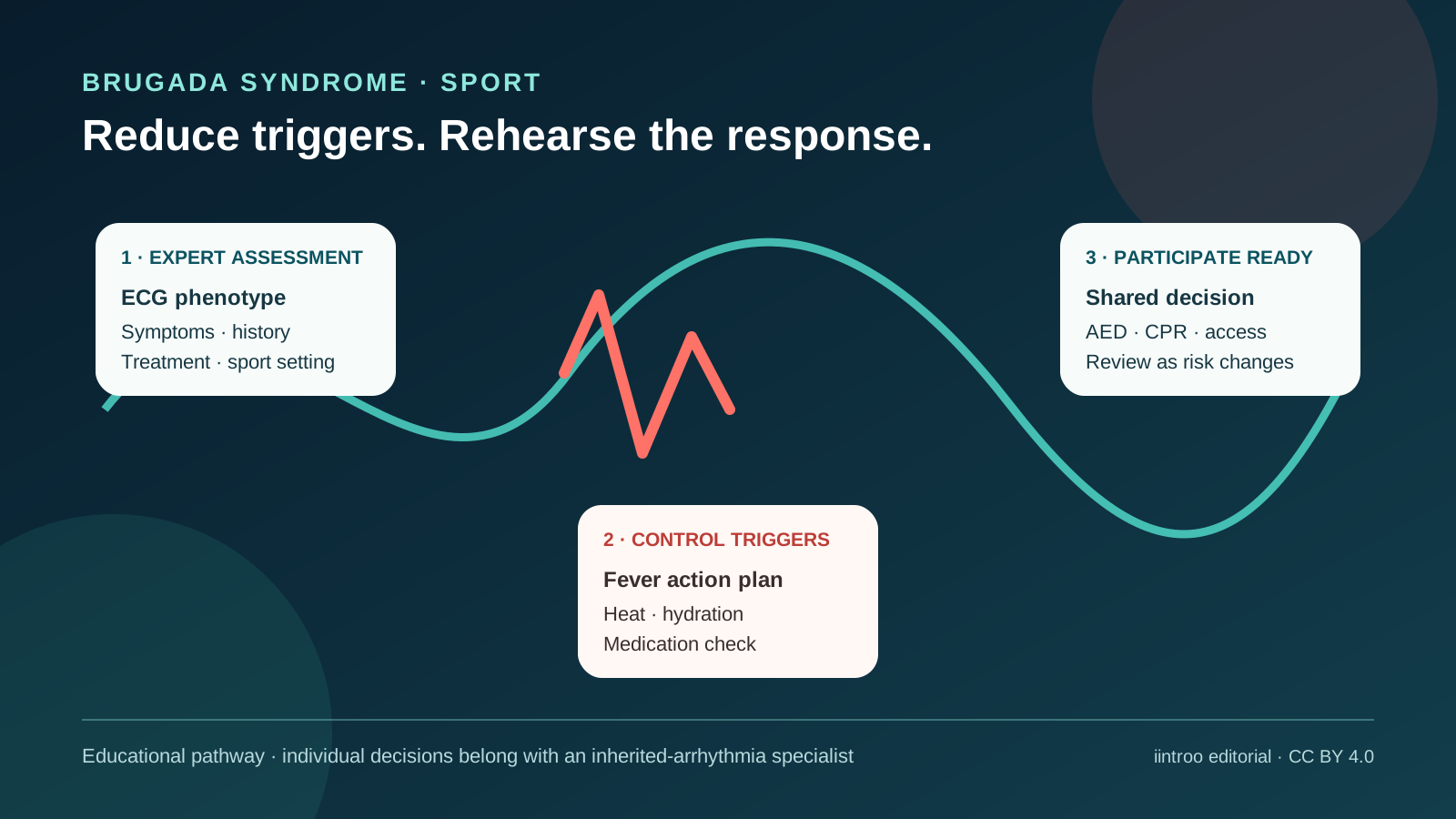
Key points
- Brugada syndrome is an inherited electrical heart disorder; a suspicious ECG pattern needs expert interpretation because fever, medicines and other conditions can alter the tracing.
- Recent athlete guidance does not support blanket sport exclusion after specialist assessment, but fever, hyperthermia and sodium-channel-blocking medicines are important triggers to manage.
- Participation decisions should reflect symptoms, spontaneous or induced ECG pattern, prior arrhythmia, treatment, sport environment and access to an emergency response.
Confirm the diagnosis and the athlete's actual risk
This guide is for athletes with confirmed or suspected Brugada syndrome and the teams around them. Brugada syndrome is an inherited cardiac channelopathy associated with a characteristic type 1 ECG pattern and a risk of dangerous ventricular arrhythmia. A single automated ECG label, a family genetic result or a tracing recorded during fever does not by itself define one athlete's risk. Evaluation belongs with a cardiologist or electrophysiologist experienced in inherited arrhythmia, who can integrate symptoms, family history, ECG phenotype, previous cardiac arrest or syncope and any device or treatment.
Fainting during exercise, seizure-like collapse, palpitations with near-fainting, nocturnal gasping or a family history of unexplained sudden death warrants prompt assessment. Collapse without a pulse requires the venue emergency plan, cardiopulmonary resuscitation and an automated external defibrillator, not a diagnostic debate at the sideline. Brugada syndrome can overlap with other causes of syncope, and not every faint is arrhythmic. Sport clearance therefore should not be inferred from a symptom checklist or from a normal training session.
Use modern participation guidance without promising zero risk
The 2024 Heart Rhythm Society athlete consensus states that there are limited data in athletes with Brugada syndrome and no evidence that exercise itself increases risk enough to justify blanket restriction. The 2025 American Heart Association and American College of Cardiology statement similarly considers competitive participation reasonable after expert assessment and management. These are shared-decision frameworks, not proof that every sport is safe. Evidence is largely observational, event numbers are small and highly selected specialist cohorts may not represent every athlete.
The older 2020 European sports cardiology guideline is more cautious about prolonged endurance events that can raise core temperature, particularly in warm or humid conditions. Differences between documents should be discussed rather than hidden. The practical decision considers whether the type 1 pattern is spontaneous or only induced, any arrhythmic symptoms, treatment, an implanted defibrillator, the intensity and environment of the sport, and the consequences of a sudden event. An ICD should not be implanted solely to make sport participation possible.
Treat fever and prevent avoidable hyperthermia
Fever can unmask the Brugada ECG pattern and trigger arrhythmia. Current guidance recommends prompt fever treatment and avoidance of exercise during febrile illness. The athlete should have a clinician-written action plan explaining when to check temperature, what usual fever medicine is appropriate, when an ECG or urgent review is needed and when emergency services should be contacted. This article cannot choose a drug or dose. A fever with fainting, sustained palpitations, breathing difficulty, confusion or severe deterioration needs urgent medical assessment.
Hyperthermia is a separate but related concern. For long events or hot climates, reduce avoidable exposure through acclimatization, environmental monitoring, fluid access, cooling opportunities and a stop plan; do not use a fixed hydration volume for everyone. Sauna, hot-tub and steam-room exposure also deserves discussion. Heat precautions should fit the sport and the individual rather than become a universal temperature threshold. Athletes with vomiting, dehydration or heat-illness symptoms should stop, cool and obtain appropriate care.
Check medicines and rehearse the emergency system
Some sodium-channel-blocking medicines can provoke the Brugada ECG pattern or arrhythmia. The BrugadaDrugs resource maintains expert-reviewed avoid and preferably-avoid lists, but medication changes still belong with the prescriber. The athlete should ask before starting prescription, over-the-counter, travel or recreational drugs and should not abruptly stop essential treatment after reading a list. Alcohol excess and very heavy meals are additional triggers noted in consensus guidance. A current medication list and diagnosis summary can reduce delay during travel or emergency care.
The emergency plan should identify the nearest AED, who calls emergency services, who starts CPR and how access works at training, competition, open water or a remote venue. Athletes with devices need additional review of impact, lead and inappropriate-shock risks. There is no universal Brugada return-to-play test or risk-free waiting period. This page cannot diagnose the condition, interpret a provocation test, prescribe fever treatment or clear competition; it supports specialist assessment, trigger control, shared decision-making and a rehearsed response if an event occurs.