
Cerebral palsy in sport: train the athlete, not a classification label
Athletes with cerebral palsy need goal-led training that respects individual movement, fatigue, pain, heat response and communication—not generic limits.
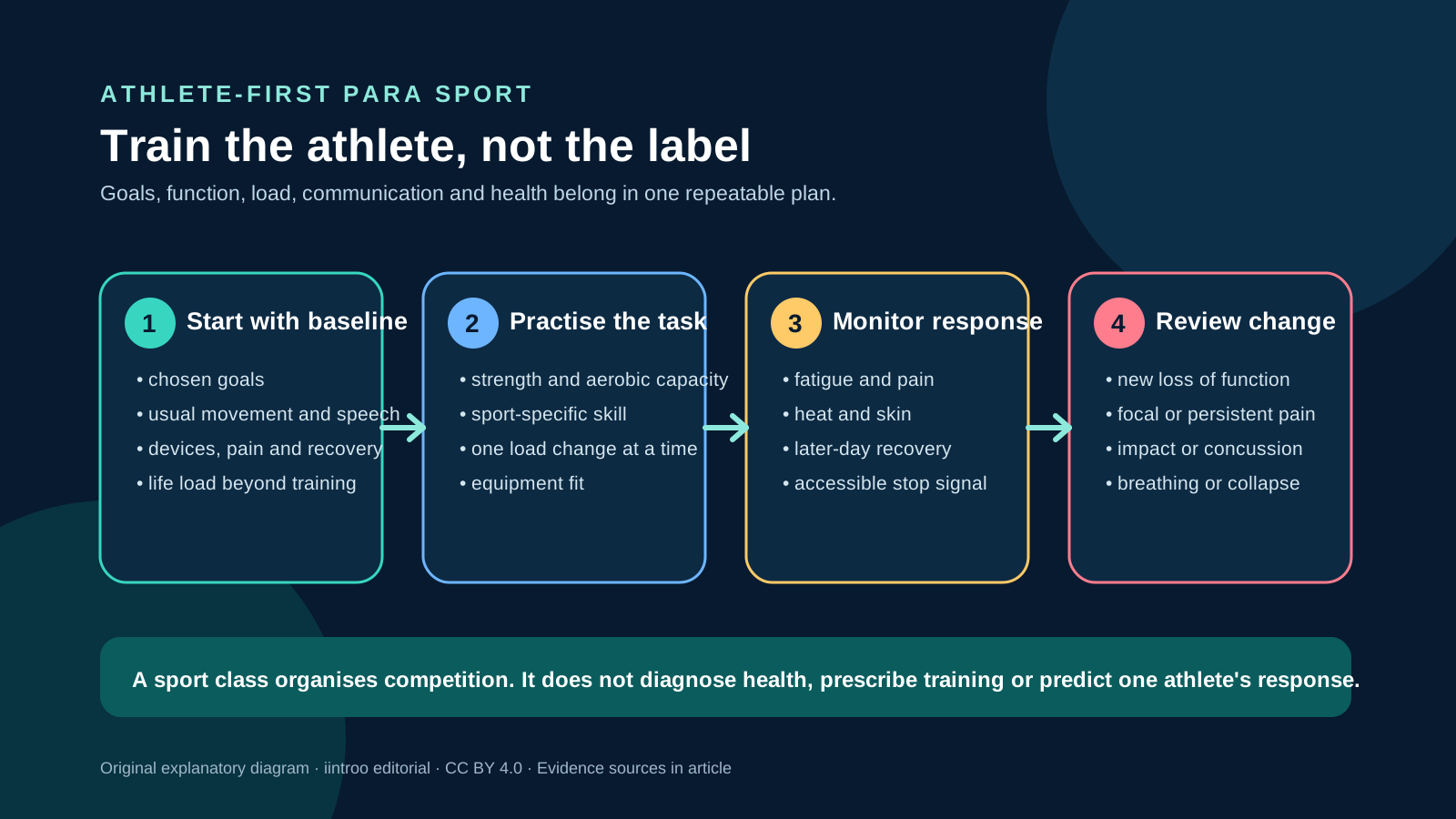
Key points
- Cerebral palsy describes a diverse group of lifelong movement and posture conditions; the diagnosis or sport class does not predict one athlete's strength, pain, communication or heat response.
- Resistance, aerobic and task-specific training can improve selected health and function outcomes, but athlete-performance studies are small and do not establish one optimal programme.
- A new loss of function, severe headache, collapse, breathing difficulty or a suspected concussion needs medical assessment rather than being attributed automatically to cerebral palsy.
Start with the athlete's baseline and chosen goals
This guide is for athletes with cerebral palsy, families, coaches, classifiers and health teams across CP football, Para athletics, swimming, cycling and community sport. Cerebral palsy is a group of lifelong conditions affecting movement and posture after an early brain disturbance, but its presentation is highly individual. Muscle tone, coordination, strength, balance, sensation, vision, speech, learning, pain and fatigue can differ between athletes and across the day. A diagnosis, Gross Motor Function Classification System level or sport class cannot replace a functional history and examination.
Begin with what the athlete wants to do and what their usual function looks like when well. Record mobility and transfer methods, assistive devices, orthoses, medicines, previous surgery, seizure or respiratory history where relevant, pain, sleep, bowel and bladder needs, communication preferences and the demands outside sport. NICE recommends access to services with neurological and rehabilitation expertise when adults need help participating in physical activity. A 2024 Para-athlete periodic-health statement similarly supports a sport- and impairment-specific baseline rather than a checklist built for non-disabled athletes.
Build strength and fitness without promising one response
International guidance for children and young people with cerebral palsy prioritises client-chosen goals, whole-task practice in real settings and family support. For an athlete, that means rehearsing the actual movement problem: accelerating to the ball, maintaining technique through a race, transferring safely, controlling a landing or repeating a stroke. Resistance, aerobic, balance and skill work can all contribute, but the exercise, equipment, rest and progression need to fit the athlete's movement pattern and sport rather than force every body toward the same technique.
A systematic review found that resistance training can improve strength in people with cerebral palsy, while evidence for direct sport-performance change in competitive athletes remained limited. A 2025 umbrella review also reported benefits for selected motor and functional outcomes but highlighted heterogeneity, small samples and incomplete adverse-event reporting. These findings support access to well-designed training; they do not prove that more strength will correct every gait pattern, that spasticity should be trained through, or that one programme prevents injury. Progress one load dimension at a time and compare with the athlete's own baseline.
Plan for fatigue, pain, heat and communication
Training cost may appear as reduced movement quality, more involuntary movement, slower communication, pain, prolonged fatigue or a longer recovery rather than one conventional workload number. Note session type, duration, surface, temperature, travel, device or orthosis changes and the athlete's response later that day and the next morning. Heat tolerance can differ with mobility, muscle activity, medication, sweating and access to cooling or fluid. Do not infer risk from impairment category alone, and do not use thirst, skin feel or a watch temperature as a clearance test.
Agree before practice how the athlete reports pain, dizziness, overload or a need to stop. Some people use speech, signs, a communication device, a partner or extra processing time. Staff should ask rather than guess and should not discuss private health details in front of teammates. Equipment fit, skin checks, toileting, transport and recovery access are training variables, not administrative extras. Persistent focal pain, repeated falls, skin breakdown, loss of device fit or a meaningful change in function deserves qualified review instead of simply reducing effort indefinitely.
Treat new symptoms as new information
Para-sport surveillance shows wide variation in injury and illness estimates and very limited evidence for prevention programmes. A three-year English Para-football study and a 2025 CP-football scoping review add sport-specific information, but their selected squads and small evidence base cannot define risk for every athlete. CP football's current rules require medical evaluation and removal when concussion is suspected. Baseline differences in balance, speech or movement should improve interpretation; they must not be used to dismiss a change after impact.
Stop and seek urgent care for severe or increasing headache, repeated vomiting, seizure, loss of consciousness, new weakness or sensation change, marked breathing difficulty, chest pain, collapse or a sudden loss of usual function. This page cannot diagnose cerebral palsy, prescribe tone management, change medication, interpret classification or clear competition. It supports goal-led training, accessible reporting, individual recovery and prompt assessment of new problems so that inclusion is built around the athlete rather than a generic disability label.