
Cervical artery dissection and sport: recognise stroke signs and individualise return
New neck or head pain with neurological signs after sport can signal cervical artery dissection. Urgent assessment comes before any return timetable.
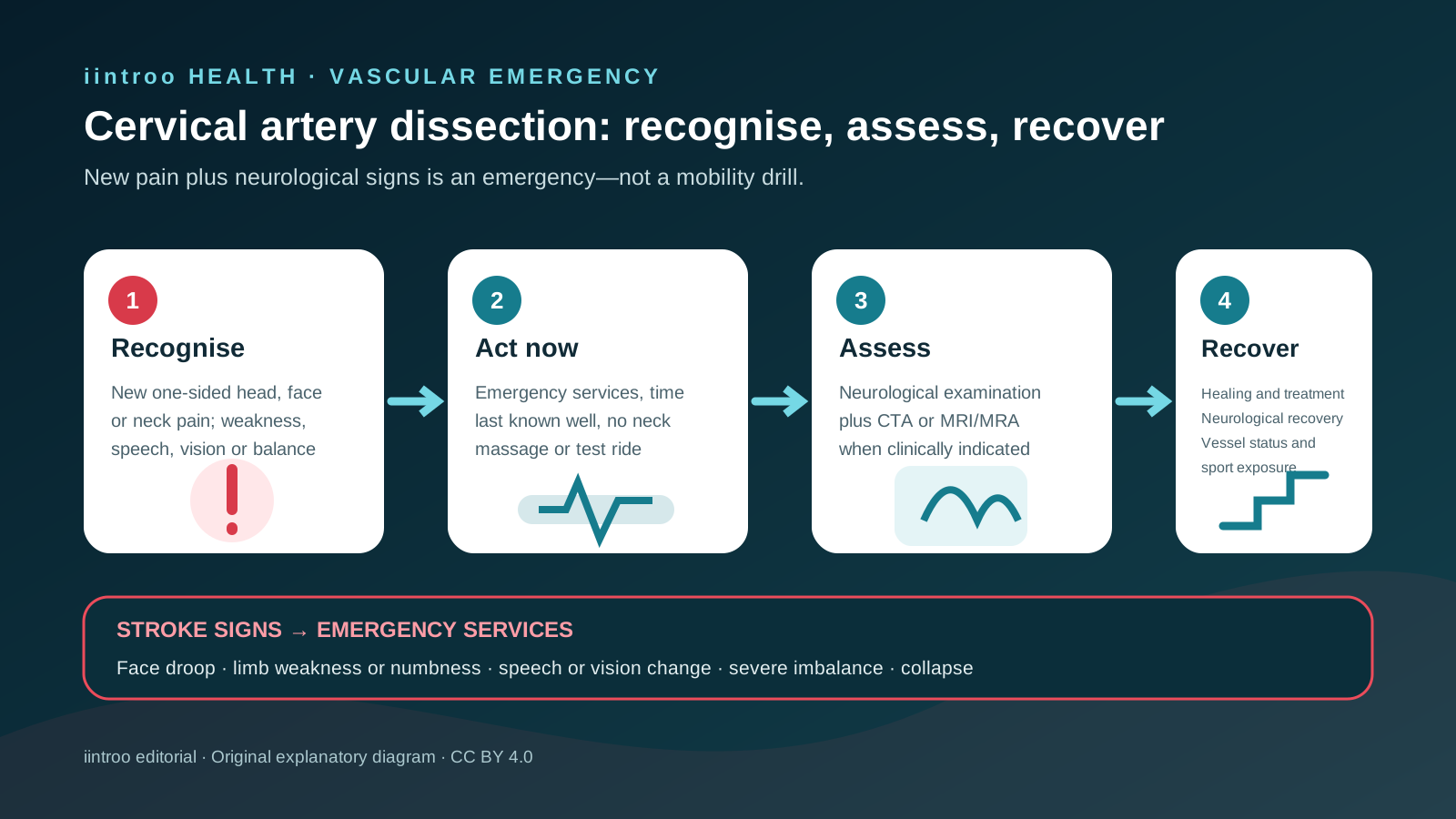
Key points
- Cervical artery dissection is an important cause of stroke in younger adults, but most sport-related neck pain is not a dissection.
- New head or neck pain with weakness, speech or vision change, imbalance or a partial Horner syndrome requires urgent medical assessment.
- Evidence for return to sport is limited; vessel healing, neurological recovery, treatment, sport exposure and individual risk shape the plan.
Recognise a rare emergency without diagnosing every stiff neck
This guide is for adult athletes, coaches and event teams after neck trauma or a new head-and-neck symptom. Cervical artery dissection is a tear or wall injury involving a carotid or vertebral artery and is an important cause of stroke in younger adults. It can occur without major trauma, and minor mechanical triggers are reported in some cases. Most neck pain after cycling, lifting, contact or an awkward movement has another cause, so neither the sport nor pain alone proves a dissection.
Activate emergency services for face droop, arm or leg weakness or numbness, speech difficulty, sudden vision change, severe imbalance, new loss of coordination, collapse or another possible stroke sign. New or worsening one-sided head, face or neck pain may precede ischaemic symptoms. A drooping eyelid with a smaller pupil, pulsating sound in one ear or new cranial-nerve symptoms also raises concern. Note the time the person was last known well; do not massage or manipulate the neck, offer a test ride or wait for symptoms to settle.
Use urgent clinical assessment and appropriate vascular imaging
The 2024 American Heart Association statement recommends a detailed symptom and trauma history, neurological examination and urgent vascular imaging when head or neck pain accompanies ischaemic symptoms or a partial Horner syndrome. CT angiography or MRI with MR angiography may be selected according to the situation, availability and contraindications. Ultrasound and catheter angiography have narrower roles. Imaging interpretation can be difficult; an ordinary neck X-ray, wearable, pulse check or symptom response to pain medicine cannot exclude a dissection.
Clinicians also consider stroke, migraine, cervical spine injury, nerve problems and other vascular diagnoses. Some people are assessed for fibromuscular dysplasia, connective-tissue features or additional arterial disease, but broad genetic or whole-body testing is not automatic for every athlete. Do not let a normal early session, young age or high fitness delay emergency assessment. Equally, an incidental vessel variant or nonspecific headache should not be labelled a dissection without qualified clinical and radiological review.
Separate acute treatment from sport decisions
Acute stroke treatment can include thrombolysis or mechanical thrombectomy in eligible patients, while antiplatelet or anticoagulant treatment after dissection is individualized. Those decisions belong to stroke and vascular specialists because vessel findings, brain injury, bleeding risk and other factors differ. An athlete must not stop antithrombotic medicine for training or competition. Collision, falls and remote environments may carry added consequences while treatment is active and need explicit discussion.
Recurrence appears uncommon overall, but the early months carry the greatest concern for worsening or another dissection. A 2024 systematic review found that estimates vary with study design and follow-up. A 2026 observational analysis found no definitive association between ordinary post-dissection physical activity and recurrence, while a trend with higher-intensity sport was imprecise and not statistically conclusive. These data support shared decisions; they do not prove that vigorous sport is harmless or causative.
Rebuild activity around healing, recovery and the actual sport
The AHA advises avoiding activities that raise cervical-injury risk during the early healing period, with duration individualized from roughly one to six months and until the index dissection has healed. A 2021 sports review proposed initial rest followed by low-intensity endurance activity, but openly acknowledged that its recommendations rely on case reports, analogy and expert opinion. Vessel status, neurological deficits, headache, blood pressure, treatment, connective-tissue features and the circumstances of the event all matter more than a generic date.
Return should progress from daily activity and supervised rehabilitation to low-intensity conditioning, then sport-specific movement only after the clinical team agrees. Cycling, martial arts, collision sport, heavy lifting, inverted positions and activities with forceful neck motion pose different exposures. Stop and seek reassessment for new head or neck pain, neurological symptoms, fainting or a sudden functional change. This page is general education, not diagnosis, imaging selection, antithrombotic advice, neck treatment or personal return-to-sport clearance.