
Marfan syndrome in sport: let the aorta, eyes and joints shape the plan
Marfan syndrome does not create one safe-sport list. Aortic status, treatment, eye and joint health, family history and sport demands shape participation.
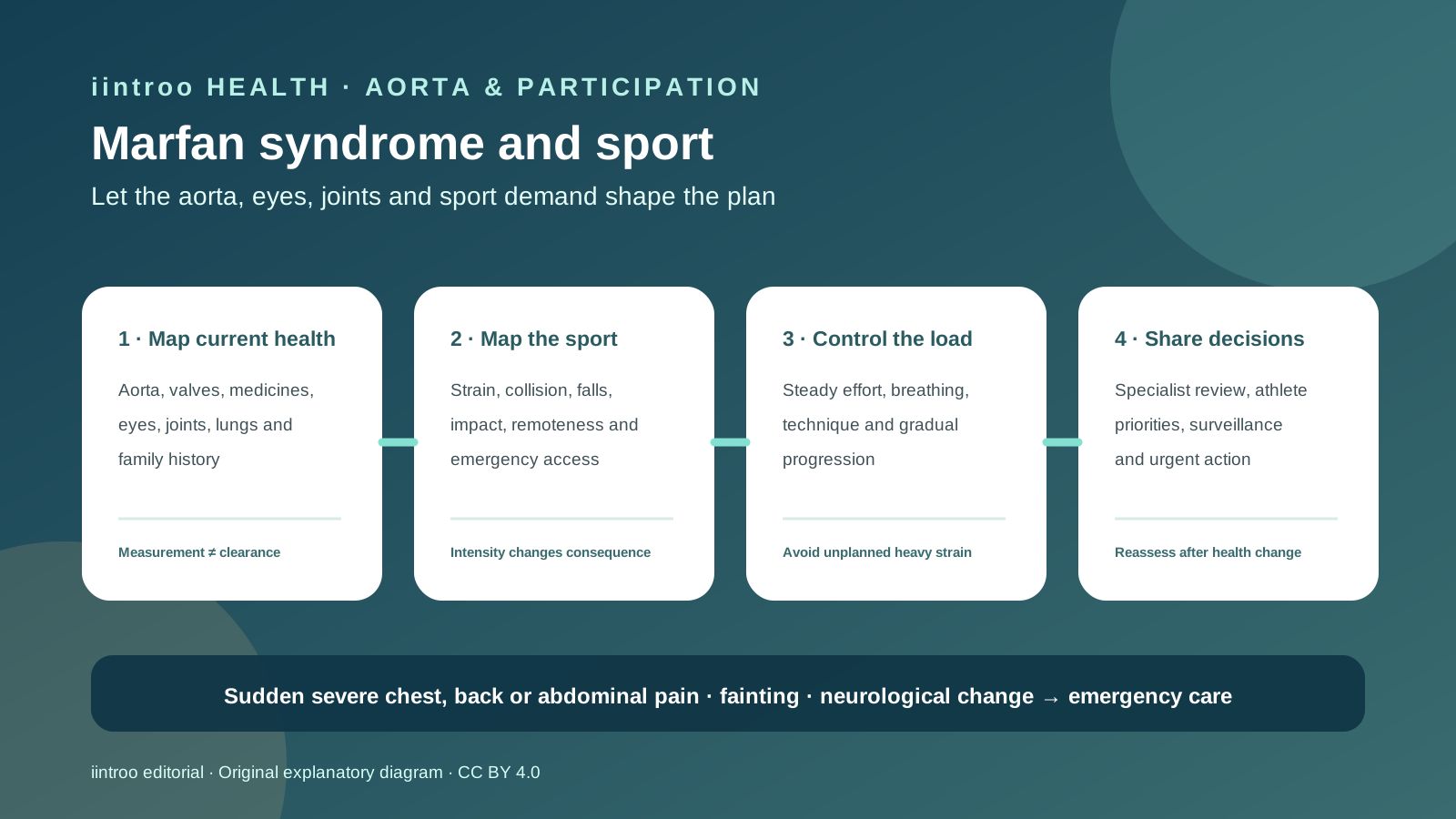
Key points
- Marfan syndrome is a multisystem connective-tissue condition; aortic measurements, growth, family history and treatment are central to sport decisions.
- Current guidance supports appropriate physical activity but warns that high-intensity strength physiology, heavy straining and collision consequences may change risk.
- Sudden severe chest, back or abdominal pain, fainting, major breathlessness or new neurological signs requires emergency assessment.
Start with the diagnosis, the whole aorta and the whole athlete
This guide is for people with Marfan syndrome, families, coaches and sport medical teams. Marfan syndrome is a genetic connective-tissue condition that can affect the aortic root and other vessels, heart valves, eyes, skeleton, lungs, skin and dura. Height, long limbs or flexibility alone do not diagnose it. Sport planning should use the specialist-confirmed diagnosis, current imaging, medicines, previous surgery, family history, symptoms and the athlete's priorities rather than a generic checklist copied from another person.
The 2025 AHA/ACC athlete statement recommends expert, condition-specific assessment for heritable thoracic aortic disease and standardized measurements of the aorta. The 2024 ESC aortic guideline also emphasizes individualizing activity in Marfan syndrome by aortic diameter, family history and prior fitness. Tall body size can complicate interpretation, and a single number without the imaging method, body context, growth rate and underlying diagnosis can mislead. Coaches should not interpret an echocardiogram or turn a social-media measurement into clearance.
Match pressure, collision and fall consequence to current risk
Map the sport before deciding what to modify. Heavy straining, breath-holding, maximal lifting, repeated high-intensity efforts, bodily collision, a blow to the chest, a hard fall, remoteness and delayed emergency access create different questions from steady recreational movement. Eye surgery, lens problems, joint instability, scoliosis, foot pain, previous pneumothorax or anticoagulation may add separate restrictions. A low-contact role or a controlled training version of an activity is not equivalent to unrestricted competition.
The newer AHA/ACC approach uses shared decision-making rather than assuming that every athlete with a normal-sized aorta has identical risk. It still states that high-intensity strength physiology may carry more risk in heritable aortopathy, and that aortic dilation or branch-vessel disease changes the balance further. The 2024 ESC guideline is more restrictive about competition. These differences make specialist discussion essential; this article cannot reconcile them for one athlete or convert aortic size into a universal list of allowed sports.
Build controlled activity without promising protection from dissection
Regular activity can support fitness, function and wellbeing. A small 2024 randomized study of personalized online training reported improvements in quality of life and physical capacity in selected participants with Marfan syndrome. The programme was supervised and individualized, and the sample and follow-up were not designed to prove long-term protection from aortic dissection. A 2026 review likewise found that evidence remains limited, so moderate exercise should not be presented as either forbidden for everyone or a treatment that makes the aorta safe.
Use the clinician-agreed intensity and monitoring plan. Progress duration, technique and resistance separately, favor controlled breathing and stop sets before straining replaces form. Painful end-range stretching is not a performance target for already lax joints. Review footwear, vision, balance and surface as well as cardiovascular load. Prescribed blood-pressure or aortic medicines should continue as directed; a coach should not alter timing or doses to change exercise heart rate. Consumer wearables cannot measure aortic stability.
Reassess after change and rehearse urgent action
The athlete's plan should state who reviews surveillance, which symptoms stop activity, how emergency information is carried and what changes trigger reassessment. New aortic growth, surgery, pregnancy planning, a medication change, eye surgery, a pneumothorax, repeated joint instability or a move to a more intense or collision-based discipline may alter the plan. Protect medical privacy: coaches need the practical limits and emergency steps agreed with the athlete, not unrestricted access to genetic or family information.
Sudden severe chest, back or abdominal pain, fainting, major unexplained breathlessness, a new neurological deficit or collapse requires emergency assessment. Do not drive the athlete to finish a session or wait for a wearable trace to normalize. There is no universal heart-rate ceiling, weight limit, aortic diameter or post-surgery interval that clears every person with Marfan syndrome. This page provides general education, not diagnosis, imaging interpretation, exercise prescription, medicine advice or personal eligibility and return-to-sport clearance.