
Chiari I malformation in young athletes: symptoms and imaging—not the scan label alone—guide sport
Chiari I malformation does not create one sport ban. Symptoms, a syrinx, neurological findings, treatment and sport demands shape individual decisions.
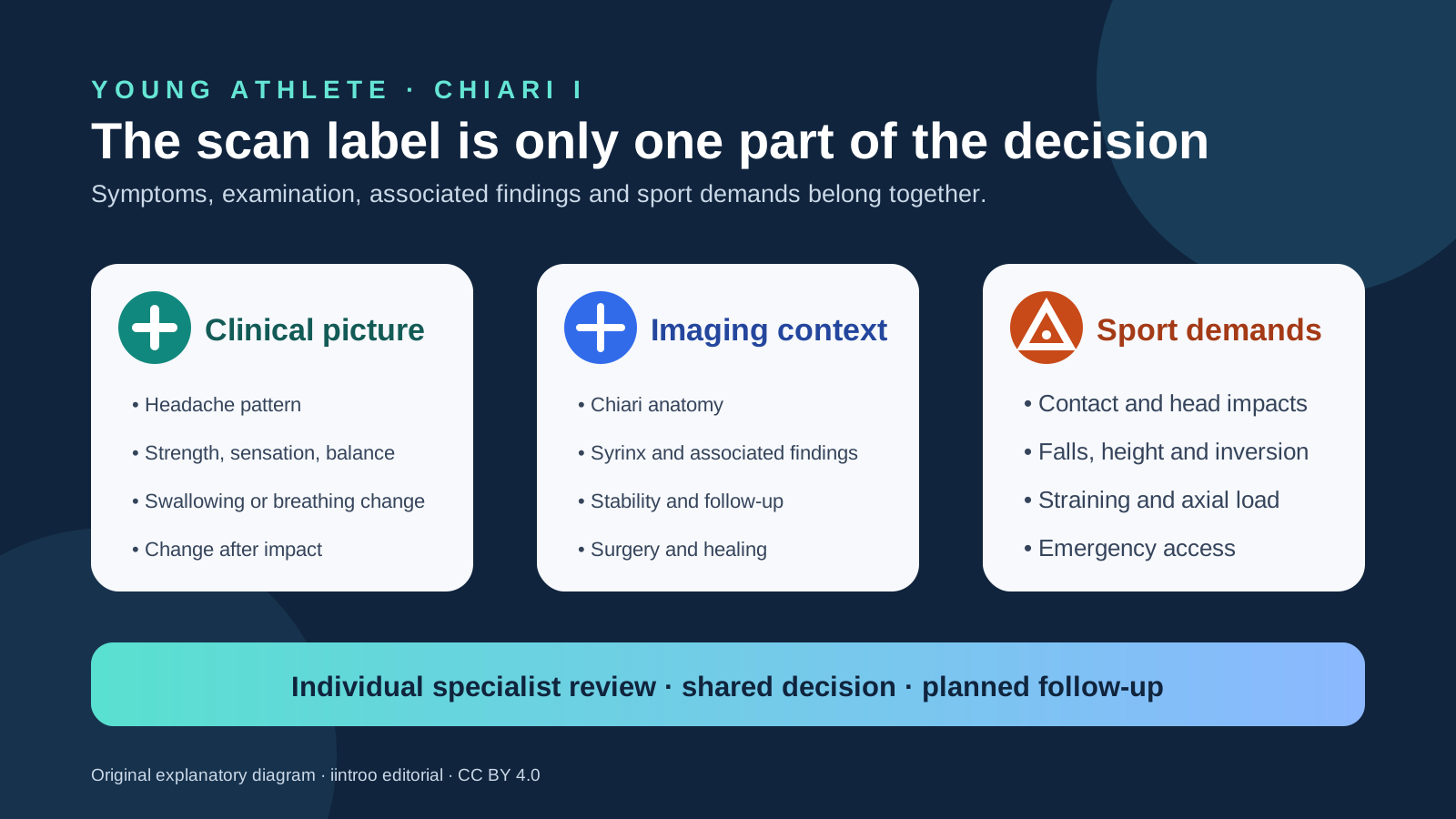
Key points
- An MRI description of Chiari I cannot by itself determine sport eligibility; symptoms, neurological examination, associated findings and the activity's consequences matter.
- Recent pediatric consensus and large observational cohorts support sport in many children, but the evidence does not erase the need for individual neurosurgical assessment.
- New weakness, numbness, balance change, swallowing or breathing difficulty, collapse or a severe unfamiliar headache needs medical review rather than a return-to-play test.
A scan finding is not a sideline diagnosis
This guide is for young athletes with Chiari I malformation, their families and sport staff working with permission. Chiari I describes downward displacement of the cerebellar tonsils at the opening at the base of the skull. It may be found while investigating headaches, scoliosis, neurological symptoms or after unrelated imaging. Some people have no symptoms; others have cough- or strain-related occipital headache, neck pain, dizziness, balance change, sensory or motor symptoms, swallowing difficulty, sleep-related breathing problems or features related to a spinal cord cavity called a syrinx. Those possibilities do not mean every headache or concussion symptom is caused by Chiari.
The Congress of Neurological Surgeons guideline emphasizes appropriate brain and spine imaging and clinical evaluation rather than interpreting tonsillar position in isolation. WFNS recommendations similarly separate asymptomatic, mildly symptomatic and progressive presentations. A coach cannot diagnose Chiari, compare millimetres on MRI or decide whether a syrinx is stable. The treating neurosurgical or neurological team should interpret imaging together with symptoms, examination, growth, scoliosis, previous surgery and the demands of the proposed sport.
Recognise changes that should stop participation
A familiar, medically assessed headache plan is different from a new or rapidly worsening neurological presentation. Stop activity and seek prompt assessment for new limb weakness or numbness, altered walking or coordination, repeated falls, new bowel or bladder dysfunction, swallowing or voice change, breathing difficulty, progressive neck or occipital pain, symptoms brought on by coughing or straining, or a major change after head or neck impact. Sudden severe headache, collapse, seizure, acute paralysis, loss of consciousness or breathing compromise requires emergency care.
Do not ask the athlete to repeat heading, tumbling, heavy straining or contact drills to see whether symptoms recur. Standard concussion assessment and graduated return processes still apply after a suspected concussion; Chiari does not make concussion symptoms automatically harmless or automatically catastrophic. The medical team should also know about a diagnosed syrinx, hydrocephalus, craniocervical instability, scoliosis progression or decompression surgery because each can change the risk discussion.
Use the evidence without promising zero risk
A 2023 prospective survey included 744 pediatric patients, 462 of whom played sport across thousands of seasons. It reported no permanent spinal cord injury or lasting neurological problem after concussion. An earlier multicentre cohort also found no catastrophic injuries, and the 2025 WFNS pediatric consensus concluded that children with Chiari I can play sport because clinical worsening appears uncommon. These findings are reassuring, but observational cohorts cannot prove that every anatomical pattern, symptom profile or collision exposure is safe.
A 2025 modified Delphi survey of 34 sport-spine surgeons reached consensus supporting high-impact, high-frequency sport for an asymptomatic Chiari malformation without a syrinx. That is expert opinion about a defined scenario, not permission for self-clearance or a rule for symptomatic athletes, enlarging cavities, abnormal examinations or recovery after surgery. Evidence is thinner for those groups and for rare catastrophic outcomes. Shared decision-making should state both the reassuring cohort data and the remaining uncertainty.
Build an individual sport and follow-up plan
The plan should record which symptoms matter, any current clinical restrictions, who can receive health information, what happens after head or neck injury and when reassessment is due. Sport demands differ: repeated heading, tackling, falls from height, inversion, heavy axial loading and remote aquatic activity create different consequences if neurological symptoms occur. Changes should be proportional and should preserve belonging where possible—for example technical work, supervised conditioning or a temporary non-contact role when approved—rather than imposing indefinite exclusion from the diagnosis alone.
After decompression or another neurological change, return is based on wound and tissue healing, symptoms, examination, imaging where clinically indicated and graded sport-specific tolerance. There is no universal Chiari return date, MRI distance or strength test. This page cannot diagnose Chiari, interpret a scan, recommend surgery, clear contact sport or replace emergency care. Its purpose is to support an informed conversation in which the athlete's goals, current clinical findings and the real demands of the sport are considered together.