
Clavicle fractures in sport: confirm healing before contact and crash exposure
A broken collarbone needs fracture-specific treatment, shoulder rehabilitation and evidence of healing before return to contact, overhead or crash-risk sport.
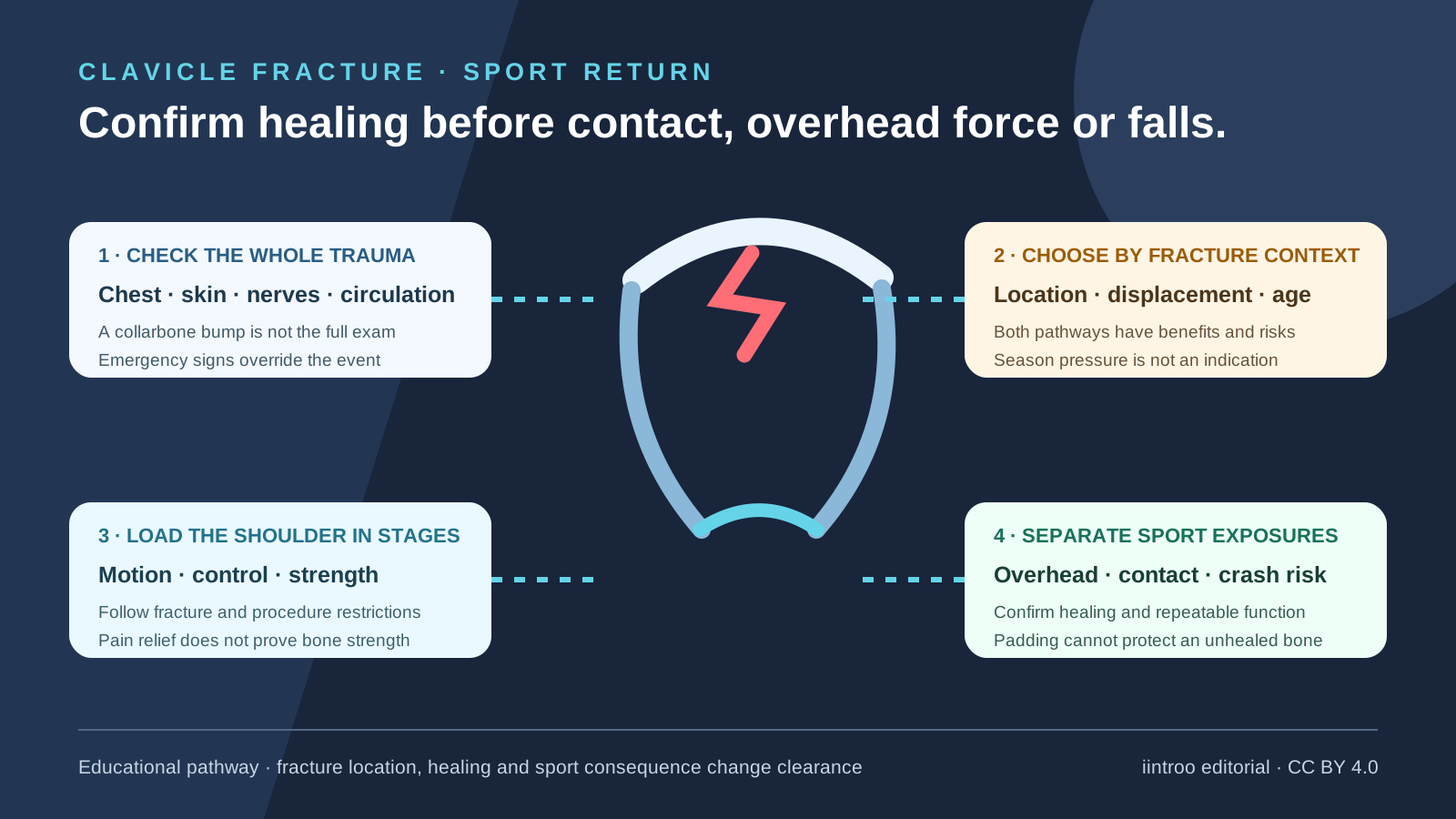
Key points
- Clavicle fractures differ by location, displacement, skin and neurovascular findings, associated injury and skeletal maturity; one athlete's treatment is not a template for another.
- Operative and nonoperative care can both lead to sport return, while surgery may improve early union outcomes in selected displaced adult fractures and also adds procedure-specific risks.
- Return should confirm clinical and radiographic healing where required, useful shoulder motion and strength, confidence and tolerance of sport tasks before collision or fall exposure.
Start with the whole trauma, not only the collarbone bump
This guide is for cyclists, rugby and ice-hockey players, overhead athletes and support teams after a fall or direct shoulder impact. A clavicle fracture can cause pain, swelling, deformity and difficulty lifting the arm, but the injury assessment must also consider the head, neck, chest, shoulder blade, ribs and skin. Emergency care is required for breathing difficulty, chest pain, loss of consciousness, an open wound, skin threatened by a sharp fragment, major deformity, uncontrolled bleeding, a cold or pale hand, absent pulse or progressive weakness or numbness.
Do not repeatedly press the fracture, pull the shoulder into position or send the athlete back because the hand still works. A clinician examines the limb and obtains appropriate imaging. Fracture location, displacement, shortening, comminution, skin condition, neurovascular status and associated injuries guide management. Paediatric and adolescent bones, distal fractures and polytrauma are not interchangeable with an isolated adult midshaft fracture.
Discuss union, function and treatment trade-offs honestly
AAOS guidance reports stronger union rates and better early patient-reported outcomes with operative treatment for selected displaced adult midshaft fractures, while long-term outcomes may become more similar. Nonoperative care remains appropriate for many fractures. In adolescents, evidence does not show the same automatic benefit from operating on a displaced midshaft fracture. Distal or medial patterns, open injury and threatened skin require their own specialist decisions.
Surgery can improve alignment or stability in selected cases but adds infection, numbness, hardware irritation, reoperation and refracture considerations. Nonoperative care can involve nonunion, symptomatic malunion or delayed function. A 2025 sport meta-analysis reported high average return after both pathways, but the included studies were heterogeneous and treatment selection was not random. Faster averages do not prove that surgery is the right route for a particular athlete or season.
Restore shoulder function while the fracture gains strength
Follow the treating team's sling, wound, motion and loading instructions. Rehabilitation commonly moves from protected hand, wrist and elbow activity to shoulder motion, then progressive scapular control, cuff and arm strength and sport-specific work as healing permits. Pain reduction alone does not show that the fracture can tolerate a tackle, goalkeeper dive, bicycle crash or repeated overhead force. Tobacco exposure, diabetes, nutrition, fracture pattern and complications can alter healing.
Track pain at the fracture, motion, strength, visible or palpable change, neurological symptoms and response after exercise. Increasing pain, new deformity, wound drainage, fever, arm swelling, numbness or a sudden loss of function needs reassessment. Hardware creates its own questions; removal is not routine for every athlete, and the period after removal can temporarily increase refracture risk. Those decisions belong with the surgical team rather than a competition calendar.
Separate conditioning return from contact and crash return
A staged return can preserve lower-body conditioning and non-contact skills within restrictions, then add shoulder loading, overhead work, falls training, contact and full practice. Clearance considers clinical healing, radiographic union when indicated, pain-free useful motion, strength and the demands and consequences of the sport. Protective padding may reduce superficial impact but cannot make an unhealed bone safe. A trainer's ability to tape the area is not evidence of union.
The 2025 meta-analysis pooled 33 studies and found generally high return rates, but location, treatment and reporting varied and heterogeneity was substantial. It cannot set one month for all fractures. Rebuild emergency braking, bike handling, stick or ball control and safe falling only when the clinical plan permits; fatigue can expose protective movement patterns that a fresh single repetition misses, especially during crowded practice and unexpected contact late in demanding training. This article cannot classify the fracture, choose surgery, prescribe rehabilitation or clear collision. It supports emergency recognition, fracture-specific shared decisions and a return that proves the shoulder and healed bone can tolerate the athlete's actual overhead, contact and fall exposure.