
Coarctation of the aorta in athletes: blood pressure and imaging shape participation
Repaired coarctation still needs lifelong surveillance. Resting and exercise blood pressure, aortic imaging and individual sport demands guide participation.
Key points
- Successful repair does not end follow-up: hypertension, residual or recurrent narrowing and aortic complications can still matter.
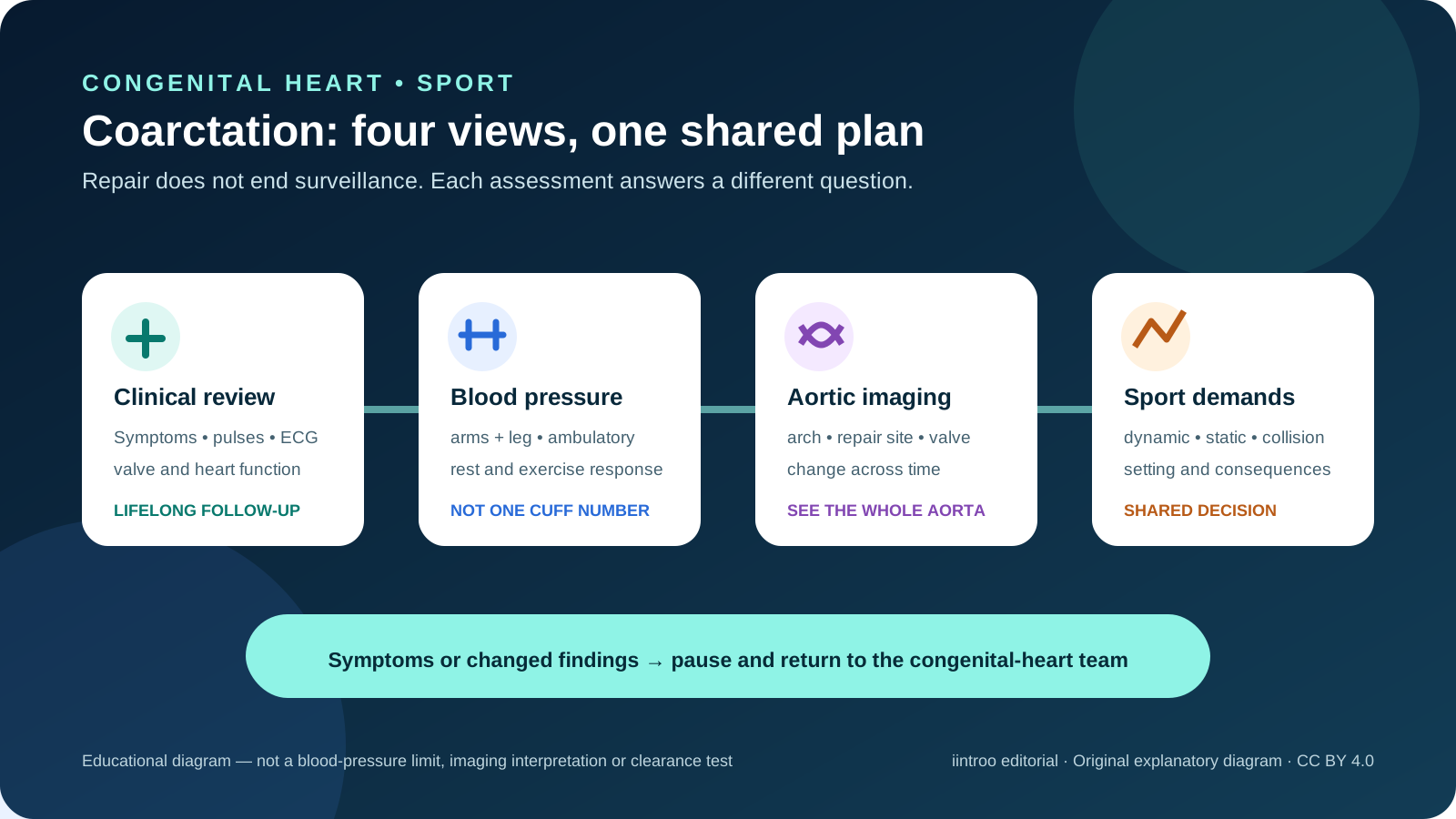
- Blood pressure in both arms and a leg, cross-sectional aortic imaging and an exercise response provide different pieces of the assessment.
- Sport advice is individualized by anatomy, blood pressure control, symptoms, testing and the pressure and collision demands of the activity.
Treat repair as the start of surveillance, not the end
This guide is for athletes with unrepaired, repaired or stented coarctation of the aorta, and for families, coaches and clinical teams. Coarctation is a congenital narrowing in the aortic arch. Repair can greatly improve circulation, but it does not remove every long-term issue. Residual or recurrent obstruction, high blood pressure at rest or during exercise, aortic enlargement, aneurysm at a repair site, bicuspid aortic valve disease and premature vascular disease may still affect care. The 2025 AHA/ACC sports statement therefore calls for longitudinal surveillance even after an apparently successful repair.
Chest pressure, fainting, unexplained breathlessness, a new sustained palpitation, sudden severe chest or back pain, new weakness or speech or vision change requires urgent medical assessment. A headache during a hard effort has many possible causes and is not itself proof of aortic trouble, but recurrent exertional symptoms should not be normalized or tested with another maximal session. An athlete who feels well may still have hypertension, so symptoms and performance cannot replace scheduled congenital cardiology follow-up.
Build the assessment from anatomy, pressure and function
The assessment may include blood pressure in both arms and at least one leg, pulses, a 12-lead ECG and echocardiography. MRI or CT is used to see the entire thoracic aorta and repair region when ultrasound cannot. The ACC follow-up algorithm notes that older children and adults often need cross-sectional imaging because acoustic windows are limited. The team considers residual gradient, collateral vessels, aortic dimensions, valve function, ventricular structure and whether measurements are changing. A single cuff value, smartwatch estimate or Doppler gradient does not provide a complete clearance decision.
Exercise testing can measure workload, rhythm, symptoms and the blood-pressure response under controlled conditions. The AHA congenital-heart CPET statement notes that exercise-induced hypertension is common even after well-repaired coarctation and is linked with later hypertension. That association does not make one peak pressure a stand-alone diagnosis. Test method, age, body size, resting pressure, medicine and anatomy all matter. Ambulatory blood-pressure monitoring can reveal masked hypertension outside the clinic, while serial imaging answers a different question about the aorta itself.
Match the sport conversation to its actual load
Competitive participation may be reasonable after specialist evaluation when there are no concerning findings, but the plan is not derived from the sport name alone. Rowing, cycling, weightlifting and paddling combine dynamic work, sustained pressure and sometimes collision or remote-environment consequences in different proportions. Heavy bracing or maximal static effort can produce large transient blood-pressure loads. A repaired arch with controlled pressure and reassuring testing is a different situation from residual obstruction, uncontrolled hypertension, aortic enlargement or symptoms. Shared decision-making should make those differences explicit.
Medication changes, stent status and another congenital lesion may alter the plan. An athlete should not skip prescribed antihypertensive medicine to change race sensations, nor use a warm-up as a blood-pressure test. The team may adjust intensity, resistance work, monitoring or competition while an issue is treated or investigated. In collision sport, previous sternotomy, an implanted device or antithrombotic treatment can add separate considerations. Those factors require clinical advice rather than a universal list of permitted and prohibited sports.
Keep training progression tied to evidence and follow-up
When the congenital-heart team supports training, progression can move from comfortable aerobic work to controlled intervals, resistance and sport-specific demands while monitoring symptoms and the agreed blood-pressure response. A graded programme can improve fitness in many people with congenital heart disease, but published studies pool different lesions and rarely establish event rates for one sport. Repeating clinical review and testing at the interval set by the specialist matters more than a one-time clearance letter. New symptoms, reduced tolerance or a treatment change should reopen the discussion.
The 2025 AHA/ACC statement and adult congenital-heart guideline favour individualized assessment over blanket exclusion, yet they also acknowledge limited direct evidence for competitive sport in specific congenital lesions. Advice remains partly consensus-based. This page cannot determine whether a repair is complete, interpret an imaging gradient, set a safe pressure limit, change medication or clear an athlete. It offers a framework for a congenital cardiology appointment and a shared, documented participation plan.