
Collagen supplements for athletes: promising tendon signals, uncertain recovery claims
Collagen research shows some tendon-structure signals when paired with loading, but small trials do not prove faster healing, stronger muscles or guaranteed return to sport.
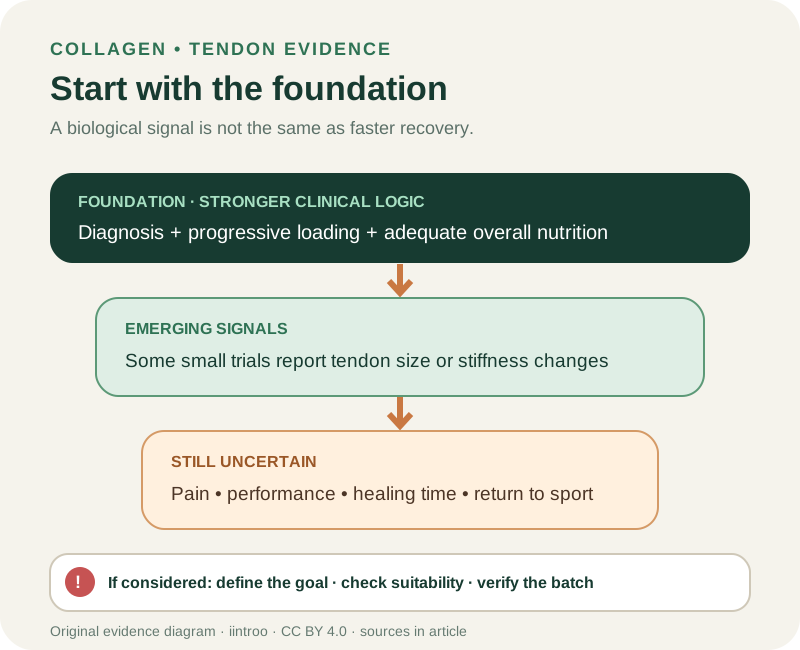
Key points
- The Australian Institute of Sport places collagen in Group B: emerging evidence suited to case-managed or research-monitored use.
- A 2026 review found possible tendon structural effects, but its eight trials were small, short and overwhelmingly male.
- Collagen is not a substitute for diagnosis, progressive loading, adequate overall nutrition or product risk checks.
Start with the question the supplement is meant to answer
This guide is for athletes, coaches and support teams considering collagen or gelatin for tendon pain, injury recovery, joint symptoms or performance. These are different outcomes. A product that changes an amino-acid concentration or laboratory marker has not automatically repaired an injured tendon, reduced pain or shortened return to sport. Define the clinical or performance question before interpreting a study or buying a powder.
The Australian Institute of Sport classifies collagen support in Group B, meaning emerging scientific support that deserves further research and may be considered in identified cases under research or clinical monitoring. That is not a general recommendation for every athlete. The IOC supplement consensus likewise places ordinary diet, health assessment and a clear evidence-based rationale before product use.
Read tendon findings alongside trial limitations
A 2026 systematic review included eight randomised trials with 257 participants. Some studies reported larger changes in tendon cross-sectional area or stiffness when collagen was combined with resistance or plyometric training. Training was present in every included study, protocols varied and the review could not perform a meta-analysis. Only 11 participants were women, which sharply limits generalisation.
A separate controlled trial in 25 young men found that twice-daily collagen peptides raised circulating collagen-related amino acids but did not further increase measured muscle connective-tissue or myofibrillar protein synthesis during one week of hard resistance training. The results do not prove collagen never helps; they show why biomarkers, structure, symptoms and performance must not be treated as interchangeable outcomes.
Loading and rehabilitation remain the main intervention
Tendon adaptation depends on an appropriate mechanical stimulus. For an injured athlete, diagnosis, symptom response, progressive loading and sport-specific rehabilitation remain central. A supplement cannot correct an unsuitable training dose, missed diagnosis or return plan that advances faster than function. If a trial combined collagen with structured exercise, the benefit cannot be assigned to the powder alone.
Pain reduction is also not proof of tissue healing, and a change in tendon thickness or stiffness is not automatically better for every condition. Track the outcome that matters: function, symptoms, training tolerance and agreed clinical measures. Seek assessment for sudden rupture signs, marked weakness, swelling after trauma, persistent night pain or symptoms that do not follow the expected course.
Check nutrition, suitability and product risk
Review total energy, protein distribution, dietary variety and the athlete's actual requirements with a qualified sports dietitian. Collagen is not a complete protein source for muscle adaptation and should not displace higher-quality protein or food needed for overall recovery. Animal source, allergies, gastrointestinal tolerance, cultural preferences, cost and interactions with a medical plan can all affect suitability.
No supplement is risk free. Multi-ingredient products can contain undeclared or prohibited substances, and a familiar brand name does not verify every batch. Use the responsible anti-doping organisation's current advice and independently batch-tested products when a supplement is justified. Batch testing reduces contamination risk; it does not prove clinical benefit or guarantee immunity from an anti-doping violation.
Avoid copying a research dose into personal treatment
Studies have used different collagen forms, amounts, timing, vitamin C co-ingestion and training protocols. Those variables, short follow-up and small samples prevent one universal regimen. Vitamin C is required for normal collagen synthesis, but more is not automatically better when dietary intake is adequate. Do not convert a review's study characteristics into a prescription without individual assessment.
A sports physician, physiotherapist and sports dietitian can decide whether the priority is diagnosis, load modification, rehabilitation, nutrition or a monitored supplement trial. Record the exact product, batch, target outcome, start date, other care and review point so an ineffective or poorly tolerated product is not continued by habit. This article does not prescribe collagen, treat a tendon injury or promise faster return to sport.