
Achilles tendinopathy in runners: rebuild tendon capacity, not just mileage
Persistent midportion Achilles pain needs a clinical diagnosis and progressive tendon-loading plan. Return to running should reflect symptoms, strength, function and next-day response—not one calendar date.
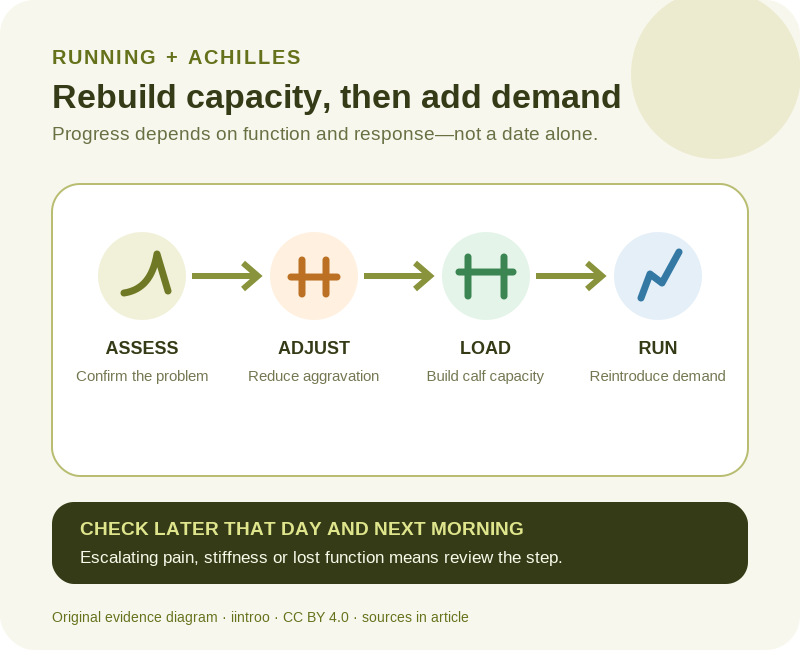
Key points
- Midportion Achilles tendinopathy is usually diagnosed clinically; imaging is not automatically required for every runner.
- Progressive tendon-loading exercise is a first-line rehabilitation approach, while complete rest alone does not rebuild capacity.
- Return to running is individual and should track function and next-day response as well as pain during the session.
Confirm the problem before copying a programme
This guide is for runners, coaches and rehabilitation teams. Midportion Achilles tendinopathy commonly produces local pain and stiffness in the tendon above the heel, often linked to running or calf loading. The 2024 clinical guideline describes diagnosis as primarily clinical, using history and examination rather than requiring imaging for every case.
Pain at the tendon insertion, sudden trauma, a pop, marked weakness, major swelling, inability to push off, calf swelling or neurological symptoms can point to a different problem and need prompt assessment. Imaging may be appropriate when the diagnosis is uncertain, recovery is atypical or another condition is suspected.
Adjust load without abandoning capacity
The goal is to reduce aggravating exposure enough to settle the problem while keeping safe activity where possible. Training changes can include running volume, pace, hills, surfaces, footwear transitions, jumping and strength work. The relevant load is the combined week, not only the run that hurts most.
Complete rest may reduce symptoms temporarily but does not rebuild the tendon's ability to tolerate running. The 2026 conservative-management review found the strongest evidence for exercise-based rehabilitation and cautioned against treating adjunctive modalities as stand-alone solutions. The plan must still match diagnosis, irritability and function.
Progressive loading is broader than one eccentric routine
The 2024 guideline recommends tendon-loading exercise with loads as high as tolerated, delivered at least three times weekly within an individual plan. Loading can include isometric, isotonic, eccentric, concentric and later faster or energy-storage work; one famous heel-drop protocol is not the only valid route.
A 2026 meta-analysis of 21 randomised trials found improvement with eccentric exercise but did not establish that it is superior to every other conservative approach. Study protocols and comparators varied. A clinician should progress load using the runner's capacity and response rather than chasing soreness or prescribing a universal number of repetitions.
Reintroduce the specific demands of running
Walking comfort and calf strength do not automatically equal readiness for continuous running, hills or speed. A staged return may move through lower-impact conditioning, calf-loading milestones, short run-walk exposure, continuous easy running and then faster or uphill work. The order and size of each step depend on the athlete and goal.
Track symptoms during the session, later that day and the next morning alongside function such as calf-raise capacity and running mechanics. A tolerable response may differ between athletes; rapidly escalating pain, worsening stiffness or declining function means the plan needs review. A single pain score cannot provide clearance.
Review the system when progress stalls
Reassess the diagnosis, adherence, total training load and exercise progression before adding passive treatments. Sleep, recovery, energy availability, other health conditions and medication can affect the wider picture. Footwear or orthoses may help selected runners, but neither is a universal cure.
Recovery can take time and recurrence can occur when competition demands return faster than capacity. The practical endpoint is not merely a pain-free day: it is durable tolerance of the runner's actual volume, speed, terrain and strength demands. Medical or physiotherapy review is appropriate when symptoms persist or the expected trajectory changes.