
Trail-running hydration: why more fluid is not always safer
Understand overdrinking and exercise-associated hyponatremia, the limits of sports drinks, and why an unwell runner needs assessment rather than guesswork.
Key points
- Overdrinking can cause serious harm during prolonged activity.
- Sports drinks and salt do not make excessive fluid intake safe.
- Confusion, seizures or loss of consciousness require urgent medical help.
A question for runners and support crews
On a long trail outing, access to water and help can change between sections of the route. Planning matters, but a rule to drink at every opportunity regardless of need can create another problem. Exercise-associated hyponatremia means a low blood sodium concentration arising during or after exercise; serious cases can be life-threatening.
This guide is for adult runners and the people supporting them. It is an explanation of risk, not a personalised drinking schedule or instructions for treating a sick participant.
Sources: 1
The problem is not only salt lost in sweat
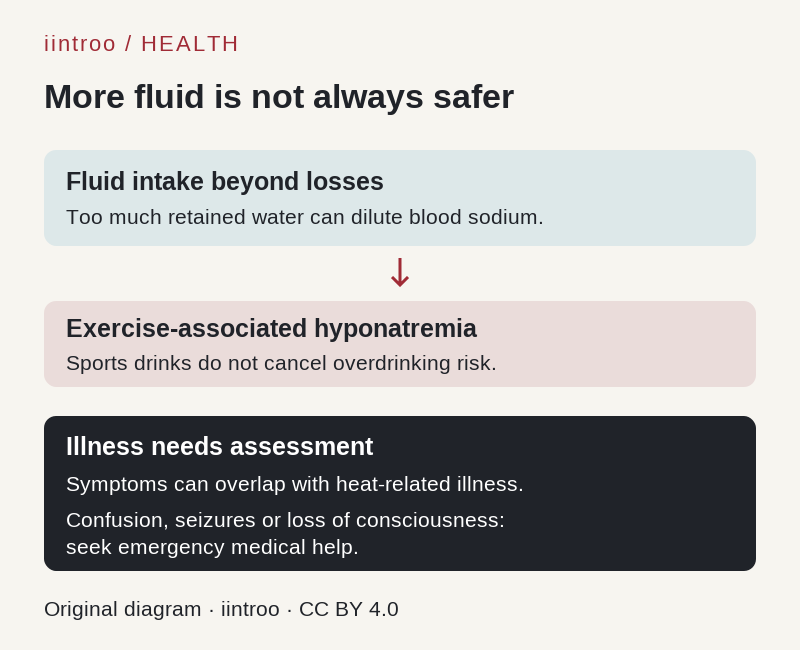
The international consensus identifies sustained fluid intake beyond losses as a major risk factor. Retaining too much water relative to the body's sodium can lower the sodium concentration in the blood. The body's regulation of water during exertion also matters, which is why a simple bottle-count rule cannot diagnose or exclude the condition.
Water is not the only drink involved. Sports drinks can also contribute when consumed excessively. Their sodium content does not neutralise the effect of overdrinking. Adding a salt product should therefore not be treated as permission to keep forcing fluid.
Sources: 2
Practise an individual approach before the event
The WMS guideline places avoiding overdrinking at the centre of prevention. Drinking in response to thirst is a key strategy for many participants; individual planning may also use experience from training. Fluid losses vary with the athlete, effort and conditions, so there is no universal hourly volume for every trail runner.
Discuss unusual fluid needs, medical conditions or previous hydration problems with a qualified professional before a remote event. Rehearse access to drinks during training without trying to meet an arbitrary quota. This guidance is not a reason to deliberately dehydrate or ignore a medical plan.
Sources: 1
An unwell runner needs assessment
Headache, nausea, vomiting, weakness and fatigue can occur with both hyponatremia and heat-related illness. Those symptoms alone do not tell a support crew which condition is present. Confusion, seizures or loss of consciousness require emergency medical help.
Contact the event medical team or local emergency services and explain the route location, symptom progression and known fluid intake. Do not assume every struggling runner simply needs more water. Clinicians may need blood sodium measurement and other assessments; this article does not provide a field-treatment protocol.
Sources: 3
Turn the evidence into a crew briefing
Agree how the runner will communicate at checkpoints and who will contact medical support. Keep the event's emergency contact and access information available. A crew briefing can explicitly separate offering drinks from pressuring someone to finish every bottle.
The evidence comes from varied endurance and outdoor settings. It does not validate one plan for every distance, climate or athlete. Event instructions and professional advice should account for the actual conditions; neither an electrolyte label nor an online article supplies medical clearance.