
Congenital adrenal hyperplasia in sport: plan exercise, illness and medicine
Athletes with congenital adrenal hyperplasia need reliable treatment and an emergency plan. Routine exercise does not automatically require extra steroid dosing.
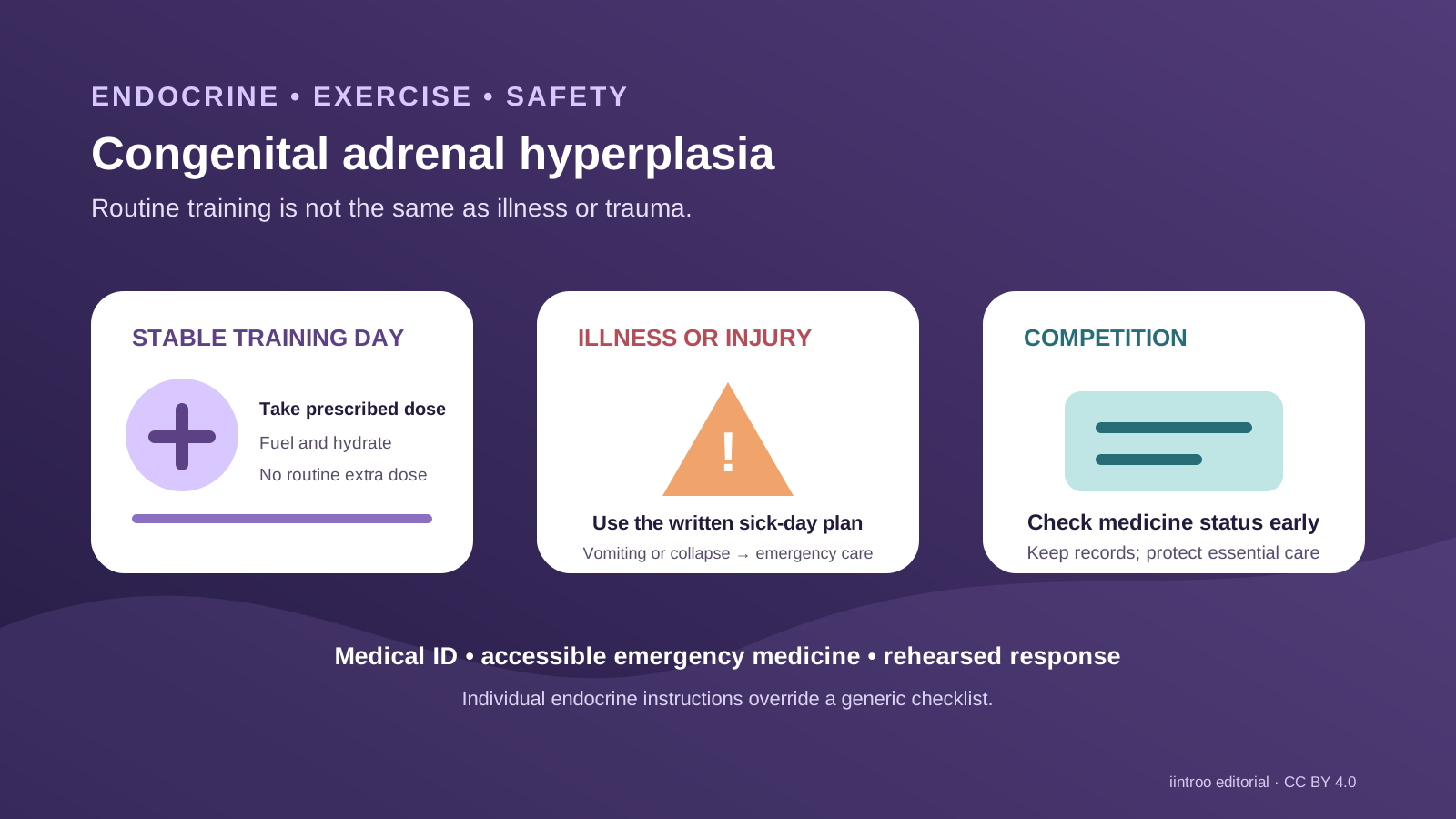
Key points
- Classic congenital adrenal hyperplasia usually includes cortisol deficiency and requires continuous specialist-managed glucocorticoid replacement.
- Endocrine Society guidance recommends against routinely increasing glucocorticoids before ordinary physical exercise; illness, trauma and individual history are different contexts.
- Competition rules may restrict some glucocorticoid routes in-competition, so essential treatment and therapeutic-use documentation should be planned early.
Separate everyday exercise from adrenal emergency risk
This guide focuses on athletes with congenital adrenal hyperplasia caused by 21-hydroxylase deficiency, especially classic disease. Classic CAH usually impairs cortisol production and may also impair aldosterone, while androgen production is altered. Treatment, salt-wasting risk and emergency needs vary by phenotype and person. Fatigue, dizziness or poor performance is not enough to diagnose CAH, and a person with nonclassic CAH does not automatically have the same adrenal-insufficiency plan as someone with classic disease or treatment-related suppression.
Endocrine Society guidance recommends continuous individualized care, medical identification and education about emergency glucocorticoid use. It specifically recommends against automatically increasing glucocorticoid doses before routine physical exercise. That statement should not be stretched to vomiting, fever, major injury, surgery, heat illness or an athlete unable to keep medication down. Those situations can require a clinician-approved sick-day or emergency plan. Collapse, confusion, severe weakness, repeated vomiting, severe abdominal pain, low blood pressure or rapid deterioration requires urgent emergency care.
Use limited exercise studies without overgeneralizing
Small laboratory studies found reduced epinephrine and glucose responses in people with classic CAH during brief high-intensity or prolonged moderate exercise. In a separate crossover experiment, an extra hydrocortisone dose before short high-intensity exercise did not improve performance or perceived exertion. These studies were small, used controlled protocols and cannot define the right dose, carbohydrate strategy or safe intensity for every athlete. They support planning and monitoring, not self-directed steroid escalation.
A 2025 laboratory study explored adrenal steroid responses during exercise in heat and raised a hypothesis about nonclassic CAH and heat susceptibility. It does not establish that all people with CAH are heat-intolerant or justify population screening from one physiological signal. Athletes can use ordinary heat-risk controls—acclimatization, access to fluids, environmental monitoring, recovery and a clear stop plan—while the endocrine team addresses individual adrenal risk. New heat symptoms, unusual hypoglycaemia or repeated exercise intolerance deserves clinical review rather than a larger unprescribed dose.
Make medicine access and anti-doping paperwork practical
Daily replacement should remain reliable across school, training, travel and competition. The athlete and authorized support people should know where routine and emergency medicine is stored, who can administer it, how local emergency services are reached and what happens if vomiting prevents oral dosing. Medical identification and an emergency information card are especially valuable when the athlete is away from family. These plans should be rehearsed without turning the athlete into a diagnosis or disclosing private information to an entire team.
The 2026 World Anti-Doping Agency Prohibited List bans glucocorticoids in-competition when administered by oral, rectal or injectable routes, with route-specific washout considerations. Mineralocorticoids and medically required replacement create additional documentation questions. An athlete should use an official medication-checking service and work with the prescribing clinician and anti-doping organization on a therapeutic use exemption where applicable. Anti-doping administration must never cause abrupt withdrawal or delay emergency treatment; complete records can support a prospective or, in genuine emergencies, potentially retroactive process.
Progress training while protecting growth and long-term health
CAH management also considers growth in young people, blood pressure, weight, bone health, metabolic risk, reproductive health, mental health and signs of over- or under-replacement. Training can include aerobic, strength and sport-skill work, progressed from stable routine sessions toward higher intensity and environmental complexity. A 2026 qualitative study found that some adults with CAH undertook demanding physical activities, but lived experience cannot establish medical safety or performance effects. It does show why plans should enable participation rather than impose blanket exclusion.
There is no validated CAH return-to-sport test. Review is useful after adrenal crisis, major illness or trauma, repeated hypoglycaemia, treatment change, new heat exposure or a move into remote or collision sport. This page cannot calculate replacement or stress doses, diagnose an adrenal crisis, prescribe emergency injections, interpret hormones or complete a TUE. The safe framework is stable endocrine care, a written illness and injury plan, reliable access to medicine, ordinary exercise progression and early coordination with competition medical and anti-doping systems.