
Cricket finger injuries: stop, assess and rebuild hand function
A cricket ball can turn a jammed finger into a fracture, dislocation or tendon injury. Protect it, seek assessment and return by function, not tape.
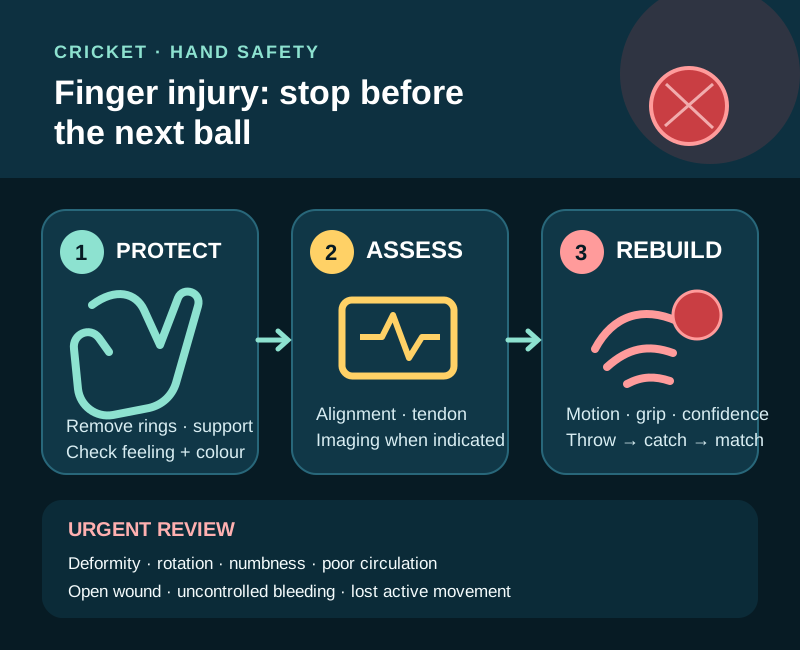
Key points
- Professional-cricket cohorts found many hand fractures and dislocations during fielding, but male professional data do not define risk for every age, format or level.
- A finger that looks crooked, rotates, feels numb, has poor circulation or cannot actively bend or straighten needs prompt assessment rather than a teammate pulling it straight.
- Return depends on diagnosis, healing, movement, strength and role-specific ball skills; buddy tape or a glove cannot provide universal clearance.
Treat a hard-ball impact as more than a jam
This guide is for cricket players, parents, coaches, officials and health teams. A finger can be struck end-on while catching, trapped against the bat or ground, forced backward, or twisted. The result may be a bruise or sprain, but the same mechanism can fracture a phalanx, dislocate a joint, injure the volar plate or damage a flexor or extensor tendon.
In a six-season county-team series, most recorded hand and wrist injuries involved the hand and more than half occurred during fielding. A larger English professional cohort also found fielding was the most common setting for hand fractures and dislocations. Both studies mainly describe adult male professionals; community surveillance is sparse and biased toward injuries reaching hospitals, so the percentages should not be treated as a personal forecast.
Stop play and protect the finger
Remove rings promptly before swelling increases. Stop batting, bowling or catching, support the hand in a comfortable position and use a wrapped cold pack for comfort without placing ice directly on skin. Check colour, warmth, feeling and circulation. Do not repeatedly test grip, continue because tape feels supportive, or ask a teammate to pull a visibly displaced joint back into place.
Urgent assessment is appropriate for an open wound, obvious deformity, abnormal rotation, loss of feeling, a pale or cold digit, uncontrolled bleeding, severe pain, or inability to actively bend or straighten. A nail injury, marked swelling or focal bony tenderness also deserves timely review. Emergency services are needed for major bleeding, compromised circulation or other serious associated trauma.
Name the structure before choosing treatment
A clinician will ask about the ball direction and position of the finger, examine joint stability and tendon function, and decide whether imaging is required. The British Society for Surgery of the Hand notes that finger dislocations are serious injuries and that a fracture involving the joint surface can leave stiffness or later arthritis. A volar-plate injury may also include an avulsion fracture visible on an X-ray.
Treatment may involve reduction by a qualified clinician, splinting, strapping, exercises, hand therapy or surgery, depending on the structure and stability. Immobilising too little can leave an unstable injury unprotected; immobilising too long can worsen stiffness. An internet photograph cannot distinguish a simple sprain from a tendon rupture or joint fracture-dislocation.
Use equipment and practice without promising prevention
Inspect batting and wicketkeeping gloves for fit, intact padding and the current competition requirements. Fielders should follow the applicable playing conditions before using hand or finger protection, because permission and equipment rules vary by role and competition. Protective equipment may reduce exposure but cannot guarantee that a fast, deflected or awkward ball will not injure a finger.
Build catching speed and difficulty progressively, use an appropriate ball and distance for the player's age and skill, and maintain clear sightlines during drills. The county study proposed buddy strapping for the ring and little fingers, but that recommendation was not tested in a prevention trial. Routine taping can also alter sensation, grip and joint motion, so teams should not present it as a universal solution.
Return through cricket-specific function
Return should follow the diagnosis and the treating clinician's restrictions. Useful checkpoints can include wound healing, swelling, active motion, grip, pinch, finger alignment, confidence and the ability to tolerate progressive throwing, receiving, catching, batting and wicketkeeping tasks. The demands differ for a close fielder, bowler, wicketkeeper and batter, and one painless squeeze does not recreate ball impact.
Start with controlled skills before unpredictable training and match exposure, then monitor pain, swelling and function later that day and the next. A protective splint or tape must be compatible with medical advice and competition rules. This page cannot reduce a dislocation, prescribe a splint or set a fixed return date.